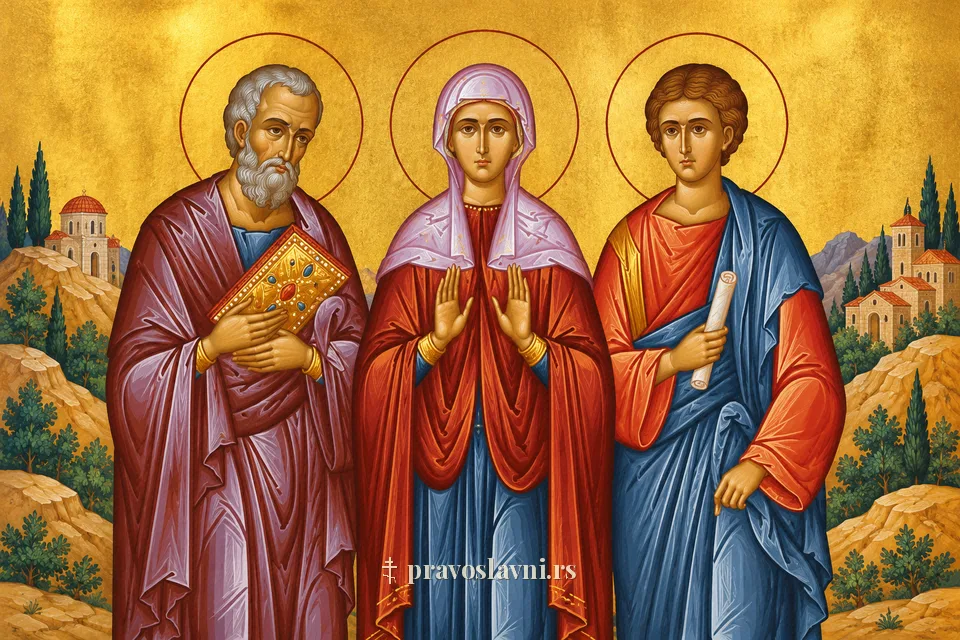
Saints of the day
Holy Apostles Archippus, Philemon and Apphia
What happenedArchippus, Philemon and Apphia, seized at prayer in Philemon's house in Colossae, were stoned for their faith in Christ.
Read the LifeOrthodox Calendar · 19 February according to the Julian calendar
Thursday, 4 March 202719 February (according to the Julian calendar)What happenedArchippus, Philemon and Apphia, seized at prayer in Philemon's house in Colossae, were stoned for their faith in Christ.
Read the Life
You may eat meat, eggs, milk and dairy products, as well as any other food — but try to be moderate.
More about the fast →
Today the Church keeps the commemoration of a saint · not a Red Letter day.
More about the feast →
“For we have great joy and consolation in your love, because the hearts of the saints have been refreshed by you, brother.”
— Philem 1:7The Apostle Paul mentions Archippus as his fellow soldier, and, according to the Prologue, he calls Philemon's home “the church in your house”. That home, at Colossae in Phrygia, gathered the faithful for worship, and Philemon's wife Apphia served the community by fasting and prayer and, according to the Life, cared for the hungry and for strangers.
Philemon, according to the Life, was a respected citizen who became a Christian. He was ordained a bishop and was sent to preach from place to place. Archippus, one of the Seventy Apostles, was according to the Life bishop at Colossae.
All three suffered together. While the pagans were celebrating Artemis, the faithful were praying in Philemon's home. The pagans burst in, attacked those gathered there and led these three away as the leaders. The Life says that Artocles, the governor of Ephesus, condemned them to the same tortures, and the Prologue mentions scourging. Buried up to the waist, they were pelted with stones. Philemon and Apphia breathed their last there, while Archippus, in whom there was still life, was killed by children with knives. Neither the Prologue nor the Life gives the year of their suffering.
The Prologue says that Archippus came with honour to the end of his earthly journey, and the Life that all three of them now stand before the Holy Trinity. Nor do the sources say anything about their relics, but their memory is kept as the memory of people who served Christ together and suffered for Him together.
While the pagans were keeping the feast of Artemis, the faithful of Colossae, a city in Phrygia, were at prayer in Philemon's house. Their Life says that this was their custom and that the prayer was led by Archippus and Philemon. The pagans broke in; according to the Life, in the attack some were beaten and some were killed. As the leaders they singled out Archippus, Philemon and Philemon's wife Apphia.
The Life states that the governor of Ephesus, Artocles, ordered the same tortures for all three, and the Prologue mentions flogging. The punishment was stoning: they buried them up to the waist and covered them with stones. Philemon and Apphia did not survive it. Archippus was still breathing; they handed him over to children, who took his life with knives.
According to the Life, Philemon was held in respect among his fellow citizens and accepted faith in Christ, and his home became the place where the faithful gather for worship, the centre of the whole community. The Prologue quotes Paul's words to Philemon about that home: “the church in your house”.
Apphia, Philemon's wife — here the Life refers to St Chrysostom — cared for that community by fasting and prayer. According to the Life, in that house the hungry and strangers were given food, and the sick and those without a roof were given help.
Archippus was one of the Seventy Apostles, and Paul calls him his fellow soldier — in the Epistles to the Colossians and to Philemon, as the Prologue records, while the Life mentions the Epistle to Philemon. According to the Life, which refers to St Ambrose, Archippus was bishop in Colossae, as the successor of St Epaphras.
A different task fell to Philemon. Of the disciples of the apostles some were given a diocese of their own, while others were sent to preach from place to place; Philemon, as a bishop, was among the latter. The Life counts him among the Seventy, says that he preached throughout Phrygia and in other regions, and records that it is said of him that he was bishop in Gaza.
Neither the Prologue nor the Life states when their suffering took place, nor do they mention their relics. What has remained is the witness of a home in which prayer, service and care for others were a part of every day.
The Prologue says of Archippus that, as Paul's fellow soldier, he brought his earthly path to an honourable end. And the Life says that all three of these apostolic martyrs now stand before the Holy Trinity.


