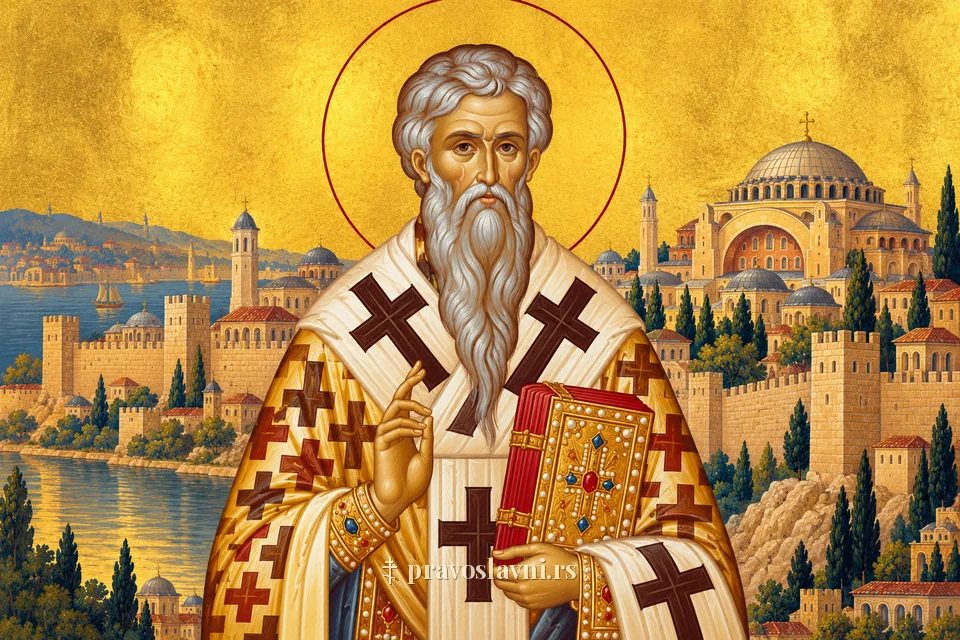
Tarasius has been remembered as the patriarch under whom the Seventh Ecumenical Council, gathered at Nicaea in the year 787, condemned iconoclasm and restored the veneration of the holy icons. The Life remembers how, opening the Council, he said: “I see the Church of God torn apart and divided.” He received back the bishops who repented, for, according to the Life, he knew that diseases which have long been putting down roots are not healed quickly. The Council, according to the Life, also had a difficult prelude: the first attempt, in Constantinople, was broken up by iconoclast soldiers, and to Nicaea there came, among others, the envoys of Pope Adrian and of the eastern patriarchs.
Tarasius had come to that hour by an unusual road. He was a layman, an educated man, a senator and imperial counsellor at the court of the Empress Irene and her son Constantine. When Patriarch Paul withdrew to a monastery, he advised that Tarasius be appointed in his place, and so it was done — the Prologue gives the year 783. According to the Life, Tarasius at first resisted, and he agreed so that Orthodoxy might win the victory over heresies. In a short time he passed through all the ranks of the Church.
As patriarch, according to the Life, he lived strictly: he slept little, without a soft bed, and he waited on himself. For the poor he built shelters and gave out food, and the Life says that at Vaskrs (Pascha) and on other feasts he personally served them at table.
When Constantine, now grown up, cast off his lawful wife Maria and took a kinswoman, Theodote, and then asked the patriarch for his blessing, Tarasius did not consent. From advice, according to the Prologue, he went on to rebuke, and then he forbade him Holy Communion. The Life preserves his words: “O Emperor, do not declare war on the law of God”. Constantine nevertheless, according to the Life, forced Maria to become a nun and married Theodote, and he even threatened to bring back iconoclasm.
He reposed in the year 806. Before his death, both sources say, he defended himself against the accusations of demons, and the Prologue adds that on his deathbed his face shone. The Life records healings at his grave, in the monastery on the Bosphorus which he had built from his family estates.
The life of Tarasius teaches that faithfulness to the law of God is worth more than the favour of the powerful.
Full Life
The counsellor who became patriarch
Tarasius, according to his Life, was born in Constantinople around the year 730, into the distinguished family of George and Encratia. He was highly educated — his Life says, in all literature and secular philosophy — and he served at court, where he became a senator and imperial counsellor. On the throne at that time was Constantine, the son of Leo IV and grandson of Copronymus, who had been made emperor at the age of ten, with his mother Irene as regent; the Prologue simply says that Irene and Constantine were reigning. Iconoclasm, according to his Life, had begun as early as the reign of Leo the Isaurian.
Patriarch Paul, whom the Life describes as a virtuous but timid man who under pressure had signed against the icons, left his see without anyone's knowledge and received the schema in a monastery. According to the Life, he told Irene and Constantine that he repented, begged them to restore the icons, said that without a seventh ecumenical council there was no salvation, and proposed Tarasius as his successor. On Paul's advice Tarasius was chosen, although he was a layman; the Prologue records that this was in the year 783. The Life adds that at first he refused, but at an assembly in the Magnaura palace everyone proclaimed him with one voice. At last he consented, for the sake of the victory of the right faith, above all over iconoclasm — according to the Life, on condition that an ecumenical council be called and that East and West be united in the faith. He passed through the sacred ranks quickly, one after another, and became patriarch.
The council that restored the icons
His Life records that letters were sent to all the patriarchs; Pope Adrian and the eastern patriarchs, who were living under Arab rule, sent their representatives. The first attempt to hold the council, in the Church of the Holy Apostles in Constantinople, was thwarted by iconoclast soldiers, so the bishops dispersed, and Irene later punished the soldiers.
The council did meet nevertheless, in Nicaea in the year 787 — according to the Life, for the first time on the day of St Thecla, and it worked for thirty days. Opening it, Tarasius, as the Life records, said: “I see the Church of God torn apart and divided.” He received back the iconoclast bishops who repented, saying that diseases which have long been taking root are not healed quickly. Basil, Bishop of Ancyra, read out the anathemas against iconoclasm, and the council condemned that heresy and restored the veneration of the holy icons.
Shepherd of the poor
As patriarch, Tarasius lived strictly. His Life says that he slept little, had neither a soft bed nor soft clothing, did not allow anyone to wash his feet and waited on himself. For the poor he had both a roof and bread, and the Life adds that he clothed the naked, kept lists of those in need and himself waited on them at table at Pascha and on other feasts. Out of his family estates he built a monastery on the Bosphorus. The Life also remembers how he protected a certain John, who had fled into the altar of a church: he would not hand him over to the empress's soldiers, fed him from his own table and threatened with excommunication anyone who might harm him, and so John was spared.
Before the emperor, yet on the side of God's law
When Constantine, at the age of twenty according to the Life, took over power from his mother, he began to live dissolutely. The Empress Maria, his lawful wife, had to leave — the Life says, after he had falsely slandered her, claiming that she wanted to poison him — and her place was taken by a kinswoman of the emperor, whom the Life calls Theodote. For that marriage Constantine wanted the patriarch's blessing. Tarasius, according to the Prologue, first admonished him, then rebuked him, and finally forbade him to receive Communion. The Life preserves his words: “O Emperor, do not declare war on the law of God”. The emperor nevertheless forced Maria to become a nun and married Theodote, and he even threatened to revive iconoclasm, but the patriarch did not give way.
Light at the end
His Life says that he served the Liturgy every day, right up until illness prevented him. On his deathbed he answered the accusations of the demons and rejected the guilt: “I am not guilty of that sin!” When, according to the Prologue, his voice failed him, he went on defending himself, with his hands; and when he breathed his last, his face, as the Prologue says, shone brightly. He reposed in the year 806. His tomb, according to the Life, is in his own endowment (zadužbina) on the Bosphorus. The Life states that people received healing at that tomb, among them a woman who had long been ill, a man with one eye missing and a man with a paralysed hand.
Tarasius shows that faithfulness to the law of God matters more than the favour of the powerful, and that a true shepherd serves the poor with his own hands.