Saint of the day
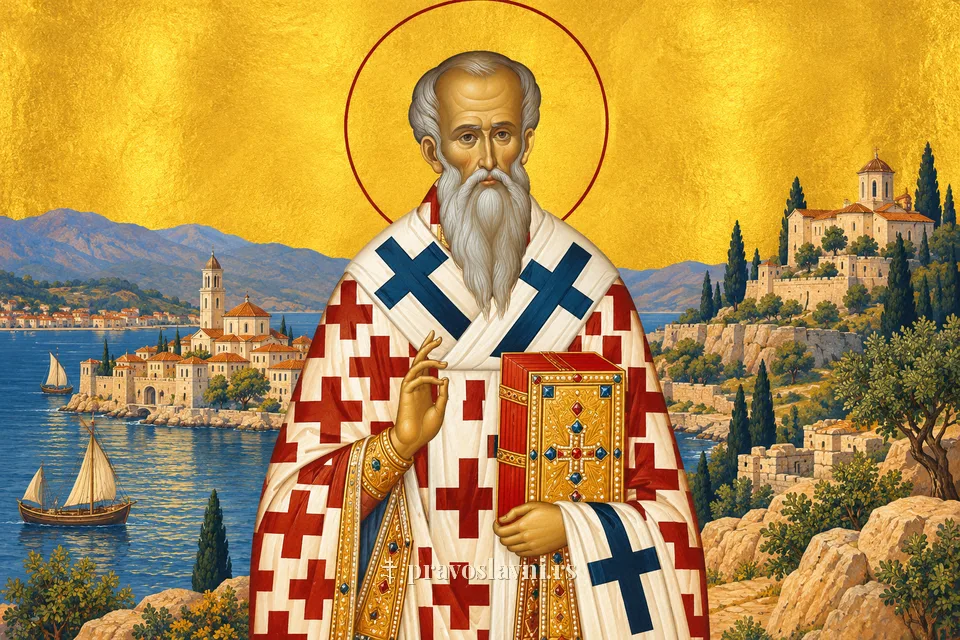
St Porphyrius, Bishop of Gaza
What happenedSt Porphyrius, a lame monk whom the Lord healed, became bishop of pagan Gaza and by prayer and patience turned that city to Christ.
Read the LifeOrthodox Calendar · 26 February according to the Julian calendar
Thursday, 11 March 202726 February (according to the Julian calendar)What happenedSt Porphyrius, a lame monk whom the Lord healed, became bishop of pagan Gaza and by prayer and patience turned that city to Christ.
Read the Life
No meat — eggs, milk, dairy products and fish may be eaten (Cheesefare Week).
This is a recommendation — for your own fast, consult your priest or spiritual father.More about the fast →
Today the Church keeps the commemoration of a saint · Cheesefare Week – dairy allowed (no meat).
More about the feast →
“Little children, keep yourselves from idols. Amen.”
— 1 Jn 5:21St Porphyrius was born in Thessalonica, in a wealthy house, but wealth did not hold him back. At about the age of twenty-five he went to the Egyptian desert, where for five years he learned the monastic life, and then with the monk Mark he crossed over to the Holy Land and spent five years in a cave. Because of illness he became lame, and so he visited the holy places on his knees. The Prologue records that Christ appeared to him at night on the Cross, with the repentant thief beside Him, and that from that hour he was well. The Life adds that this took place on Golgotha and that he then received a particle of the Precious Cross.
He accepted the office of bishop in Gaza unwillingly. There were only two hundred and eighty Christians in the city; otherwise Gaza belonged to Marnas and other idols. The Life tells that the pagans blamed him for a drought, but that rain fell only when he went out in procession with his small community, and some pagans were baptised then, and many others in that year.
To protect his flock, Porphyrius went to Constantinople together with John, Metropolitan of Caesarea. The Life says that, with the help of John Chrysostom and the Empress Eudoxia, they obtained an imperial order against the pagan temples. The temples in Gaza were pulled down, and on the site of the temple of Marnas Porphyrius built a church in the form of a cross. The Prologue mentions that thirty marble columns adorned it and that the Empress gave particular help to the building. According to the Life, the bishop also built a house for travellers and the poor.
Even after that it was not easy: in one riot seven Christians lost their lives, and Porphyrius himself, according to the Life, hid in the house of the pagan orphan girl Salaphtha, who later became a Christian. Yet he persevered and, as the Life records, as a shepherd he led the Church in Gaza for almost twenty-five years.
The Prologue remembers that he won the city for Christ only after many years of labour and tearful prayer. His relics, according to the Prologue, remained in Gaza, and the gift of working miracles did not leave him after his repose, just as it had not left him in this life either. His life bears witness that patient faith and prayer bring even unbelievers to Christ.
When Porphyrius arrived in Gaza as its bishop, he found there, as the Prologue and his Life record, only two hundred and eighty Christians. All the rest were zealous idolaters. His Life explains why: that city close to Egypt was ruled by the worship of the idol Marnas and of other gods, and the few Christians endured persecutions, especially in the time of the Emperor Julian the Apostate. The new bishop felt this while he was still on the road — his Life says that the pagans blocked his way with thorns, dug pits and let out smoke.
The occasion for the first accusation was a drought: according to the Life, the pagans put the blame on the new bishop, while their seven days of prayers to the idols brought no rain. Then Porphyrius led his two hundred and eighty faithful in a procession. The pagans locked the city gates before them, but a storm arose and rain fell. That day, according to the Life, changed many people: a few of the pagans let the procession into the city and received baptism, and by the end of the year many others were baptised as well.
Porphyrius was born in Thessalonica, into a wealthy family. At about the age of twenty-five he left his parents and the world, and in the Egyptian desert, with an experienced spiritual father, he spent five years as a monk; his Life states that this was in Scetis. Then he went to the Holy Land with the monk Mark, who, according to the Life, became his disciple, took care of him and later wrote his Life. For five years he lived in a cave — the Prologue says near Jerusalem, the Life says beside the Jordan.
Then a new trial came. Illness made him lame, and from then on he went to venerate the holy places on his knees. He did not keep his inheritance for himself: according to the Life, Mark went to the family at his bidding, left the younger brothers and sisters their share and sold Porphyrius's, and the money was given out to the poor and to monasteries. Healing came in a vision by night. The Prologue records that he saw Christ on the Cross and beside Him the repentant thief, and that from then on he was completely well. The Life places that vision on Golgotha and adds that the Lord gave him a particle of the Precious Cross to keep. According to the Life, Praylius, Patriarch of Jerusalem, ordained him presbyter and entrusted that holy treasure to him.
He did not wish to become a bishop. When Aeneas, Bishop of Gaza, died, John, Metropolitan of Caesarea, guided by a vision according to the Life, chose none other than him; Porphyrius wept and resisted, but in the end he consented.
His Life tells that Porphyrius first sent Mark to Constantinople to ask the Emperor Arcadius to close the pagan temples. The emperor ordered that they be closed, but not that they be pulled down, and the official Hilarius took a bribe and left the great temple of Marnas open. Then Porphyrius set out for the capital himself, together with Metropolitan John. According to the Life, the monk Procopius from Rhodes showed them the way to Patriarch John Chrysostom and to the chamberlain Amantius, and through them to the Empress Eudoxia as well. The bishops foretold to her that she would bear a son, and in the year 401 Theodosius was born. Their petition was laid upon the child at his baptism, and the emperor ordered that it be fulfilled.
In Gaza the imperial envoy Cynegius pulled down the temples and idols in ten days, except for that of Marnas. The fate of the temple of Marnas, according to the Life, was decided by a child seven years old: speaking Greek, a language it had never learned, the child said that the temple should be set on fire, and that is what was done.
On the site of the temple of Marnas Porphyrius built a church in the shape of a cross. His Life says that the Empress Eudoxia sent the plan and the columns, while the Prologue mentions thirty marble columns and her special help. The church was five years in the building, and then the bishop consecrated it. Beside it he also built a house for travellers and the poor.
Peace did not come at once. The Life records a riot over church property in which seven Christians were killed; Porphyrius then took shelter in the house of the pagan orphan girl Salaphtha, who later received the faith and dedicated herself to God as a virgin. The imperial officials punished the rioters in the year 407, and the pagans fell quiet. The Life also mentions the servant Baruch, whom the pagans, in a quarrel over taxes, beat almost to death, and who came back to life after a night of prayer; later Baruch and Mark became deacons.
He governed the Church in Gaza, according to the Life, for twenty-four years, eleven months and eight days, and he reposed in peace — in 421 according to the Prologue, and in 420 according to the Life. The Prologue says that he was a wonderworker both during his life and after his death, and that his relics rest in Gaza.
The Prologue stresses that the conversion of Gaza did not come overnight, but as the fruit of the bishop's many years of labour and tearful prayer. The lesson remains that persevering faith and prayer bring to Christ even those who have long lived far from Him.


