Saints of the day
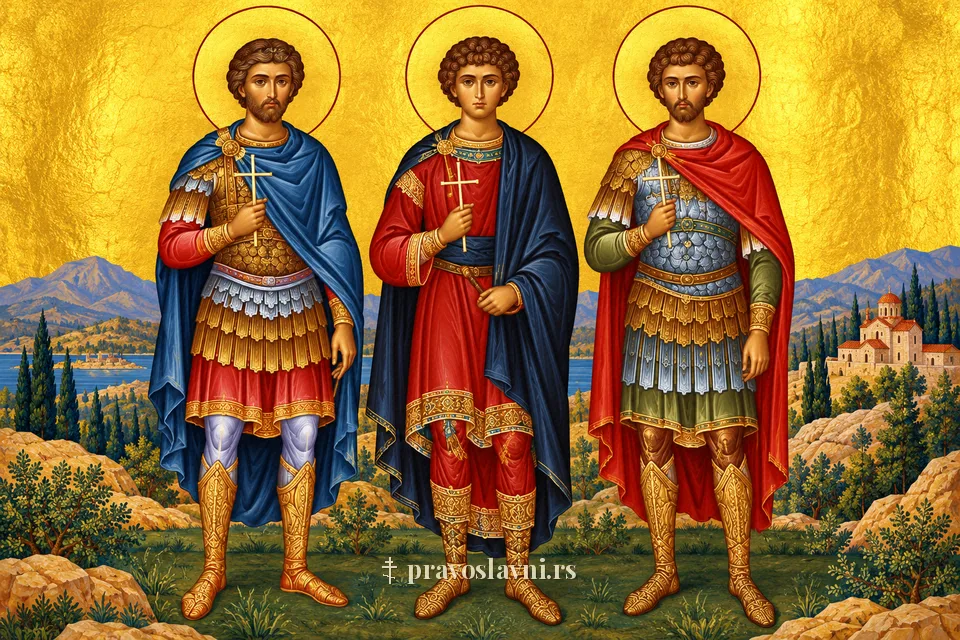
Holy Martyrs Eutropius, Cleonicus and Basiliscus
What happenedThree of Theodore's fellow soldiers rejected silver, honours and flattery, remaining inseparable in the faith until death for Christ.
Read the LifeOrthodox Calendar · 3 March according to the Julian calendar
Tuesday, 16 March 20273 March (according to the Julian calendar)What happenedThree of Theodore's fellow soldiers rejected silver, honours and flattery, remaining inseparable in the faith until death for Christ.
Read the Life
The first days of Great Lent: according to the Typikon, no food until Vespers — as far as each person is able, with a priest's advice.
This is a recommendation — for your own fast, consult your priest or spiritual father.Prayer of St Ephraim the Syrian →More about the fast →
Today the Church keeps the commemoration of a saint · First week of Great Lent.
More about the feast →
“Though one may be overpowered by another, two can withstand him. And a threefold cord is not quickly broken.”
— Eccl 4:12The governor offered Eutropius silver — a hundred and fifty litrae, according to the Prologue — and the Life mentions gold and costly clothing as well. He needed only to deny Christ. Eutropius refused, recalling Judas and the price of his pieces of silver. Before that, as the Prologue records, he had also refused to sit at the governor's table, and according to the Life the promised ranks did not attract him either.
He and his brother Cleonicus, Cappadocians according to the Life, were, together with Basiliscus, a kinsman of Theodore, fellow soldiers of St Theodore the Tyro. Theodore's death at Amasea did not open the prison doors for them: their trial was long put off, because, according to the Prologue, the governor was replaced. The new one, according to the Life Asclepiodotus from Phrygia, ordered that they be brought before him. The Prologue says that he was even more cruel than his predecessor.
Before him they did not give way. The Prologue records that they said that neither faith nor love would allow them to be separated. Threats of torture and of burning were of no use. When Eutropius denounced the governor and was struck on the mouth, the hands of those who struck him, according to the Life, withered. The Life tells that God strengthened them with signs: with light in the prison, with an earthquake which set them free, with the fall of a pagan statue at the prayer of Eutropius, and with the promise of eternal life which the Lord gave them at midnight.
The brothers ended on the cross, thankful that, as the Prologue says, it was given to them to die like Christ. The Life adds that Quintus and Belonicus buried them and that healings took place at their grave. Basiliscus was beheaded; the Prologue has him put to death together with the brothers, while the Life says that this happened later, and so he also has his own separate commemoration. According to the Prologue, the three thus found themselves once more beside Theodore, in the Kingdom of God.
The example of these three shows how much brotherly love in the faith is worth. What might perhaps have broken each one of them separately could not break them together. They rejected wealth and honours, and by their perseverance, which the Life calls a gift of God, they gained eternal life.
Eutropius, Cleonicus and Basiliscus belonged to the circle of St Theodore the Tyro. Eutropius and Cleonicus were brothers — the Prologue stresses that they were brothers by birth, and the Life that they were natives of Cappadocia. Basiliscus was a kinsman of Theodore; the Life gives his birthplace as Amasea, the very city in which Theodore suffered.
Theodore's death did not bring them freedom. They lay in prison for a long time without anyone trying them, which the Prologue explains by the change of governor. The Life knows more: Publius, Theodore's torturer, died under the wrath of God, and he was succeeded by Asclepiodotus of Phrygia, to whom the emperor — the Life calls him Maximian — entrusted authority over the Christians. From the old court records, which the scribe Eulasius read out to him, the new governor learned of Theodore's companions, and when he saw the burnt temple of Juno he summoned them before him. According to the Prologue, he surpassed his predecessor in cruelty.
The governor did not reach for tortures straight away. First he tried to win them over: the Life mentions ranks and riches in return for a sacrifice to the idols, and the Prologue an invitation to the governor's table. Eutropius refused the table with the words of the psalm about the righteous man who does not walk in the counsel of the ungodly.
When fair words did not succeed, silver was put on the table — the Prologue says a hundred and fifty litras, and the Life adds gold and costly clothing. Eutropius refused, remembering the fate of Judas and the price he paid for the pieces of silver.
Threats did not help either. The governor promised tortures and the burning of their bodies, and the three answered as one man. The Prologue records their statement that neither faith nor love would allow them to be parted, while the Life says that Cleonicus and Basiliscus openly confessed the Holy Trinity. Eutropius, according to the Life, said that he would not serve lifeless idols, referring to Psalm 113. When he denounced the governor, the latter ordered that he be struck on the mouth, but the hands of those who struck him, the Life records, withered at once.
The Life fills this account with signs of God's nearness. While still on the way to the court Eutropius was singing a verse from Psalm 132. The gaoler, watching them at prayer, understood that God was standing by them. The earth shook at the prayer of Eutropius — once in order to set them free, and a second time in order to throw down the statue of a pagan goddess in her shrine. Not even boiling pitch with sulphur could harm them, while those who were pouring it out were burned up. More than once, as the Life says, they received consolation from above: the promise that they would rest with Theodore and that eternal life awaited them. Even the soldiers asked to be released from torturing them any further, and some of those present claimed that they had seen Theodore alive.
At last the brothers Eutropius and Cleonicus were condemned to death on the cross. The Prologue says that each was crucified on his own cross and that they gave thanks to Christ that they were dying as He did; the Life puts the place of execution outside the city and adds that they were buried by Quintus and Belonicus and that their tomb became a place of healings.
Basiliscus met his end by the sword. The Prologue does not separate the three and links their death with the year 308; the Life, however, says that Basiliscus remained in the dungeon for some time longer and was beheaded only under the governor Agrippa, and for that reason he is also commemorated separately. According to the Prologue, after all this they were with Theodore once more — now in the Kingdom of God.
These three were not strong each one by himself: their strength lay in the fact that faith had bound them together. Neither flattery nor money nor ranks separated them from Christ, and they accepted the kind of death that He endured as a gift. The Life calls their perseverance a gift of God, the reward for which is eternal life.


