Saint of the day
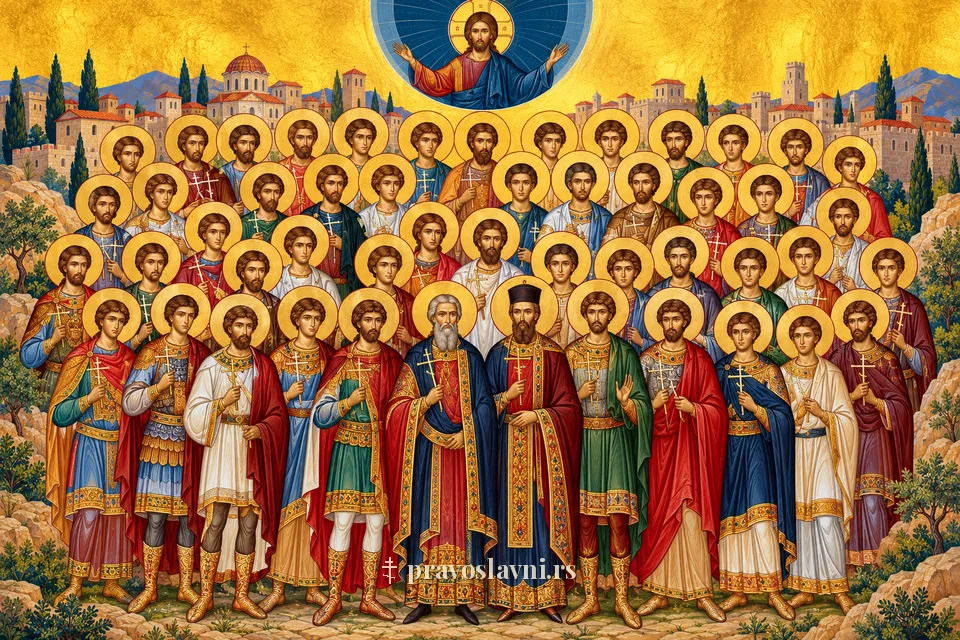
Holy 42 Martyrs of Amorium
What happenedForty-two Byzantine commanders refused for seven years in prison to accept a foreign faith, and remained faithful to Christ until death.
Read the LifeOrthodox Calendar · 6 March according to the Julian calendar
Friday, 19 March 20276 March (according to the Julian calendar)What happenedForty-two Byzantine commanders refused for seven years in prison to accept a foreign faith, and remained faithful to Christ until death.
Read the Life
No meat, dairy products, eggs, fish or oil — food cooked in water.
This is a recommendation — for your own fast, consult your priest or spiritual father.Prayer of St Ephraim the Syrian →More about the fast →
Today the Church keeps the commemoration of a saint · First week of Great Lent.
More about the feast →
“For you have need of endurance, so that after you have done the will of God, you may receive the promise.”
— Heb 10:36The Euphrates did not keep the bodies of the forty-two martyrs: the Prologue says that the water carried them out on the opposite side, where Christians found them and buried them with reverence. They were commanders of the Emperor Theophilus, taken captive when Amorium fell into the hands of the Saracens — a defeat which brought slavery or death to many Christians — and they were put to death in the year 845, after seven years of imprisonment. The Prologue does not give their names, nor the name of the ruler in whose prison they were held.
Throughout those seven years they were constantly pressed to deny Christ and go over to the faith of Muhammad. They answered calmly and reasonably. The truth, they said, is proved by witnesses, and many prophets bear witness to Christ, while Muhammad has only his own words about himself. The Saracens, according to the Prologue, had to admit that they had no answer to that. To the claim that fortune in war shows whose faith is the true one, they recalled that Rome, Persia, Hellas, Babylon and Egypt had also been victorious in their day, so that by the same measure their idols too would be true. And when Christians lose, God in this way, as they said, corrects His people, calls them to repentance and cleanses them of sin.
This story teaches that faith does not rest on success, but on the truth which many witnesses confirm, and that even through defeat God leads His own to salvation.
The forty-two martyrs of Amorium were, as the Prologue records, military commanders of the Byzantine Emperor Theophilus. After the defeat of the imperial army Amorium fell into the hands of the Saracens, and they fell with the city. To the Christians of that region the war brought death, slavery or the slave market, and to the commanders it brought prison.
They spent seven years in prison. In all that time they were not left in peace: they were constantly being urged to forsake Christ and go over to the faith of Muhammad. The Prologue preserves neither their names nor the name of the ruler under whose power they were imprisoned. It does, however, preserve what they answered.
The Saracens took their own supremacy as proof. God, they said, had given them victories, conquered lands and a vast kingdom — does that not show whose faith is the true one?
The captives did not accept that the truth is measured by the fortunes of war. They recalled the kingdoms that had followed one another in history — the Persian, the Roman, the Hellenic, the Babylonian, the Egyptian. Each of them had at some time prevailed, and by that reckoning all their idols would have to be true as well.
Of themselves and their brethren they said that they receive both victory and defeat from the hand of God. Through affliction God, in their words, admonishes His people and leads them to repentance.
They gave one more answer with a story about a disputed field and about witnesses. “Christ has many witnesses,” they said, meaning the prophets, whereas Muhammad has only his own word about himself. To this, the Prologue records, the Saracens had nothing to say.
The seventh year of their imprisonment ended with their execution, in the year 845. The bodies of the martyrs were thrown into the Euphrates, but the water, according to the Prologue, did not swallow them: it carried them to the opposite bank. There Christians found them and laid them in a grave with reverence.
The martyrs of Amorium taught that faith does not rest on the fortunes of war. The prophets bear witness to Christ, and when Christians lose, God leads them to Himself through affliction as well. Neither defeat nor seven years of prison separated them from Christ.


