Monday22March 20279 March (according to the Julian calendar)‹›
Illustration
Saints of the day
Mladenci — Holy Forty Martyrs of Sebaste
Holy Forty Martyrs of Sebaste
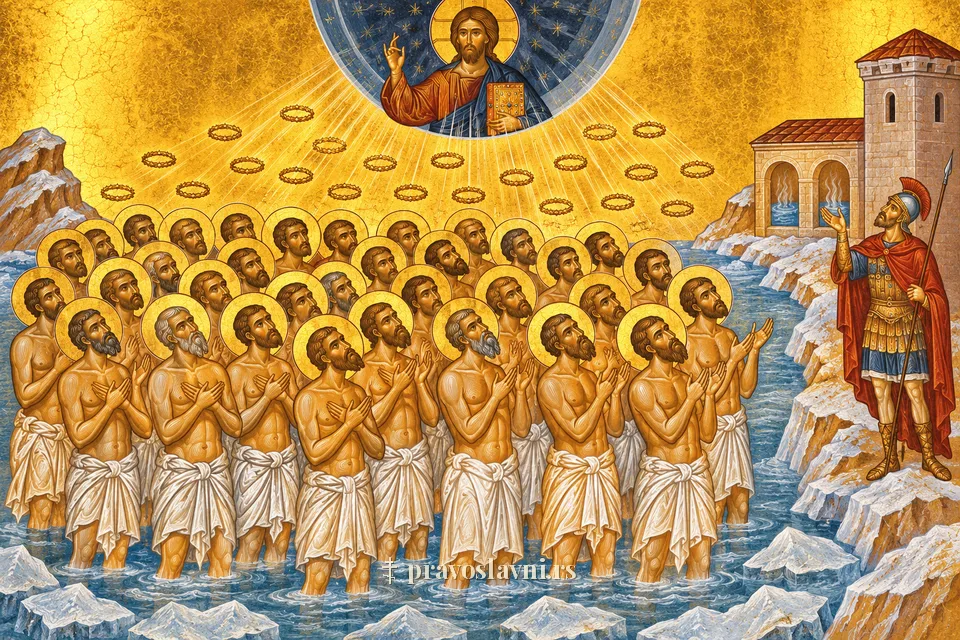
What happenedForty soldiers spent the night in a frozen lake without denying Christ, and the place of the only one who gave way was taken by a guard from the shore.
Mladenci is the folk name for the feast of the Holy Forty Martyrs of Sebaste. The name is a reminder that the martyrs were young men. The day is also linked with young married couples, so many Serbs keep it as the feast of all who have been married since the previous Mladenci.
They are linked with the wedding by the service, in which God is asked to remember the spouses as He remembered His holy martyrs, sending them crowns from heaven. The crown is the reward of the victor, and the wedding, as the priest explains it, is an image of martyrdom: the spouses sacrifice themselves for one another and are rewarded for the good fight. It is good for spouses on that day to remember their marriage vows and to pray to the martyrs that they may remain faithful to one another as the martyrs were to Christ.
Among the Serbs it is the custom to knead for this day forty small honey cakes of wheat flour, called mladenčići, as a sign of a long, happy and sweet life. Before noon they are given to children and guests. By folk custom, guests come to the young couple on that day and bring gifts, and the lady of the house welcomes them with what she herself has baked. A modest celebration and a Lenten table befit this day, which always falls in Great Lent. For more on fasting, see the guide “Fasting — simply explained”.
The Forty Martyrs of Sebaste were Roman soldiers and Christians. The Prologue records that they suffered in the year 320, under Licinius, and their Life adds that Licinius wanted to cleanse his army of Christians, even though Constantine the Great had already granted freedom of faith. Their story is a story about the choice between comfort and faith.
The threat of losing their rank did not shake them. The Prologue preserves the answer that Candidus gave to the commander: “Take from us not only our military honour, but our bodies as well.” Their Life says that they did not give way even before the flattery of the commander Agricolaus, and that in prison they heard a voice saying that he who endures to the end will be saved. Stoning did not succeed either: the Prologue says that the stones struck those who were throwing them.
The trial that followed was twofold: the cold of the frozen lake and a warm bath-house on the shore, open to anyone who would deny Christ. The martyrs, as their Life says, encouraged one another and sang to God. Only one gave way. For the others the night, according to the Prologue, ended with heavenly light and crowns. The empty place was filled by a guard, Aglaius according to their Life, who counted thirty-nine crowns, confessed himself a Christian and went into the water.
Their Life also preserves the memory of the youngest, Meliton, whom his mother encouraged to the end and herself laid beside his companions. In the morning they were found alive, and so the torturers broke the bones of their legs. The Prologue records that the martyrs afterwards appeared to Bishop Peter and that their bones were found thanks to a light above the water, and so they were gathered and buried.
Their faithfulness reminds us that God crowns those who remain faithful to Christ to the end, and that not even someone's fall leaves a place empty.
Full Life
The Guard on the Shore
One of the Forty Martyrs did not begin as a martyr, but as their guard on the shore of the frozen lake. The Prologue records that he confessed that he believed in Christ, went into the lake among them and received the crown that had been left without an owner. Their Life gives him a name as well, Aglaius. While the other guards slept, he kept watch, and he counted thirty-nine crowns and understood that the fortieth had been lost by the one who had run away. Then he too made his choice: he woke his fellow guards, told them that he was a Christian and went into the water.
Who They Were
The Prologue says that the martyrs were Roman soldiers of firm faith in the Lord Jesus, persecuted in the time of Licinius. Their Life explains the background: Constantine the Great granted freedom of faith in the year 313, but his co-ruler Licinius, a zealous pagan, went on persecuting Christians, and before his war with Constantine he wanted there to be no more of them in his army. In Sebaste, a city in Armenia, the commander Agricolaus had forty soldiers under him, Cappadocians according to their Life, and all of them were Christians.
What They Were Offered
Their torturers offered them one choice after another. According to the Prologue, the commander threatened that they would be stripped of their rank, and Candidus answered him: “Take from us not only our military honour, but our bodies as well.” Their Life says that Agricolaus also tried fair words, praising their youth and strength and promising honours and the Emperor's favour. Cyrion, the eldest among them, reminded him that he had no authority from the Emperor to put them in chains, and the commander, put to shame, gave up the chains. Nor did Lysias, the dignitary who later judged them, hear anything different: for them Christ was worth more than both rank and life. The last offer stood on the shore of the lake — a heated bath-house for anyone who would deny Christ. One of them gave way: according to the Prologue he went into the bath-house, and their Life says that he fell dead on its threshold.
What Sustained Them
Already on the first night in prison, before the trial, they heard, as their Life records, a voice saying that he who endures to the end will be saved. The stoning did them no harm: the Prologue records that a stone broke the commander's teeth, and their Life says that Agricolaus was struck in the face by a stone thrown by Lysias himself. According to the Prologue, they were thrown bound into the frozen lake, while according to their Life they were stripped in the bitter frost and left on the ice all night; they endured by encouraging one another and singing to God. The Prologue records that in the night a heavenly light shone upon them, that the water became warm and that thirty-nine crowns came down over them; their Life says that at the third hour of the night the ice melted.
Light over the Water
In the morning they were found alive, and the judges ordered that the bones of their legs be broken. Their Life especially remembers the mother of the youngest, Meliton, who encouraged him the whole time to endure. The torturers wanted to spare him, as he was still alive, but she did not allow him to be separated from his companions: she herself carried him after them and, when he breathed his last, laid him among them. According to the Prologue the bodies were thrown into the water, while their Life says that they were burned and that the remains ended up in the water, because the torturers did not want anything of them to be left to the faithful.
The martyrs, according to the Prologue, appeared to Bishop Peter on the third day, and their Life says that this was in a dream. The Prologue further records that the bishop with his clergy found their remains at night shining above the water, and so they were gathered and buried. As the year of their suffering the Prologue gives 320.
Their Life adds that their commemoration is among the most honoured feasts, that many churches were built to them, about ten in Constantinople alone, and that St Basil the Great and St Gregory of Nyssa wrote homilies about them.
God crowns those who remain faithful under persecution, and not even someone's fall leaves an empty place: the crown of the one who faltered was received by a man who came to believe that very same night.
The day of their commemoration is called Mladenci among the people.
Other saints of the day
Holy Martyr Urpasianus of Nicomedia
St Urpasianus was in the imperial service in Nicomedia in the time of the Emperor Maximian, whom his Life calls a zealous worshipper of idols. The Emperor set a condition for the Christians in his service: whoever would not return to the gods would lose his post and would have to leave the court and the city. While the others managed as best they could, Urpasianus, before the Emperor and the senate, himself laid aside the insignia of his rank and said that he served the heavenly King, Christ, because earthly honour passes away. By this he pronounced sentence upon himself: there followed tortures, prison and, in the end, death by fire. The Life says that he prayed amid his torments and that his death was accompanied by a sweet fragrance and by a light, which some of the faithful saw. The Emperor did not leave even his bones in peace, but ordered them to be thrown into the sea. From his story the Life draws the lesson that temptation only purifies faith and that the one who loves God with a pure heart is not afraid of torturers.
St Caesarius was the brother of St Gregory the Theologian — the younger one, according to his Life. The Life says that he was educated in Alexandria and that in the time of the Emperor Constantius he was the chief physician at the imperial court. When Julian the Apostate came to the throne, Caesarius left the court, and the Life also records that he survived the earthquake in Nicaea in a miraculous way. His brother Gregory advised him to leave worldly affairs, and so Caesarius did just that, was baptised and gave himself wholly to God. He fell ill while still young and died in the year 369, and Gregory the Theologian delivered the funeral oration for him. Among the questions of faith about which, according to the Prologue, he wrote there was one unusual one — how long Adam and Eve dwelt in Paradise before their expulsion: others spoke of six hours, of twenty-four hours or of three days, but he taught that it was forty days. The Prologue connects this with the forty days which Christ spent in the wilderness, where the devil tempted Him: the old Adam did not withstand the temptations in Paradise, but “the New Adam withstood them valiantly in the hungry and thirsty wilderness.”
The Holy 42 Martyrs of Momišići were two priests and forty children whom they taught religious instruction — pupils from their parish, most of them from the Popović clan. According to the communiqué of the Holy Assembly of Bishops of the Serbian Orthodox Church, in the year 1688 they were all burned alive in the Church of St George in Momišići, today a part of Podgorica. They were killed by the army of the pasha of Skadar, in reprisal for the losses which the Turks had suffered in the preceding months from the highland tribes, especially from the Kuči. The remains of the martyrs were buried beneath the holy altar table of that church, and in 1936 they were transferred to the restored Church of St George. When in 2006 they were brought out for veneration on the feast of the Forty Martyrs of Sebaste, Metropolitan Amfilohije washed them with wine and anointed them with rose oil. On 17 May 2012 the Holy Assembly of Bishops entered the two hieromartyrs and the forty pupil martyrs in the diptych of the saints, and the canonisation was celebrated on 19 May in the Church of St Sava on Vračar, at a service led by Patriarch Irinej. According to the decision of the Assembly, their commemoration is kept in the Metropolitanate of Montenegro and the Littoral on the same day as the commemoration of the Forty Martyrs of Sebaste. Teachers and pupils together laid down their lives because they were Orthodox Christians.