Saturday23January 202710 January (according to the Julian calendar)
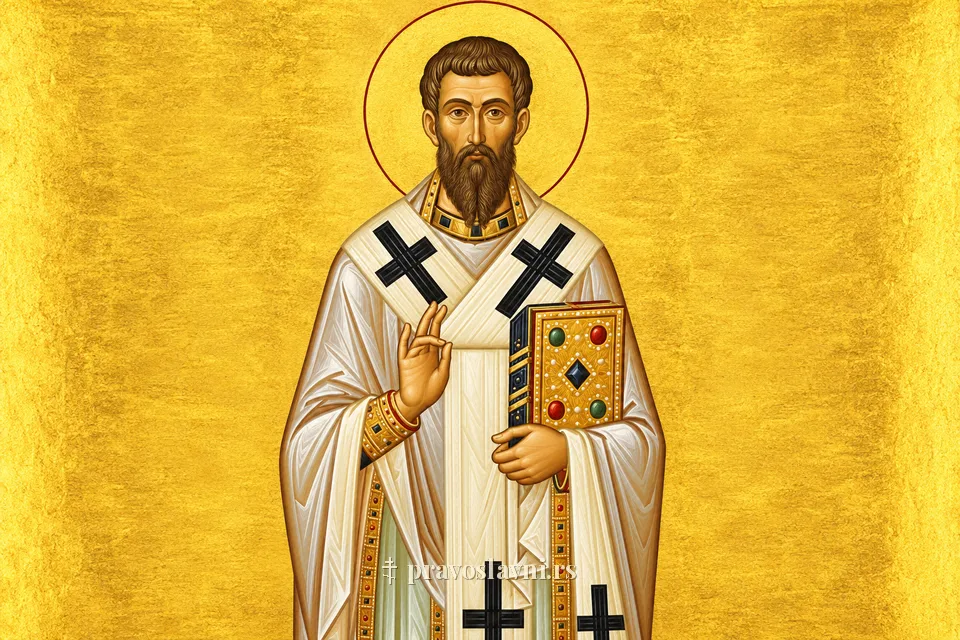
Illustration
Saint of the day
St Gregory of Nyssa
What happenedSt Gregory of Nyssa, brother of Basil the Great, patiently endured exile and at the Second Ecumenical Council defended the faith in the Holy Trinity.
“Those who are wise shall shine Like the brightness of the firmament, And those who turn many to righteousness Like the stars forever and ever.”
— Dan 12:3
Life
St Gregory of Nyssa was the younger brother of St Basil the Great. His Life says that he was born around the year 335 in Neocaesarea, in Pontus, into a devout family that gave the Church many saints. Basil was his first teacher, and Gregory became learned both in secular and in spiritual knowledge. For a time he wished to become a secular rhetorician, but St Gregory the Theologian turned him away from this. He married Theosebia and served in the Church as a cleric. His Life says that he later entered Basil's monastic community, while Theosebia served as a deaconess. When Theosebia died, St Gregory the Theologian in a letter called her “the glory of the Church and the adornment of Christ”.
As a widower he became Bishop of Nyssa; he was appointed to that small Cappadocian town, according to his Life, so that Basil, Archbishop of Caesarea, might have a support there. Because of his faith he became a target of the Arians, who under the Emperor Valens deprived him of his see and banished him. The Prologue says that he bore the want and the humiliations of exile without murmuring. His Life says that he returned to his see after the death of Valens.
When Basil was no longer alive, the care for the true faith was taken up by Gregory. His writings defended the teaching on the Holy Trinity, and for several months he also temporarily led the Church in Sebaste. He took part in the Second Ecumenical Council in Constantinople in the year 381, which was gathered against the Arians and Macedonius. His Life says that he helped in setting out the Creed, while the Prologue only supposes that the second part of the Creed is his work. The president of the council, Meletius of Antioch, died while the council was still in session, and the oration at his funeral was entrusted to Gregory.
The Prologue points out three of his gifts: oratory, the interpretation of Holy Scripture and theology. According to his Life, he was a grey-haired man, slighter than his brother, but with the same features of face. He lived to a great old age and reposed towards the end of the fourth century.
St Gregory of Nyssa defended the faith in the Holy Trinity and patiently endured exile, and his writings are of benefit to the faithful to this day.
Full Life
From a House of Saints
St Gregory of Nyssa was the brother of St Basil the Great. His Life says that he was born around the year 335 in Neocaesarea, in Pontus, into a devout family that gave the Church many saints. His first teacher was his elder brother Basil, and Gregory became learned both in secular and in spiritual knowledge.
Gregory married, and his wife was called Theosebia; the Prologue calls her Theozva. He served in the Church as a cleric: the Prologue says that he was a presbyter, and the Life that he was a reader. The Life also records that for a time he thought of becoming a secular orator, a rhetorician, but that St Gregory the Theologian turned him away from this.
He received the monastic tonsure, according to the Life, in Pontus, where Basil had gathered his brotherhood on the river Iris; Theosebia then entered the ministry of a deaconess. After her death Gregory the Theologian wrote of Theosebia in words of praise; that letter is mentioned both by the Prologue and by the Life. The Life hands down his words: he called her “the boast of the Church and the adornment of Christ”.
Bishop of a Small Town
Gregory, now a widower, then became Bishop of Nyssa. The Life states that this was in the autumn of the year 371 and that Nyssa was a small town in Cappadocia. He was appointed so that he might be a support to his brother Basil, who at that time was Archbishop of Caesarea.
Because of his faith he became a target of the Arians. Both the Prologue and the Life bear witness that they saw in Gregory their chief opponent and that they hated him for it. They got their chance under Valens, an emperor who was on their side: Gregory was left without his see and went into exile. According to the Prologue, the exile lasted eight years, full of want and humiliation, and Gregory bore them without murmuring. The Life, however, gives a shorter period: he was deposed in 375, and he returned to his see in the year 378, after the death of Valens.
Defender of the Holy Trinity
Basil's death, according to the Life, left on Gregory's shoulders the controversy with Eunomius, the sharpest among the Arians; his writings from that time defend the teaching on the Holy Trinity. In the year 379 he was, according to the Life, among the fathers of the Council of Antioch, alongside St Meletius. In the following year, 380, he temporarily, for just a few months, led the Church in Sebaste as archbishop, until it received another Orthodox shepherd.
Gregory also took part in the Second Ecumenical Council, which was gathered in the year 381 in Constantinople, under the Emperor Theodosius the Great, against the Arians and Macedonius. How great his share in the Creed was, the sources tell differently. The Life ascribes to him help in setting forth the Nicene-Constantinopolitan Creed and counts him among the chosen fathers of the council, while the Prologue leaves only the supposition that the second part of the Creed is his work. The president of the council, Meletius of Antioch, died while the council was still in session, and the oration at his funeral was entrusted to Gregory. The Life records that after this he also took part in some later councils in Constantinople.
A Lamp through the Ages
The Prologue points out three of his gifts: oratory, the interpretation of Holy Scripture and theology. The Life also preserves a description of his appearance: Gregory was a grey-haired man, slighter than his brother, but with the same features of face. He placed his knowledge and his gift of speech in the service of the true faith in the Holy Trinity.
He lived to a great old age and reposed towards the end of the fourth century, according to the Life around the year 395. Both sources bear witness that his work did not remain tied to a single age: the Church still venerates him, and the faithful even today read his writings to their benefit.
St Gregory of Nyssa was Basil's brother, disciple and fellow labourer. He defended the faith in the Holy Trinity against the Arians and patiently endured exile, without departing from the truth. That is why the Church remembers him as a great lamp and theologian, and his writings even today lead believers along the path of faith.
Other saints of the day
Venerable Dometian of Melitene
St Dometian is remembered above all as a peacemaker between Byzantium and Persia. His Life says that by order of the Emperor Maurice he travelled to Persia many times, and that these affairs of state strengthened the peace between the two empires. The most important fruit of that service was the return of the Persian King Chosroes to the throne, which the rebel Bahram had taken from him; with the help of Dometian, Chosroes came to rule once more, and after that he paid tribute to the Greeks. By then he was already Bishop of Melitene, to whose throne he had come at the age of thirty. Before that, according to his Life, he had studied secular learning and had been married, but when his wife died soon afterwards, he left the world and devoted himself to the ascetic life. He was born in the reign of Justin the Younger, and his parents Theodore and Eudocia were wealthy and devout. As a hierarch he did not separate the book from prayer, and in his care there was a place also for those who were not Christians. The gold which the Emperor and Empress gave him as a friend he did not keep for himself, but with it he built churches and homes for orphans. He reposed during his second stay in the capital, in the year 601. His own Melitene received the relics of its bishop back, and the honour of bringing them fell to eminent men of the Church and of the imperial court; his Life ascribes many miracles to him, and not even death brought them to an end. His life shows that knowledge and asceticism can be joined together in the service of peace and the common good.
St Marcian was born in Rome, but he spent his life as a priest in Constantinople, mostly in the time of the Emperor Marcian and the Empress Pulcheria. According to his Life, he came to Constantinople as a boy, when his wealthy parents, whose only child he was, moved there. While still young he was ordained a presbyter, and according to his Life the care of the Great Church was entrusted to him. The property that was left to him by his parents he gave out to the poor and spent on churches, both new ones and those that were in need of restoration. Among them are two new churches in Constantinople, of St Anastasia and of St Irene. He explained these expenses with a comparison: just as a father richly provides for a daughter whom he is giving in marriage to a nobleman, so it is fitting to adorn the Church too, the bride of Christ. He was strict with himself and held to the word of the Apostle: “And having food and clothing, with these we shall be content.” His Life tells that he once gave a poor man his only garment, and that at the Liturgy some people saw him clothed in golden vestments. According to his Life, by prayer he brought back to life a pregnant woman who had fallen and died, and he stopped a great fire in the city. The Prologue says of him: “He was wholly in God and God in him.” He passed away in deep old age, in the year 471. Wealth becomes holy when it adorns the house of God and feeds the poor, and the one who gives it away keeps for himself only what is necessary.