Thursday25March 202712 March (according to the Julian calendar)‹›
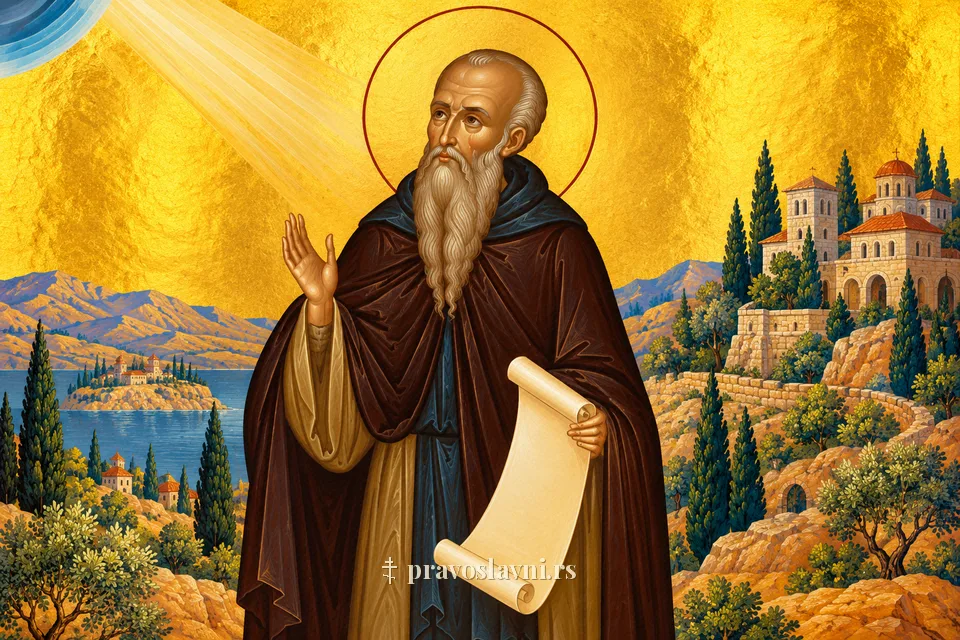
Illustration
Saint of the day
Venerable Symeon the New Theologian
What happenedSymeon left the imperial court, his place as a senator and his inheritance, and in the monastery came to know God's grace as a living reality; the Church calls him the New Theologian.
After St Gregory the Theologian, says the Prologue, the Church had no greater theologian than St Symeon the New Theologian. Grace lived in his heart, and so everything that he said about God was a revelation.
The road to that grace began with renunciation. Symeon was born in Galate in Paphlagonia, and as a boy he came to the imperial court in Constantinople. His Life says that he held a rank at court and a seat in the Senate, wealth and standing. Yet while still a young man he sought out a spiritual father in the elder Symeon the Devout. His Life says that at that time, in prayer, he saw a great light and his elder standing at the right hand of God. He renounced his inheritance, gave away his property to the poor and entered a monastery.
The elder taught him obedience through humble tasks, and his Life says that in this way Symeon overcame faint-heartedness, fear and lust. When envious monks drove him out, he moved to the Monastery of St Mamas and there he was tonsured a monk. His relatives and the senators tried to bring him back into the world, but in vain. He lived strictly, in prayer and in night vigil.
He became a priest, and when they asked him about the priesthood, he would answer: “Woe is me, brethren! Why do you ask me about that!” Later he also became abbot of St Mamas, although he refused it with tears. His Life records that at every Liturgy he used to see the Holy Spirit as a great light. He restored the monastery and adorned it with icons, he ate with the monks and often less than they did, and the monks who rebelled against him he himself brought back from exile. He taught his disciples humility.
He remained faithful to his elder even after the elder's death: he wrote his Life and hymns for him and established a feast with an icon, and when he was accused of venerating a sinner, he defended the veneration of spiritual fathers before the Synod. The Prologue says that he spent his last years as a hermit and that he died in the year 1032.
Symeon shows that God is known in a humble heart that prays.
Full Life
A Theologian of Grace
The Prologue calls St Symeon the greatest theologian after St Gregory the Theologian. Grace, according to the Prologue, he felt in his own heart, and what he spoke was a revelation about God and about the spiritual life. His Life records that in prayer he saw a great light and that a voice revealed mysteries to him, and he wrote works on prayer and virtue.
This man of the spirit came from a world of power and wealth.
The Court or the Monastery
He was born in Galata in Paphlagonia, according to his Life in a noble and wealthy family, of his parents Basil and Theophano. While still a child he was taken to relatives at the court in Constantinople, where he distinguished himself in calligraphy and secular learning. The Prologue says that he was among the courtiers of the emperors, and his Life adds that, at his uncle's urging, he unwillingly accepted a court rank and a seat in the Senate.
After his uncle's sudden death he looked for a spiritual father and found him in the elder Symeon the Pious of the Studite Monastery. His Life says that the elder, when he was about fourteen years old, told him to wait until he had grown up. In the meantime the young man read ascetic books and gave himself to prayer and Holy Scripture. Then in prayer he saw a great light and a cloud, and his elder standing at the right hand of God, and he cried out: Lord, have mercy.
Six years later, according to his Life, he went home to Galata and lived in a cell beside a church, reading the Ladder. His parents begged him to stay, but he renounced his inheritance, returned to Constantinople and distributed his property to the poor. He left everything for the sake of Christ and entered the monastery, under the guidance of the elder Symeon.
A School of Obedience
The elder tested his obedience with lowly tasks, alternating humiliation and rest. His Life says that in this way Symeon overcame the demons of faint-heartedness, fear and lust, and that from then on he always stood during the services. His Life also remembers the elder's words addressed to Symeon: “Rise, child; I too am a man.”
Not even in the monastery was he spared troubles. Envious monks and the abbot Peter drove him out, so he moved to the Monastery of St Mamas, to the abbot Anthony, where the elder tonsured him a monk. Relatives and senators tried to bring him back into the world, but he refused. He received Holy Communion every day, ate greens and seeds and kept vigil at night.
Abbot and Priest
His Life says that after two years he began to preach and that he was ordained a priest. When he was later asked about the priesthood, he would answer: “Woe is me, brethren! Why do you ask me about that!” At his ordination, according to his Life, he saw the Holy Spirit as a great light, and he saw Him at every Liturgy during forty-eight years of priesthood. When the abbot died, Patriarch Nicholas Chrysoberges appointed him, although he refused with tears, abbot of St Mamas.
He restored the monastery, laid marble floors and added icons. He shared a modest table with the monks and often ate less than they did. When some thirty monks rebelled and accused him, the Patriarch ordered that they be banished, but Symeon interceded for them and brought them back himself.
Faithfulness to His Spiritual Father
He remained faithful to his elder even after the elder's death. He wrote hymns and his Life, and established a yearly feast for him with an icon. The former Metropolitan of Nicomedia, Stephen of Alexina, accused him of venerating a sinner, and Symeon defended the veneration of spiritual fathers before the Synod, citing the words of the Gospel according to Matthew and of the holy fathers, among them Gregory the Theologian. The Prologue records that at the end he lived as a hermit and that he died in the year 1032, and that his relics are wonderworking.
St Symeon teaches humility, obedience to one's spiritual father and perseverance in prayer, and above all that grace is a living experience, and not only a teaching.
Other saints of the day
Venerable Theophanes the Confessor
St Theophanes is numbered among the confessors who paid for their faithfulness to the holy icons with their freedom and their life. Under the Emperor Leo the Armenian he refused both offers and threats, spent two years in prison, and was then exiled to Samothrace, where he died twenty-three days after his arrival; the Prologue says that he had foretold that place in advance. He had defended the icons earlier too, as a participant in the Seventh Ecumenical Council in Nicaea, and his Life remembers that he arrived at the council on a lean donkey, poorly dressed. That modesty was his own choice: he came from a wealthy and distinguished family, related to the Emperor Leo the Isaurian and his son Copronymus. About the place of his birth the sources differ — the Prologue links him with Sigriane, after which he is called Theophanes of Sigriane, and the Life with Constantinople. Not even marriage separated him from God, for he won his wife over to a life of continence, and the Life says that a radiant young man confirmed that decision to both of them in a dream. Later they both received the monastic tonsure, and the Prologue says that as a monk Theophanes lived so poorly that people marvelled. According to the Prologue, God gave him the gift of healing, especially of the mentally ill, while he accepted his own long illness with thanksgiving, not praying for himself. His life bears witness that God glorifies those who serve Him faithfully, both in life and after death.
St Gregory the Dialogist united the highest office in the Church with humility and mercy. Elected pope after the death of Pelagius, he tried to hide in the mountains, but, according to the sources, a pillar of fire showed where he was. As first hierarch he gave his income to the poor and to guests, and he entertained the poor at his own table. His Life tells of an angel who first came to him as a shipwrecked man in distress, and who later sat among his guests as the thirteenth, although only twelve of them had been invited. His path began in the senatorial family of Gordian and Silvia, and according to the Prologue he himself was a senator and the prefect of the city. After his father's death he spent his inheritance on the poor and on seven monasteries, of which the one in Rome, dedicated to the Apostle Andrew, was his home and the place of his tonsure. His mother Silvia also became a nun. He received the name Dialogist from his books of conversations with the archdeacon Peter, in which the saints of Italy are spoken of. The Prologue attributes to him the Liturgy of the Presanctified Gifts. According to the Life, he led the Church for thirteen years, six months and ten days and reposed in the year 604.