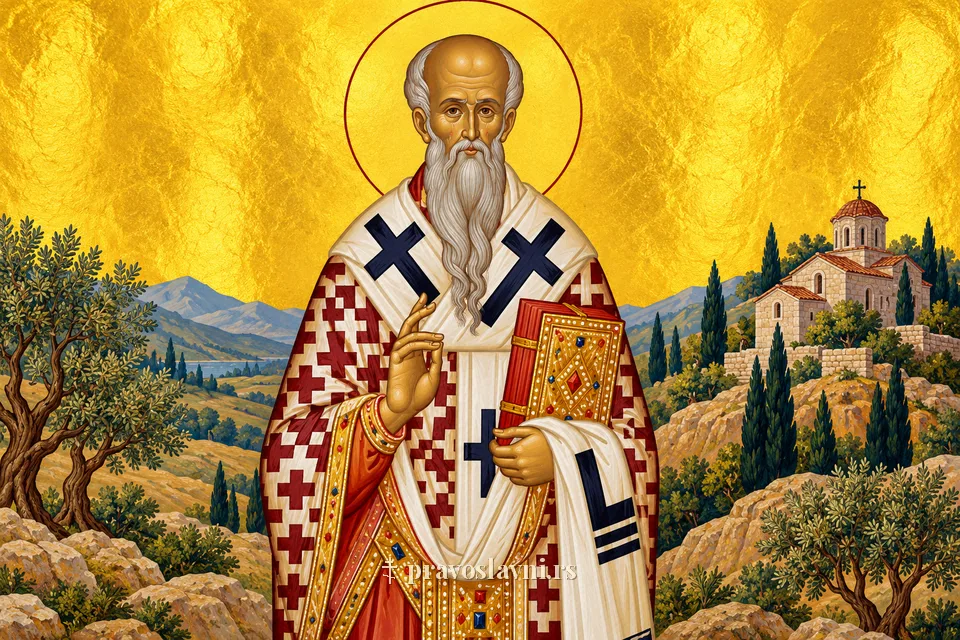
Saint of the day
Holy Apostle Aristobulus
What happenedThe Apostle Aristobulus, brother of St Barnabas, was sent as bishop to Britain, and there, enduring beatings and mockery, he enlightened a pagan people.
Read the LifeOrthodox Calendar · 16 March according to the Julian calendar
Monday, 29 March 202716 March (according to the Julian calendar)What happenedThe Apostle Aristobulus, brother of St Barnabas, was sent as bishop to Britain, and there, enduring beatings and mockery, he enlightened a pagan people.
Read the Life
No meat, dairy products, eggs, fish or oil — food cooked in water.
This is a recommendation — for your own fast, consult your priest or spiritual father.Prayer of St Ephraim the Syrian →More about the fast →
Today the Church keeps the commemoration of a saint · Third week of Great Lent.
More about the feast →
“After these things the Lord appointed seventy others also, and sent them two by two before His face into every city and place where He Himself was about to go.”
— Lk 10:1Among the Seventy Apostles was also St Aristobulus, a Cypriot, the brother of the Apostle Barnabas. After the Ascension of the Lord he joined the Apostle Paul and with him carried the Gospel through many lands. In the Epistle to the Romans Paul greets the members of Aristobulus' household: “Greet those who are of the household of Aristobulus” (Rom 16:10). According to his Life, Aristobulus himself was at Paul's side at that time.
Paul ordained many bishops and sent them to various regions. Britain fell to the lot of Aristobulus, and its people, according to the Prologue and his Life, were pagan, wild and wicked. He endured countless sufferings and insults, from beatings to mockery.
The sources do not ascribe the fruit of that labour to his own strength, but to the grace of God. By it the people who had ill-treated him were taught the faith and baptised in the name of Christ the Lord. Aristobulus built churches, set the Church in order and appointed priests and deacons.
It was in Britain, too, that he reposed, peacefully, and departed into the Kingdom of the Lord; the year has not been recorded.
His life bears witness that fruit in the work of God does not come from human strength, but from the grace of God.
St Aristobulus was one of the Seventy Apostles. He was a native of Cyprus, and his own brother was the Apostle Barnabas. After the Ascension of the Lord he followed the Apostle Paul and with him preached the Gospel in various lands.
His name has been preserved in Holy Scripture as well. Writing to the Christians in Rome, where the members of Aristobulus's household were also living at that time, the Apostle Paul greets them: “Greet those who are of the household of Aristobulus” (Rom 16:10). The Life adds that Aristobulus was at Paul's side while that epistle was being written.
Among the bishops whom Paul appointed was Aristobulus too, and Britain was given to him as his field of labour. That road did not lead to comfort. The Prologue and the Life agree in saying that the people there were pagan, wild and wicked.
Countless sufferings and insults awaited the Apostle there. According to both sources, they beat him, dragged him about and exposed him to mockery, so that there was no numbering his sufferings and insults.
What a man could not have done by himself, the grace of God accomplished. The people who had ill-treated him in the end, by its power, accepted faith in Christ and baptism in the name of Christ the Lord. Aristobulus built churches, set the Church in order and ordained priests and deacons.
He reposed in peace, there in Britain, and departed into the Kingdom of the Lord. The sources do not give the year of his death.
Aristobulus preached where no one was waiting for him and where he was met with beatings. The sources do not ascribe his success to his own strength, but to the power of God's grace. His example teaches that the Gospel is spread by patience and by trust in God, and not by human might.
The holy martyr Sabinus suffered in the year 287: after grievous tortures he was thrown into the Nile and so received from Christ the crown of victory. Before that he had been a distinguished Egyptian, the governor of Hermopolis. His Life places his struggle in the time of Diocletian, when Christians in Egypt were suffering in great numbers. In order to keep the faith, he left his home, his estate and his relatives; the Prologue says that he took refuge with other believers in the mountains, and the Life in a remote village. There he lived in a hut in fasting and prayer. According to the Life, the pagans searched for him for a long time in vain. The way was shown to them by a poor man whom Sabinus had been supporting, and two gold coins were the price of a betrayal which the Prologue and the Life compare with that of Judas. The Christians in the hut, says the Life, opened the door themselves, thinking that one of their own was coming. Sabinus was led away in chains with six others, and the judge Arianus, according to the Life, tried for a long time to persuade him to offer sacrifice to the idols — in vain. The Life says that his fellow sufferers also died under torture and were counted worthy of the same glory.


