Saint of the day
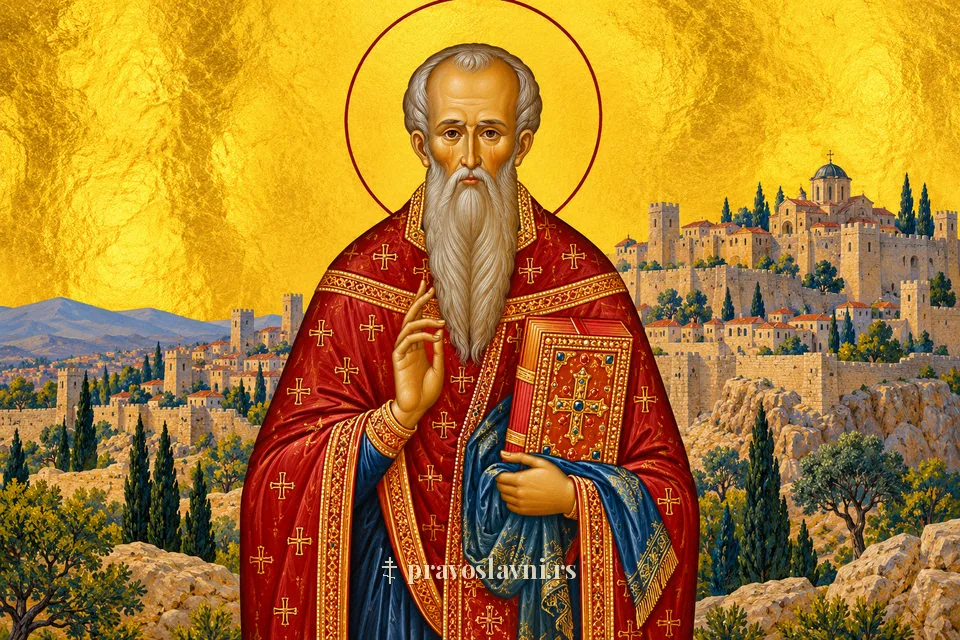
Hieromartyr Basil of Ancyra
What happenedSt Basil of Ancyra refused the honours offered by Julian the Apostate and told him that he believed in Christ, whom the emperor had denied.
Read the LifeOrthodox Calendar · 22 March according to the Julian calendar
Sunday, 4 April 202722 March (according to the Julian calendar)What happenedSt Basil of Ancyra refused the honours offered by Julian the Apostate and told him that he believed in Christ, whom the emperor had denied.
Read the Life
No meat, dairy products, eggs or fish — oil and wine are allowed.
This is a recommendation — for your own fast, consult your priest or spiritual father.Prayer of St Ephraim the Syrian →More about the fast →
Today the Church keeps the commemoration of a saint · Sunday — a festive day · Third Sunday of Lent – Veneration of the Cross (Great Lent).
More about the feast →
“When Christ who is our life appears, then you also will appear with Him in glory.”
— Col 3:4St Basil had to defend the faith twice: first against heretics, and then against an emperor who had renounced Christ.
He was a presbyter in Ancyra. The Prologue remembers him as a zealous defender of Orthodoxy, who during the reign of Constantius endured many sufferings at the hands of the Arians. According to his Life, he went about the city every day and warned the people to beware of false teachers and of the feasts of idols.
The second adversary was Julian the Apostate. Not even before the emperor did the presbyter lower his voice: wherever he went, he encouraged the faithful and in front of everyone denounced the return to idols. For this he was shut up in prison. His Life tells that before the governor Saturninus he confessed Christ, refused to render divine honour to the emperor, endured torture while giving thanks to God, and on the way to prison bore the mockery of the pagan Felix. Not even the envoys whom the emperor sent, the apostates Elpidius and Pegasius, shook him, according to his Life, and he rebuked Pegasius for having abandoned the holy mysteries.
Not even the meeting with the emperor himself changed anything. Julian, according to the Prologue, offered him honours and riches, and Basil answered: “I believe in my Christ”, and foretold to the emperor the speedy loss of his empire and, according to the Prologue, also death in agony and a body without a grave. His Life adds that before the emperor he called the idols worthless, deaf and blind, and death for Christ a gain.
The emperor ordered that he be tortured every day by having his skin flayed. The Prologue records the moment when Basil himself tore off a piece of skin and threw it in the emperor's face: “Take it, Julian, and eat”, saying that for him Christ was life. That scene could not remain a secret, and so the emperor, out of shame, left secretly for Antioch.
The torturers carried on. Red-hot iron, as the Prologue and his Life say, ended Basil's life in the year 363. According to his Life, at the end he prayed that Christ would receive his spirit and peacefully breathed his last, and soon after that Julian too was killed.
St Basil remains an example of a shepherd whom neither honours nor tortures separated from Christ, for Christ was his life.
Basil was a presbyter in Ancyra, in the region of Galatia. His Life says that he taught the people the faith and went round the whole city every day, warning people to beware of false teachers, wolves in sheep's clothing, and to flee from the idols and from the feasts of the idols.
The first troubles came from the Arians. In the time of the Emperor Constantius, according to the Prologue, the Arians caused him many troubles, and he became renowned as a tireless defender of the Orthodox faith and a shepherd on whom Ancyra could rely. According to his Life, the Arian Patriarch of Constantinople removed him from serving at an Arian council in the capital, but later the bishops gathered in Palestine — there were two hundred and thirty of them — restored to him the right to serve. Falsely accused of stirring up the people, he was acquitted and went on teaching.
A new danger arrived with Julian the Apostate. Basil preached against the idols before everyone and called the faithful to steadfastness. According to his Life, by the Emperor's order Galatia was forced into idolatry for a year and three months, and Basil prayed publicly for Ancyra. To a certain idolater, Macarius, who asked him why he was stirring up the city and defying the imperial law, he replied that the God of heaven would overthrow the power of the idols.
Brought before the governor Saturninus, he confessed himself a Christian and refused to pay honour to the Emperor as to a god. His Life records his words: “Until now I have obeyed the Heavenly King, and I shall go on obeying Him” and “I will not bow down to worthless gods.” He was tortured, and for everything he gave thanks to God, and then he was thrown into prison, where, according to his Life, he glorified God day and night. According to his Life, neither Julian's envoys, the apostates Elpidius and Pegasius, nor the pagan priest Asclepius from Nicomedia could shake him. Basil rebuked Pegasius for having abandoned the holy mysteries, and he, according to his Life, went away shaken.
When Julian came to Ancyra, Basil was brought before him — with a radiant face, his Life says. The Emperor, as the Prologue records, tried to win him over with honours and riches. Basil answered him: “I believe in my Christ” — the Christ whom Julian had renounced — and said that the Emperor would soon lose his earthly kingdom. The Prologue adds that he foretold to him that he would die in torment and that his body would not be buried. His Life also remembers a conversation in which the Emperor reminded him that the Christians had hidden him from death in a holy place when he was a child, and Basil replied that Julian had abandoned the law which he himself had once taught as a cleric.
The enraged Emperor ordered that he be tortured every day by having his skin flayed; according to his Life, the order was carried out by Frumentinus, the commander of the shield-bearers. After several days Basil asked to see the Emperor, who, as his Life says, was hoping that he would offer sacrifice in the temple of Asclepius. Instead, Basil tore off a piece of his own skin and threw it in the Emperor's face, with the words that the Prologue records: “Take it, Julian, and eat,” “but for me Christ is life.” His Life adds this as well: “Know, O Emperor, that those whom you call gods are nothing.” When word of what had happened spread through the city, Julian, put to shame, left Ancyra in secret; his next city was Antioch.
The torture continued. Frumentinus, who was afraid of the Emperor's wrath, demanded, according to his Life, that he offer sacrifice or die, and Basil answered him that Christ had healed him and that Julian would die in his apostasy. His life, as the Prologue and his Life record, was ended by torture with red-hot irons; according to his Life, at the end he prayed to Christ to receive his spirit and reposed in peace. This was in the year 363. Nor did Julian, according to his Life, live long after that — he was killed, and the Christians were able to pay honour freely to the martyr's body.
St Basil of Ancyra bears witness to a shepherd who defended the faith first against heretics and then against an apostate emperor, and whom neither honours nor tortures could move, because Christ was his life.


