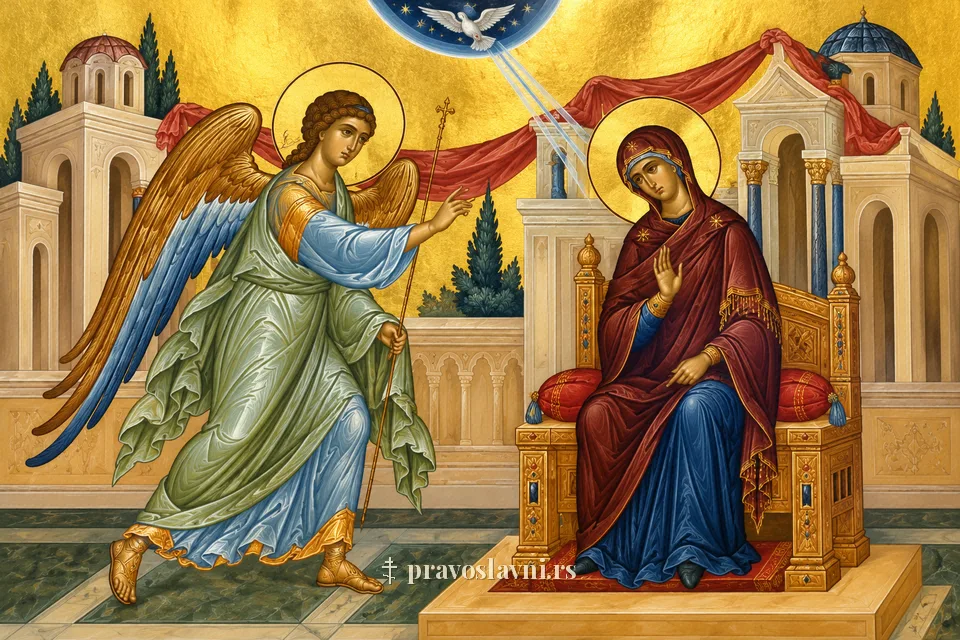
Great feast
Annunciation of the Most Holy Theotokos
What happenedThe Archangel Gabriel brought to the Virgin Mary in Nazareth the joyful news that by the Holy Spirit She would give birth to the Son of God.
Read the LifeOrthodox Calendar · 25 March according to the Julian calendar
Wednesday, 7 April 202725 March (according to the Julian calendar)What happenedThe Archangel Gabriel brought to the Virgin Mary in Nazareth the joyful news that by the Holy Spirit She would give birth to the Son of God.
Read the Life
Fish, oil and wine are allowed — no meat, dairy products or eggs.
This is a recommendation — for your own fast, consult your priest or spiritual father.Prayer of St Ephraim the Syrian →More about the fast →
Red Letter day — great feast; by custom, no work is done
More about the feast →
“And having come in, the angel said to her, ”Rejoice, highly favored one, the Lord is with you; blessed are you among women!”“
— Lk 1:28Sung at the Slava (family patron saint's feast) and on the feast day.
To-day is the crown of our salvation, and the manifestation of that mystery which is from everlasting: The Son of God becometh the son of a Virgin, and Gabriel announceth the glad tidings of grace. Wherefore let us also cry aloud with him unto the Birth-giver of God: Hail, thou that art full of grace, the Lord is with thee!
In the small Galilean town of Nazareth, on which the people of Jerusalem looked down, the Archangel Gabriel appeared to a young girl, Mary. The Life says that God chose precisely that lowly place, because He looks upon the lowly. The angel greeted her with the words: “Rejoice, highly favored one, the Lord is with you; blessed are you among women!” (Lk 1:28).
Mary was then living in the house of Joseph of Nazareth, to whom the priests had entrusted her so that he might guard her virginity. Before that she had spent eleven years in the Temple in Jerusalem. And when, according to the Law, she had to leave the Temple, she declared that she belonged to God and that she wished to remain a virgin for ever. As Joseph's ward, too, she gave most of her time to prayer, fasting, the Scriptures and work.
The angel told her that she had found favour with God and that she would conceive and bear a Son, to whom she would give the name Jesus. The Life says that the Virgin was troubled by the angel's words, but not frightened. That Son will be called the Son of the Highest, and of His Kingdom there will be no end (Lk 1:30–33). To her question how this would be, since she did not know a man, the angel answered that the Holy Spirit would come upon her and that the power of the Highest would overshadow her. He added that her relative Elizabeth had also conceived a son in her old age, for with God nothing is impossible (Lk 1:34–37).
Mary answered: “Behold the maidservant of the Lord! Let it be to me according to your word” (Lk 1:38). The Life says that at that hour, by the action of the Holy Spirit, the Word became flesh.
The Prologue sees in the Annunciation the beginning of the road by which people are saved and creation is renewed. Both sources call it a great and joyful feast, because the New Testament begins with the word “Rejoice”, which brings joy to people and to all creation. The Church celebrates the feast on 25 March by the Church calendar, that is, on 7 April.
The Virgin's humility, purity and obedience opened the way for the Incarnation of God the Word.
Both sources call the Annunciation a great and joyful feast, because the first word which the Archangel Gabriel addressed to the Virgin, “Rejoice”, stands at the beginning of the New Testament and brings joy to mankind and to all creation. The Prologue sees a beginning in this event: with the glad tidings and the descent of the Holy Spirit upon the Most Pure Virgin there begins the path by which people are saved and creation is renewed. The Church celebrates the feast on 25 March according to the church calendar, which is 7 April according to the civil one.
Who was the maiden to whom the angel came? The Life remembers her as the child of the aged parents Joachim and Anna, obtained by prayer, a descendant of a royal and priestly line. She spent eleven years in service in the Temple in Jerusalem. When, at about fourteen years of age, she was obliged by the Law to leave it and to marry, she declared to the priests that she belonged to God and wished to remain a virgin for ever. The Prologue records their astonishment.
The solution was found by the priests, led by Zacharias, the father of the Forerunner, and God guided that choice: they gathered twelve unmarried men of the tribe of David. The Life relates that God showed the choice by a sign — of the staffs left overnight in the sanctuary it was Joseph's that blossomed, and a dove alighted on it. Joseph of Nazareth, her kinsman according to the Prologue, was given the task of guarding her virginity.
Prayer, fasting, the reading of Scripture and handiwork remained her daily occupation even when she had left the Temple. She seldom went out of the house, she cared nothing for worldly things, and she talked most with Joseph's two daughters. The Life, following the church writers, adds that as early as the age of twelve, while praying at night, she saw a great light and heard a voice saying that she would give birth to the Son of God. She kept that secret right up to the Ascension.
The Prophet Daniel, according to the Prologue, had marked out the time of this event beforehand, and when it came, the Archangel Gabriel entered Mary's room. According to some writers, to whom both sources refer, the angel found her over the book of the Prophet Isaiah, as she was pondering the prophecy about the Virgin, as the Prologue quotes it: “Behold, the virgin shall conceive and bear a Son!” (Is 7:14).
Nazareth in Galilee (Lk 1:26–27) was not a town that Jerusalem admired; the Life says that God chose it for that very reason, because He looks upon the lowly. According to St Andrew of Crete, as the Life states, the angel considered carefully how he should approach her and came in quietly.
“And having come in, the angel said to her, “Rejoice, highly favored one, the Lord is with you; blessed are you among women!”” (Lk 1:28). Mary was troubled but, as the Life observes, she was not frightened. “Do not be afraid, Mary, for you have found favor with God.” (Lk 1:30). The Life says that she found grace through her humility, her purity and her love for God. “And behold, you will conceive in your womb and bring forth a Son, and shall call His name Jesus.” (Lk 1:31). That Son will be great and will be called the Son of the Highest; God will give Him the throne of His father David, He will reign over the house of Jacob for ever, and of His Kingdom there will be no end (Lk 1:32–33).
Mary asked how this could be, since she did not know a man (Lk 1:34). The answer was: “The Holy Spirit will come upon you, and the power of the Highest will overshadow you” — therefore the Holy One who is to be born will be called the Son of God (Lk 1:35). As a sign, the angel told her about her relative Elizabeth, who had been considered barren, and who had conceived in her old age and was already in her sixth month: “For with God nothing will be impossible.” (Lk 1:36–37). The Virgin answered: “Behold the maidservant of the Lord! Let it be to me according to your word,” and the angel departed (Lk 1:38).
The Life teaches that the Virgin conceived at once, by the power of the Holy Spirit, without carnal desire, but in joy of spirit. Thus the Word became flesh. The Life also says that Gabriel then returned to heaven, where he glorified the mystery of the Incarnation.
The Annunciation shows that the history of salvation begins with joy. The Virgin of Nazareth brought to God her humility, purity and obedience, and by her “let it be to me” the way was opened for the Incarnation of God the Word.


