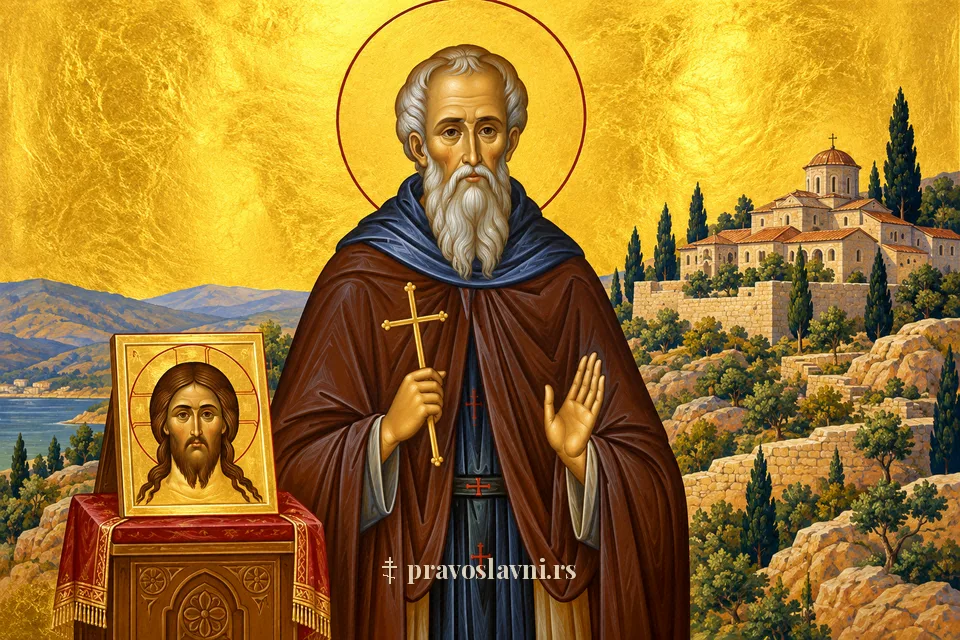
Saint of the day
Venerable Hilarion the Confessor
What happenedAbbot Hilarion did not renounce the veneration of the holy icons even when his monastery was burnt down, but died as a confessor in a prison near Ephesus.
Read the LifeOrthodox Calendar · 28 March according to the Julian calendar
Saturday, 10 April 202728 March (according to the Julian calendar)What happenedAbbot Hilarion did not renounce the veneration of the holy icons even when his monastery was burnt down, but died as a confessor in a prison near Ephesus.
Read the Life
No meat, dairy products, eggs or fish — oil and wine are allowed.
This is a recommendation — for your own fast, consult your priest or spiritual father.Prayer of St Ephraim the Syrian →More about the fast →
Today the Church keeps the commemoration of a saint · Fourth week of Great Lent.
More about the feast →
“For which I suffer trouble as an evildoer, even to the point of chains; but the word of God is not chained.”
— 2 Tim 2:9Hilarion, whom the sources call the New, a confessor, died in the year 754 in a prison near Ephesus, as an exile for his veneration of the holy icons. There, as the Prologue and his Life record, he passed over into the Kingdom of Christ.
He was a monk from his youth. According to his Life, after long years of seclusion in a cell without light he attained dispassion, and then received the priesthood. He became abbot of the Monastery of Pelekete, which both sources place near the Hellespont. The Prologue says that he shone with the Spirit of God. He healed illnesses and cast out evil spirits. His Life also ascribes to him signs over nature and over illnesses: at his prayer the hail stopped and rain fell in a time of drought, a river parted, a blind man received his sight, and fishermen drew up full nets.
Then came the iconoclast persecution — according to the Prologue in the time of Leo the Armenian, according to his Life under Emperor Leo III the Isaurian. His Life tells that soldiers burst into the monastery during the Liturgy and threw the Holy Mysteries on the ground. According to his Life, they put the forty-two most respected monks in chains, tortured the rest, and set fire to the monastery and the church. St Joseph the Hymnographer, to whom the Life refers, calls him a martyr in the canon, because he was persecuted for venerating the icon of the Saviour. Hilarion was sent into exile together with his monks; the Prologue says that there were forty monks with him.
St Hilarion teaches faithfulness: neither the burnt monastery nor the prison separated him from the veneration of the holy icons.
Hilarion, whom both sources call the New, a confessor, was a monk from his youth. According to his Life, he lived strictly, quenching the passions by abstinence, and in virtue he surpassed the other monks; in this way he followed the Crucified One. For years, according to his Life, he lived as a recluse in a cell without light, until he attained dispassion. Only after that was he ordained a priest.
He became abbot of the monastery of Pelekete, which both sources place near the Hellespont. The Prologue says of him that he shone with the Spirit of God.
Both the Prologue and his Life remember him as a healer: he cured illnesses and drove out evil spirits. His Life lists a good deal more. With a word he drove pests from the fields and out of the gardens. He had, according to his Life, authority over nature as well: hail stopped at his prayer, and a drought ended with rain. Like the Prophet Elisha of old, he parted the waters of a river. Among those healed his Life mentions a man whose hand was withered, a blind man and many who were lame. For fishermen who had long been casting their nets in vain he filled the nets with fish.
Hilarion suffered in the iconoclast persecution. The sources do not agree about the emperor: the Prologue says that it was in the time of Leo the Armenian, while his Life names the iconoclast Emperor Leo III the Isaurian. His Life refers to St Joseph the Hymnographer: in the eighth ode of his canon he testifies that Hilarion was persecuted because he venerated the icon of the Saviour, and gives him the name of martyr.
His Life also describes the day when the monastery suffered: in the middle of the Divine Liturgy soldiers burst into Pelekete without warning, led by the Emperor's commander. They entered the altar, interrupted the chanting and threw the Holy Mysteries on the ground. According to his Life, they put in chains forty-two monks who were held in the highest regard, while the rest they beat, tortured, and some they even maimed. The monastery and the church were set on fire.
Hilarion was sent with his monks into exile near Ephesus — according to the Prologue with forty monks, according to his Life with those forty-two fathers in chains. There, as both sources record, he died in prison in the year 754 and passed into the Kingdom of Christ.
St Hilarion was an ascetic and a wonderworker, but his greatest witness is his faithfulness. Not even when his monastery was burnt and his brethren tortured did he renounce the veneration of the holy icons, and he died as a confessor in prison.


