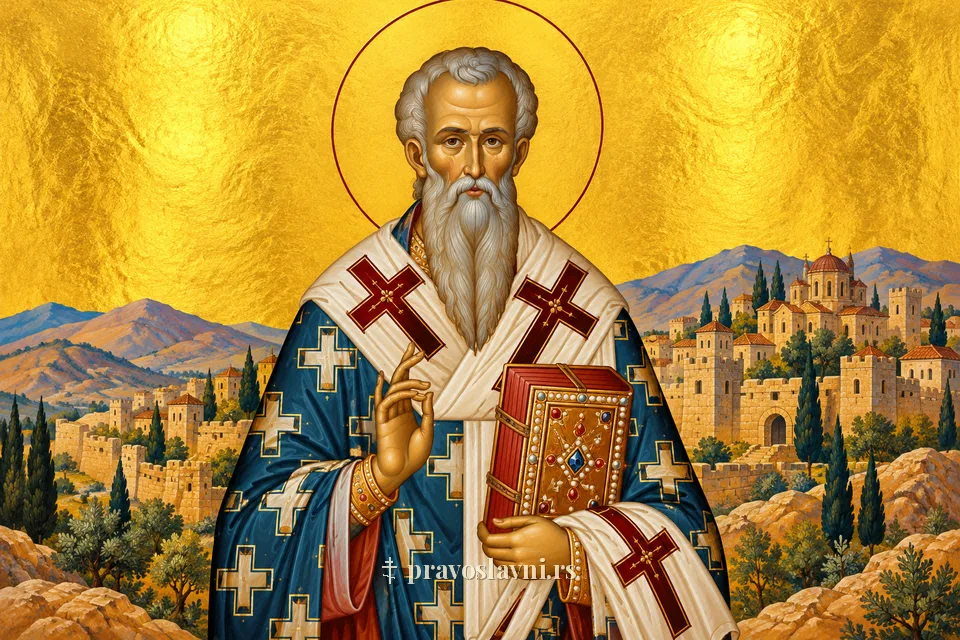
Saint of the day
Hieromartyr Hypatius, Bishop of Gangra
What happenedMortally wounded by heretics, Bishop Hypatius prayed for his murderers, and the woman who killed him was healed at his grave.
Read the LifeOrthodox Calendar · 31 March according to the Julian calendar
Tuesday, 13 April 202731 March (according to the Julian calendar)What happenedMortally wounded by heretics, Bishop Hypatius prayed for his murderers, and the woman who killed him was healed at his grave.
Read the Life
No meat, dairy products, eggs, fish or oil — food cooked in water.
This is a recommendation — for your own fast, consult your priest or spiritual father.Prayer of St Ephraim the Syrian →More about the fast →
Today the Church keeps the commemoration of a saint · Fifth week of Great Lent.
More about the feast →
“Yes, and all who desire to live godly in Christ Jesus will suffer persecution.”
— 2 Tim 3:12Before his death, according to his Life, Bishop Hypatius prayed for those who had attacked him, as the Protomartyr Stephen once did: “Lord, do not charge them with this sin.” The Novatian heretics lay in wait for him in a narrow pass on his way home, wounded him and threw him off the road. Then a woman who was with them gave him the final blow with a stone.
Hypatius, according to the Prologue, was born in Cilicia, and he was Bishop of Gangra and took part in the First Ecumenical Council. The Prologue and his Life remember him for his holy life and his miracles. According to his Life, the sick found a cure with him, the possessed found deliverance, and bitter water became fit to drink; at his prayer a warm healing spring also began to flow. When one night he was walking along a river in the dark, light came to him, according to his Life, from the water itself.
He became famous in Constantinople as well. His Life tells that in the time of Emperor Constantius an enormous dragon appeared in the palace, and no one was able to drive it away. The Emperor sent for Hypatius. The bishop prayed for a long time, then asked for a fire to be lit in a great furnace at the Hippodrome, and then by the name of Jesus Christ he forced the dragon to follow him and to go into the fire, where it was burnt up. From then on the Emperor honoured him as a father, and according to the Prologue and his Life he kept his portrait in the palace.
The murderers, according to his Life, hid the body in a hay shed. His Life says that the owner, when he came for hay, heard angelic singing and found the body of his bishop, and the people of Gangra buried him with weeping and with honours. The woman who had killed him lost her mind straight after the murder. According to his Life, she walked behind the funeral procession and publicly confessed her guilt. The Prologue records that the members of her household brought her to his grave and that after prayer she was healed, and from then on she lived as a penitent. According to his Life, the other murderers were healed as well, and many other miracles took place at the grave.
Hypatius teaches us that forgiving one's enemies is the mark of a martyr of Christ.
The Prologue says that Hypatius was born in Cilicia. He was Bishop of Gangra in Paphlagonia and took part in the First Ecumenical Council in Nicaea, where, according to his Life, together with the other fathers he anathematised Arius. The Prologue and his Life remember him for his holy life and his miracles.
His Life says that he cured every illness and drove out demons. By prayer, according to his Life, he gave one village drinking water in place of bitter water, and in another place a warm healing spring flowed forth at his prayer. Once he had to travel at night beside a river, and the darkness was complete; his Life says that lighted candles then appeared out of the water and kept him from falling.
The best-known story about him is preserved by his Life. In the time of the Emperor Constantius, the son of Constantine the Great, an enormous dragon appeared in the imperial palace. It lay down before the treasury and let no one come near. Many priests tried to drive it away, without success, and some it even killed. The frightened Emperor sent for Hypatius, whose miracles were known in Constantinople too. The Emperor received him with the greatest respect, bowing down to the ground before him. Hypatius then said to him: “Even if our prayer does not succeed, O Emperor, your faith in God will succeed.”
Hypatius first prayed for a long time, lying on the ground. The fire in a great furnace was, at his wish, kindled in the Hippodrome, beside the statue of the Emperor's father. For a long time he beat the beast, which was sixty cubits long, with his bishop's staff, yet it did not so much as stir; those present feared for his life. Then, crying out to the Lord, he thrust the staff between the dragon's jaws and in the name of Jesus Christ commanded it to follow him. The dragon obeyed. Without letting go of the staff, it dragged itself after the bishop across the Hippodrome and the square, all the way to the furnace. There Hypatius, again in the name of Christ, commanded it to enter the fire. The dragon leapt into the flames and was burnt up.
The people glorified God, and the Emperor gave thanks to God and to Hypatius and from then on honoured him as a father. The Emperor, as the Prologue and his Life record, while Hypatius was still alive ordered his portrait to be made and kept it in the palace, believing that it defended him from every evil that comes from enemies.
On his way back from Constantinople to Gangra, in a certain narrow pass, the Novatian heretics lay in wait for him. They wounded him and hurled him off the road — according to the Prologue into a marsh, and according to his Life from a high hill into the mud. His Life compares him in those moments with the Protomartyr Stephen: barely alive, he prayed for his attackers: “Lord, do not charge them with this sin!” The death blow was dealt him by a woman who was among them — she struck him with a stone.
According to his Life, the attackers hid the body in a hay shed nearby, and then went their ways. Punishment did not wait: the murderess at once lost her reason — his Life ascribes this to an unclean spirit — and began to strike herself with the same stone. His Life adds that all the others who took part in the murder also went mad and suffered grievously.
His Life says that the owner of the shed, when he came for hay, heard angelic singing, found the body and recognised his bishop. The villagers sent word to the inhabitants of Gangra, and they came weeping, took the body and buried it with honours in a prominent place. Behind the funeral procession, according to his Life, walked the woman who had killed him too, beating herself with the stone and confessing aloud what she had done.
The Prologue says that the members of her household brought her to his grave and that after prayer she was healed there; his Life says that the other murderers were healed as well. According to the Prologue, from then on she lived only for repentance and prayer. And the tomb, says his Life, went on healing many who approached it in faith after that too.
St Hypatius showed meekness and freedom from malice even in his very death: he prayed for his murderers and healed them at his tomb. Forgiveness of enemies, says his Life, is the mark of a martyr of Christ.


