Saint of the day
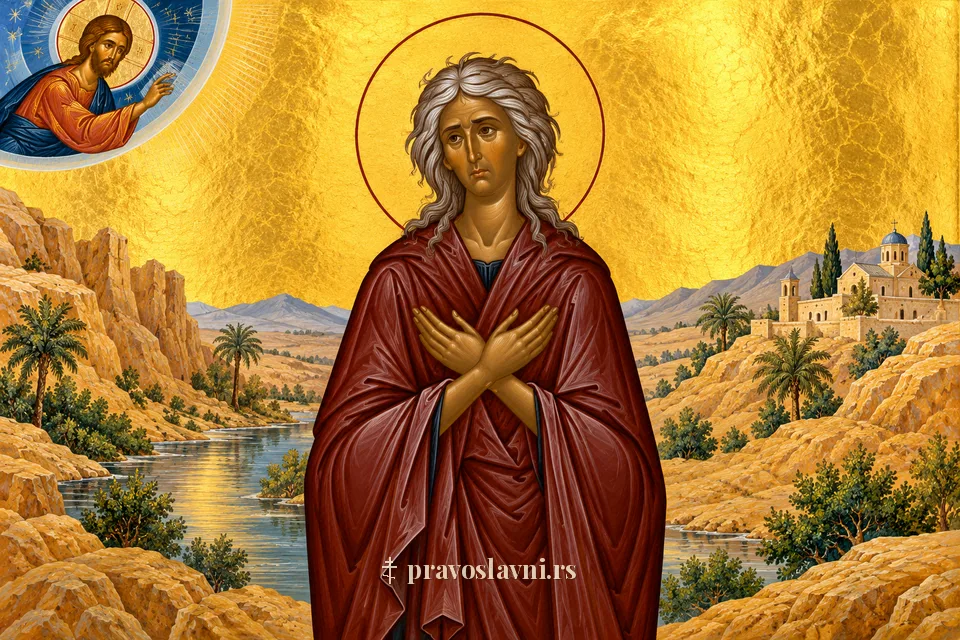
Venerable Mary of Egypt
What happenedThe former sinner Mary lived for decades in the desert beyond the Jordan, and at her meeting with the elder Zosimas she crossed the river walking on the water.
Read the LifeOrthodox Calendar · 1 April according to the Julian calendar
Wednesday, 14 April 20271 April (according to the Julian calendar)What happenedThe former sinner Mary lived for decades in the desert beyond the Jordan, and at her meeting with the elder Zosimas she crossed the river walking on the water.
Read the Life
No meat, dairy products, eggs or fish — oil and wine are allowed.
This is a recommendation — for your own fast, consult your priest or spiritual father.Prayer of St Ephraim the Syrian →More about the fast →
Today the Church keeps the commemoration of a saint · Fifth week of Great Lent; First Vigil (Great Canon of St Andrew).
More about the feast →
“This is a faithful saying and worthy of all acceptance, that Christ Jesus came into the world to save sinners, of whom I am chief.”
— 1 Tim 1:15A woman from Egypt stood on the threshold of a church in Jerusalem, on a feast day — according to her Life the Exaltation of the Precious Cross — and could not go in. Something invisible turned her back, three or four times. This was Mary, who from the age of twelve, in Alexandria, had lived for seventeen years in fornication, and had come to Jerusalem led by the same passion.
In the narthex she prayed before the icon of the Theotokos, told her what kind of woman she had been, and promised that she would go wherever the Mother of God might lead her. Then she went in and kissed the Cross. After that she heard a voice: “If you cross the Jordan, you will find good rest!” She received Holy Communion by the Jordan and crossed over into the desert.
There she spent more than four decades. Her Life says that for years she was pursued by her old habits and passions, and that she overcame every temptation by prayer and tears before the Theotokos. Her clothing fell to pieces, and she lived on the plants of the desert.
Towards the end of her life the monk Zosimas met her in the desert. Her Life says that this elder, after decades of ascetic struggle, had the thought that there was no longer anyone who could teach him anything, and so an angel sent him to a monastery beside the Jordan, from which the monks went out into the desert every year. She knew his name, and he saw her raised up above the ground in prayer. She told him the story of her life and asked him to bring her Holy Communion the following year. When he came, she crossed the Jordan walking on the water, received Communion and went back.
A year later Zosimas found her dead. Beside her in the sand there was a written request that he should bury her; from it he learned that she had died straight after that Communion. Her Life says that the ground was hard, and he had no tools, and so the grave, according to her Life, was dug by a lion, which then went back on its way. Her life was later written down by Sophronius, Patriarch of Jerusalem, from the account of the monks of the Jordan.
St Mary of Egypt has remained an example of repentance: God receives even the greatest sinner who sincerely returns to Him.
The most important moment in the life of Mary of Egypt took place at the doors of a church in Jerusalem. She wanted to go in and venerate the Cross, but something invisible would not let her cross the threshold — according to her Life, not even after three or four attempts. Behind her lay a youth which she could not wipe away: as a girl of twelve, while her parents were still alive, she had left Egypt for Alexandria and lived there for seventeen years in fornication. Her Life says that in doing so she took no money and that she lived in want, from the spinning of flax. She came to Jerusalem by ship, led by the same passion, in the company of pilgrims who, according to her Life, were travelling for the feast of the Exaltation of the Precious Cross.
In the narthex she stood before an icon of the Theotokos, confessed to her what her life had been like, and promised that she would go wherever the Mother of God directed her. Then she went in without hindrance and kissed the Cross. After that she heard a voice: “If you cross the Jordan, you will find good peace!” With three loaves, bought for three coins which, according to her Life, someone had given her, she reached the river that very same day. She received Holy Communion at the church of St John the Baptist, and the next day she was on the other bank.
In the desert beyond the Jordan she spent, according to the Prologue, forty-eight years; her Life says that, when she met Zosimas, forty-seven years were being completed since she had left Jerusalem. Her bread, according to her Life, lasted for several years, and after that she lived on the plants of the desert. The first seventeen years were, says her Life, years of hard struggle: the hunger for meat, fish and wine kept coming back, as did the memory of worldly songs and bodily passion. Each time she had recourse to the Theotokos, with prayer and tears, until a light brought her peace. Her clothing fell to pieces on her, and she endured both scorching heat and bitter cold. From the crossing of the Jordan she had seen neither man nor beast. She had never learnt to read, and yet, according to her Life, she spoke in the words of Holy Scripture.
All of this was learnt by the monk Zosimas. Her Life says that he had lived from childhood in a monastery in Palestine and in his fifty-third year had the thought that there was no longer anyone who had anything to teach him. An angel showed him that there is a higher way as well and directed him, like Abraham, to a monastery beside the Jordan, under the governance of Abbot John. Life there was lived in prayer and work, on bread and water. According to her Life, at the beginning of the yearly fast the monks would receive Holy Communion and scatter through the desert, each one alone, with the words of the Twenty-sixth Psalm. They did not talk among themselves about their ascetic labour.
For twenty days Zosimas had been walking into the depths of the desert when he caught sight of a human form, dark from the sun, with white hair, without clothing. Her Life says that he first thought it was a demon and made the sign of the cross, and then ran after it. The unknown being fled, and then addressed him by name and asked for his cloak. This frightened Zosimas.
In prayer, as Zosimas saw, she was lifted up from the ground — according to her Life by a cubit, turned towards the east. She assured him that it was no apparition before him, but a mortal woman, dust and ashes. She said to him: “I am ashamed, father, to tell you my deeds” — and yet she told him everything.
She asked him to bring her the Holy Gifts to the bank of the Jordan in a year's time. When he came, he did not know how she would get to him across the river. She made the sign of the cross over the water and crossed it on foot, without sinking. She received Holy Communion and went away by the same path, after telling him to come the following year to the place where they had first met.
There he found her dead. Beside the body, in the sand, he came upon a few written words: her name and a request that he bury her. From them he understood that immediately after Communion, that same night, she had reached that distant place and there given up her soul to God. The ground was hard, and he was without tools; her Life says that a lion then came and at the elder's request dug the grave with its paws, and then quietly withdrew. Zosimas told in the monastery what he had seen. Her Life adds that he lived to be almost a hundred years old, and Sophronius, Patriarch of Jerusalem, later wrote this story down just as the monks from the Jordan had been handing it on by word of mouth.
Her story, according to the Prologue, bears witness that a repentant sinner does not remain in shame before God, but is glorified.


