Saint of the day
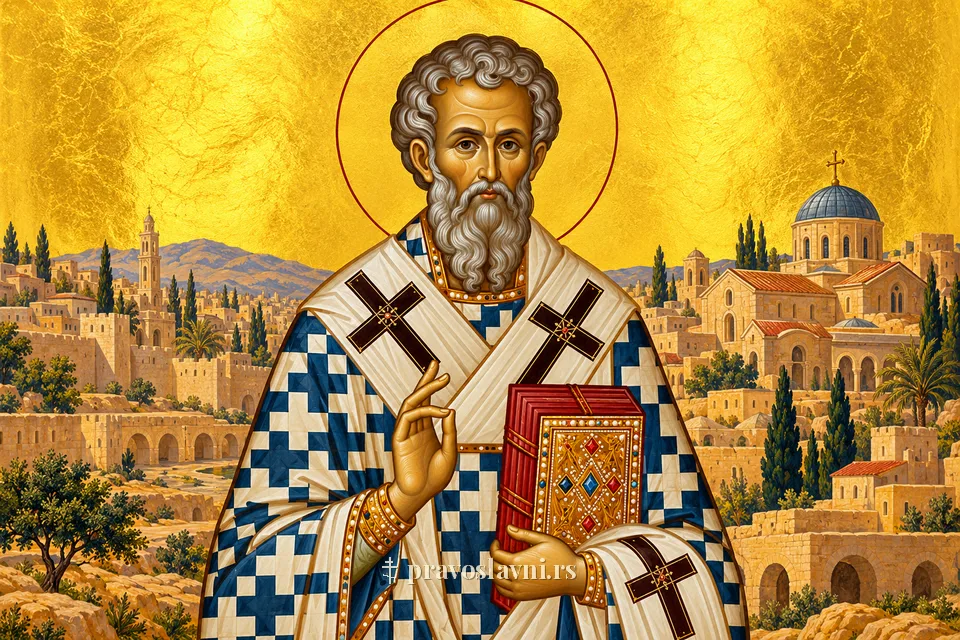
Venerable Mark, Bishop of Arethusa
What happenedThe aged Bishop Mark would not give even a single coin for a pagan temple, and his torturers, amazed at his endurance, finally let him go.
Read the LifeOrthodox Calendar · 29 March according to the Julian calendar
Sunday, 11 April 202729 March (according to the Julian calendar)What happenedThe aged Bishop Mark would not give even a single coin for a pagan temple, and his torturers, amazed at his endurance, finally let him go.
Read the Life
No meat, dairy products, eggs or fish — oil and wine are allowed.
This is a recommendation — for your own fast, consult your priest or spiritual father.Prayer of St Ephraim the Syrian →More about the fast →
Today the Church keeps the commemoration of a saint · Sunday — a festive day · Fourth Sunday of Lent (Sredoposna) – St John Climacus (Great Lent).
More about the feast →
“Having your conduct honorable among the Gentiles, that when they speak against you as evildoers, they may, by your good works which they observe, glorify God in the day of visitation.”
— 1 Pet 2:12“Are we not ashamed, O Emperor, to put this old man to so many torments?” So, according to his Life, the prefect of Arethusa, himself a pagan, spoke to the Emperor. He added that in a victory over such an old man there is neither glory nor honour. The old man of whom he spoke was St Mark, a bishop in Syria, according to the Prologue already a very old man.
The pagans hated him because of the temple which he had torn down under Constantine the Great, and because of the many whom he had turned away from idols and brought to Christ. When Julian the Apostate took power, and some of the citizens, according to the Prologue, turned to idols again, the persecution began. His Life records a bitter coincidence here: that very same Julian had once, as a young man, been saved from murderers by Mark.
At first, according to his Life, he withdrew, chiefly because of Christ's word about fleeing before persecutors. When he heard that others were suffering because of him, he came back of his own accord.
They demanded compensation from him for the demolished temple, either in money or in a new building. He did not agree. The beatings, the dragging through the city — in which, his Life says, both the city magistrate and the leading men of the city took part — and the honey with which they smeared him in order to expose him to the stings of insects did not break him. The Prologue says that he did not utter a sound, and his Life that he saw honour in his torments.
The price was then lowered, until it became insignificant, and even then Mark did not pay. His Life sees in this the proof that he was defending the faith, and not money. His steadfastness turned the city round: according to the Prologue, in the end the citizens cared only that he should stay alive, and so they let him go; for this his Life refers to Theodoret. Those who had fallen away began to listen to him and, according to the Prologue one by one, became Christians again.
The sources do not say where and when he died; we remember him as a confessor. St Mark teaches us that patience without hatred brings back to God even those who have fallen away.
The story of St Mark turns on one single coin. For the pagan temple he had pulled down, the pagans at first demanded a great deal: either a new temple, or compensation in a large sum of money. When the old man refused, the demand began to shrink, until it came down to an amount that would have been no burden to him at all. Mark refused that too. His Life explains why: had he paid even a trifle, it would not have been seen that he was suffering for the faith, and not on account of money.
Mark was a bishop in Syria, in the city whose inhabitants his Life calls Arethusians. The Prologue remembers him as a man of great age, whose face shone with angelic light. In the time of Constantine the Great he pulled down the temple of the idols in the city. He brought many pagans to Christ, and his Life says that he drew them by his preaching and his pure life. Those who stayed with the idols did not forgive him for this.
His Life also preserves one bitter detail. Mark had once hidden the young Julian when men were seeking his head. The youth who was saved became the Emperor who turned against Christ. His Life also gives the opinion that the old man's later torments were the payment for having, unknowingly, prolonged the life of a man who was to sin so greatly.
Under Julian the Apostate, according to the Prologue, some of the citizens renounced the faith and went back to the idols, and the pagans turned on the bishop. His Life says that at first Mark withdrew into hiding. He did so above all in order to fulfil Christ's word about fleeing from city to city in a time of persecution (Mt 10:23). As soon as he learnt that others were paying for his absence, he came forward of his own accord and gave himself up.
They beat him and dragged him through the city, and his Life says that neither the prominent men of the city nor the city's governor held back from this. In the end, according to the Prologue and his Life, they smeared his naked body with honey and left him, bound, to the insects.
The Prologue says that not even then did he cry out. His Life adds that his face did not darken and that he saw honour in his torments, and not misfortune; it seemed, according to his Life, that he did not even feel the pain and that he was actually rejoicing. The story of how the pagan prefect himself went to the Emperor is introduced by his Life with “it is told”. The prefect then said: “Are we not ashamed, O Emperor, to put this old man to so many torments?” And further: “Yet it is neither glorious nor honourable to defeat him.”
In the city, too, the mood turned. According to the Prologue, the citizens cared that the old man should survive, and so it no longer mattered to them how much he would pay. Amazed, they let him go; for this his Life refers to Theodoret, while the Prologue names Theodoret and Gregory the Theologian as those who wrote about Mark. Many who had fallen away listened to his teaching after that and became Christians once more — according to the Prologue, one by one. Nowhere is it written down when and where Mark died. He has been remembered as a confessor who survived his torments and brought his fellow citizens back to Christ.
Along with Mark both sources also mention the deacon Cyril from Heliopolis, a city at the foot of Lebanon. He zealously smashed idols: his Life places this in the time of Constantine the Great, while according to the Prologue he suffered under Julian. The pagans killed him, and punishment, according to both sources, soon overtook the murderers. Both sources also mention many others who were killed at that time; his Life names among them priests and maidens consecrated to God in Ascalon and Gaza.
Mark teaches us that patience without hatred can win back even those who have abandoned the faith. His Life adds that persecution should be borne patiently, and that one should be gentle towards the persecutors, so that they may not bring themselves to ruin. For this the martyrs, according to his Life, receive crowns in the Kingdom of Christ.


