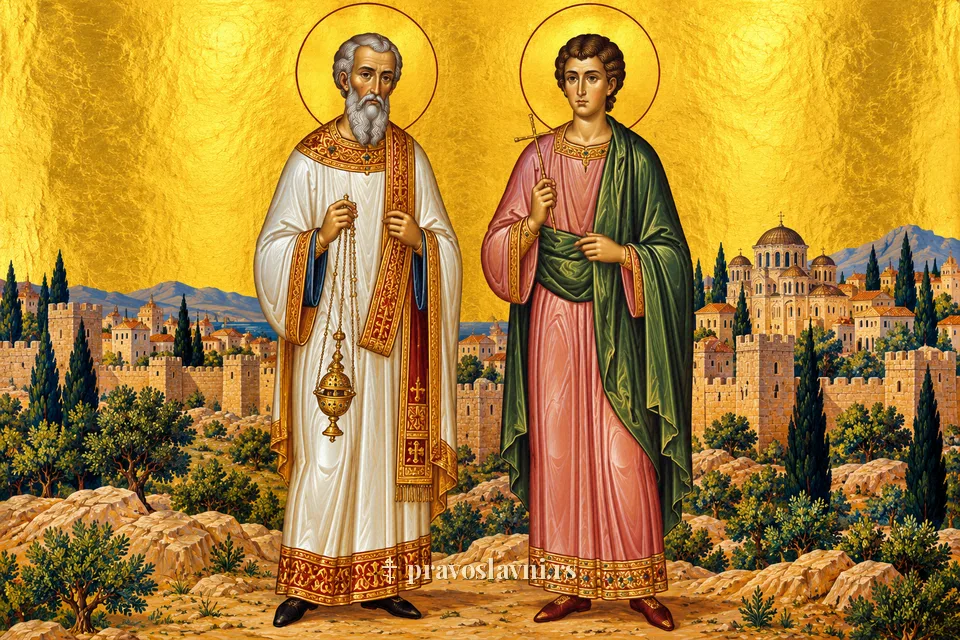
Saints of the day
Holy Martyrs Agathopodes and Theodulus
What happenedThe deacon Agathopodes and the reader Theodulus, an old man and a youth, confessed Christ holding hands and together received a martyr's death in the sea.
Read the LifeOrthodox Calendar · 5 April according to the Julian calendar
Sunday, 18 April 20275 April (according to the Julian calendar)What happenedThe deacon Agathopodes and the reader Theodulus, an old man and a youth, confessed Christ holding hands and together received a martyr's death in the sea.
Read the Life
No meat, dairy products, eggs or fish — oil and wine are allowed.
This is a recommendation — for your own fast, consult your priest or spiritual father.Prayer of St Ephraim the Syrian →More about the fast →
Today the Church keeps the commemoration of a saint · Sunday — a festive day · Fifth Sunday of Lent (Gluvna) – St Mary of Egypt (Great Lent).
More about the feast →
“And everyone who has this hope in Him purifies himself, just as He is pure.”
— 1 Jn 3:3In the time of Diocletian the Church of Thessalonica gave two witnesses of the faith: the old deacon Agathopodes and the young reader Theodulus. When the order arrived that all should bow down to the idols, some fled and some offered sacrifices. These two, says their Life, remained in the church and prayed until the soldiers led them away.
Before the governor Faustinus they were of one mind. They said that they were Christians, and neither kind words nor threats were of any avail. Theodulus would not hand over the sacred books and, according to the Life, he himself bent his head before the sword, while Agathopodes ridiculed the idols. The Life also says that Theodulus had earlier received in a dream a wondrous ring with a cross, by which the sick were healed, and so many pagans came to believe.
In prison, according to the Life, both of them dreamed the same dream on the same night, a ship in a storm and a path over a mountain up to heaven, and in it they recognised the announcement of martyrdom and of reward. Neither the long imprisonment nor the hunger broke them, and so in the end they were condemned to be drowned. On the shore, according to the Life, they were once more offered freedom in exchange for a sacrifice to the idols, and again they refused.
Agathopodes was thrown into the sea first, with a stone around his neck. The Prologue records that he called death a second baptism which cleanses them from sin and leads them to Christ. Theodulus followed after him. They suffered in Thessalonica in the year 303. The Christians buried with honour the bodies, which the sea gave back, and afterwards Theodulus, as the Prologue and the Life say, appeared to his acquaintances in the radiance of an angel and asked that his property be given to the poor.
The Prologue says that Theodulus valued the life beyond the grave more than the present one. That is why he gladly renounced this life.
They stood before the judges without fear, hand in hand, repeating: “we are Christians!” In this way, as the Prologue and the Life record, the deacon Agathopodes and the reader Theodulus of the church of Thessalonica answered Diocletian's persecution, when it was ordered that everyone should bow down to the idols; along with Diocletian the Life also mentions Maximian.
The city ruler Faustinus, whom the Prologue calls the governor of Thessalonica, took the greatest pains over the young Theodulus. According to the Life, he alternated gentle words and threats, and the priest of Jupiter spoke of tortures. Theodulus answered with a confession: Christ is the Creator and Mediator, crucified and risen. He did not hand over the holy books. When they threatened him with mutilation, with wild beasts and with the sword, he knelt down of his own accord, offered his neck and gave thanks to God, but the ruler ordered that he should remain alive. Agathopodes, says the Life, was asked whether he and Theodulus were relatives, and he answered that they were bound by a spiritual kinship. He mocked the idols and refused to sacrifice. Not one word of the judge separated them from Christ.
Agathopodes was advanced in years, while Theodulus was young, according to the Prologue and the Life a man of pure life; the Life adds that he was handsome and that his parents were devout Christians. The Life remembers that Theodulus once received in a dream a ring with a cross on it, and on waking found it in his hand. The ring healed the sick, and because of this many pagans came to believe in Christ.
When the persecution began, some Christians, according to the Life, fled, and some bowed down to the idols. These two remained where they were: in their church, in prayer for the Church, until the soldiers came.
In the darkest cell, in chains, they went on praying, and the prisoners around them asked their forgiveness. The Life says that on the same night both of them dreamed the same dream: a ship on a stormy sea, a helmsman, and a path over a mountain that leads to heaven. They understood it as a promise of martyrdom and of reward. People began to come to the prison, and so the chief judge Eupsychius, according to the Life, advised Faustinus to put them to death, or else many would abandon the idols. After a long imprisonment and fasting, at the third trial, the confession was the same: “We are Christians, and for the sake of the name of Christ we wish to endure every torment!” The sentence was — death in the sea.
On the shore the envoy Fulvius, according to the Life, once more offered them life in exchange for a sacrifice to the idols. They refused. With his hands bound behind his back and a stone about his neck, Agathopodes was the first to be thrown into the sea. The Prologue preserves his last words: “behold, by a second baptism we are washed of all our sins and depart clean to Christ Jesus!” Soon Theodulus too sank after him. This was in Thessalonica in the year 303.
The waves returned them to the shore. Their acquaintances, according to the Life, freed them from the stones, and the Christians gave them an honourable burial. After that Theodulus appeared to his friends in angelic radiance and asked them to distribute his property to the poor.
The Prologue records Theodulus's conviction that life after death is better than this one, and so he gladly renounced the present life. That is why death in the sea was for both of them a baptism, and not a defeat.


