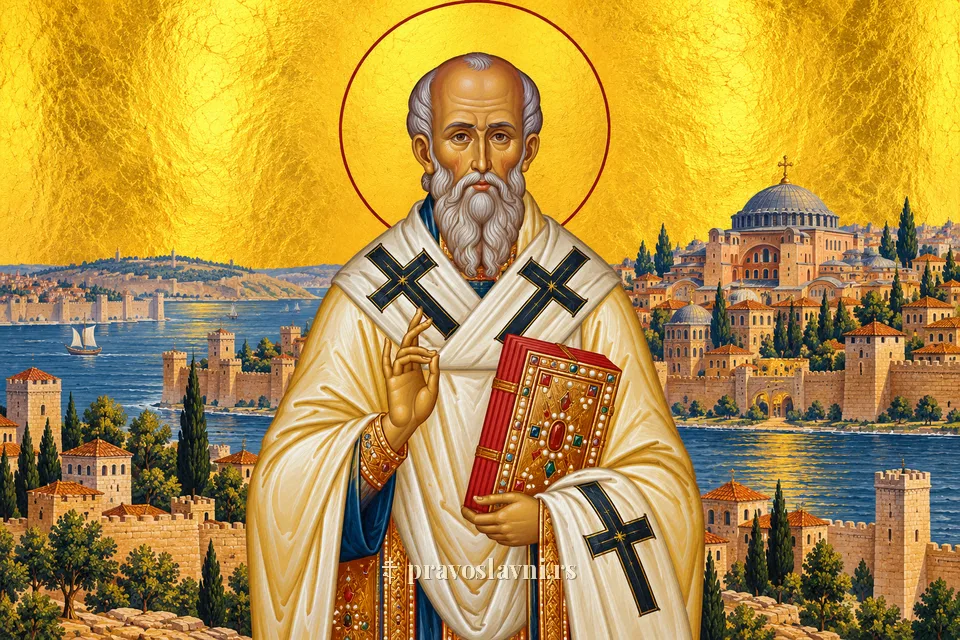
When Emperor Justinian the Great began to teach that even before the Resurrection the body of Christ could not hunger, thirst and suffer, Eutychius, Patriarch of Constantinople, did not agree, although the Emperor loved him and had chosen him himself. He refused to sign the heresy and defended the truth that the body of Christ was like ours in everything except sin. For this he was deposed and exiled to a monastery in Amasea.
That monastery was not strange to him. Born in Phrygia, in a devout family, Eutychius as a boy at play wrote “Eutychius the Patriarch!”, and when he grew up he chose the monastic life. His Life says that in Constantinople, where he went at the age of twelve, he surpassed those of his own age in learning, but valued the wisdom from above more than the wisdom of the world. In Amasea he became abbot. Later, in place of the sick metropolitan, he took part in the Fifth Ecumenical Council and distinguished himself by his learning and his piety. The Emperor grew fond of him, and Patriarch Menas before his death wished to have him as his successor. So Eutychius became Patriarch and for twelve years led the Church in peace.
He did not spend his exile in bitterness. The Prologue says that he lived in it for twelve years and eight months and that he healed the sick by prayer and by anointing with oil. His Life remembers a deaf and dumb boy who began to speak, paralysed children who began to walk, and an empty monastery granary which, in a time of famine, was filled at his prayer.
In the end Justinian repented and died, and the new Emperor Justin restored Eutychius to his throne. His Life says that he was welcomed with joy and that he served in peace until his death, still healing as before. His Life also records that he foretold to Tiberius, who visited him on his deathbed, that he too would soon die, which indeed came to pass. He reposed in his seventieth year, in the year 582, and was buried, according to his Life, in the Church of the Holy Apostles.
His life teaches that it is worth more to preserve the truth about Christ than to keep one's position. The Prologue reminds us that Christ truly hungered, thirsted and suffered, and that the Cross is the source of salvation.
Full Life
An inscription from childhood
As a boy, at play with his friends, Eutychius wrote down what he would be when he grew up: “Eutychius the Patriarch!” The Prologue says that he wrote it on a stone, his Life — on a wall. The child's game was fulfilled in a way that no one could have foreseen: he became Patriarch of Constantinople, lost his throne on account of his faithfulness to the truth, and received it once again.
He was born in Phrygia, into a devout family, and his father was a military officer. His Life states that his father was called Alexander, and his mother Synesia, and that she was the daughter of the priest Hesychius from Augustopolis. Before his birth his mother, according to his Life, dreamt that she was surrounded by light, as a sign that the child would be a spiritual light. His grandfather Hesychius, according to his Life, baptised him and taught him his letters.
From learned youth to abbot
According to his Life, at the age of twelve he went to Constantinople for higher schooling and outstripped his peers. Yet he valued worldly wisdom less than the wisdom from above and resolved to serve God as a monk. He was a deacon, and then in his thirtieth year a priest; he was to have become a bishop, but another was chosen, and he went away to a monastery in Amasea and became a monk. There he became abbot, according to the Prologue in his thirtieth year, while his Life says that he was archimandrite of all the monasteries of the metropolis.
When the Metropolitan of Amasea fell ill, Eutychius was sent in his place to the Fifth Ecumenical Council. The Prologue says that he was forty years old at the time. He distinguished himself by his learning and his piety. He argued, referring to the Books of Kings, that heretics can be anathematised even after death; his Life gives as an example King Josiah, who burnt the bones of idolaters. The Emperor Justinian the Great grew fond of him, and Patriarch Menas, before his death, expressed the wish that Eutychius should succeed him.
The Patriarch before the Emperor
According to his Life, many sought the patriarchal throne by bribery, but the Emperor was choosing Eutychius. He said that the chief apostle had pointed him out to him as the future bishop, and the senate and the clergy cried out: “Worthy! Worthy!” He became Patriarch and for twelve years governed the Church in peace.
The trial came from the Emperor himself. Justinian sided with the Aphthartodocetae, who claimed that Christ, even before the Resurrection, did not have a body like ours: that His body was incorruptible and that He could neither hunger, nor thirst, nor feel pain. Eutychius opposed him and refused to sign. He taught, says his Life, that the body of Christ was like ours in everything except sin and that it was able to suffer. According to his Life, at the instigation of the heretics a council was convened with false witnesses, which deposed him and brought John Scholasticus into his place. The Emperor banished him to his old monastery in Amasea.
An exile who heals
The Prologue records that he spent twelve years and eight months in exile, working miracles, healing by prayer and by anointing with oil. His Life lists many healings: a married couple whose children had been born dead were given sons, a deaf-mute boy began to speak, paralysed children began to walk, and one man, who had sworn a false oath and gone blind, regained his sight after he had repented. When famine and a Persian invasion struck the region, the empty monastery granary, according to his Life, was filled at his prayer, and the bread multiplied as it was being given out.
Justinian repented before his death. His successor Justin restored Eutychius to the patriarchal throne, where he served until his death; his Life says that he was welcomed with joy. He reposed in his seventieth year, in 582, and was buried, according to his Life, in the Church of the Holy Apostles.
The hymn in the Prologue celebrates him as a witness that Christ truly hungered, thirsted and suffered. Eutychius defended that truth even before a mighty Emperor who loved him, and showed that faithfulness to the truth is worth more than an emperor's favour.