Great feast
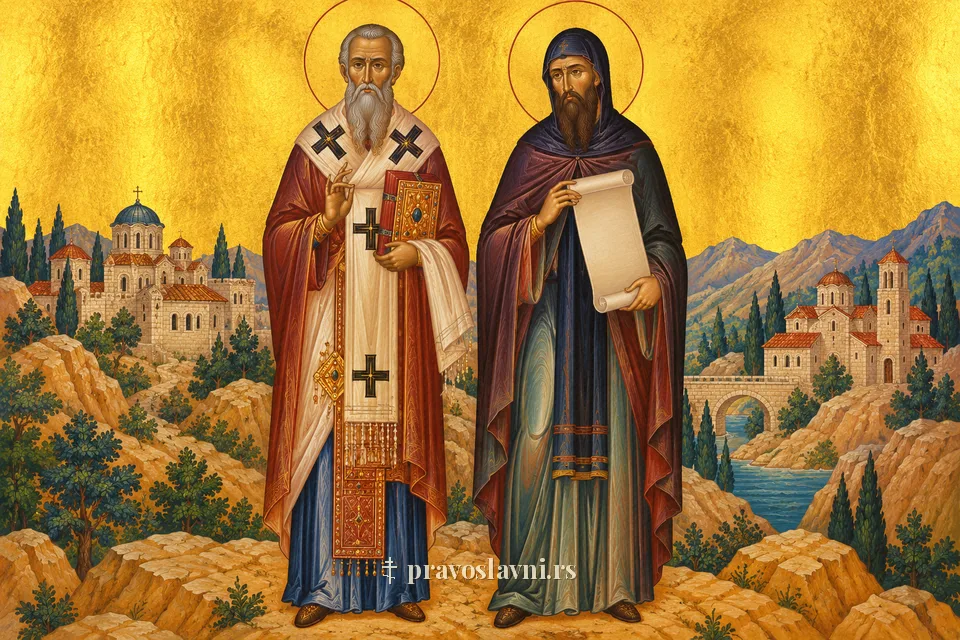
Sts Cyril and Methodius
What happenedThe holy brothers Cyril and Methodius devised a Slavic alphabet of thirty-eight letters and began translating the church books from Greek.
Read the LifeOrthodox Calendar · 11 May according to the Julian calendar
Monday, 24 May 202711 May (according to the Julian calendar)Save your slava — you'll get a reminder a week and a day before.
Send a greeting card →What happenedThe holy brothers Cyril and Methodius devised a Slavic alphabet of thirty-eight letters and began translating the church books from Greek.
Read the Life
You may eat meat, eggs, milk and dairy products, as well as any other food — but try to be moderate.
More about the fast →
Red Letter day — great feast; by custom, no work is done
More about the feast →
“Yet in the church I would rather speak five words with my understanding, that I may teach others also, than ten thousand words in a tongue.”
— 1 Cor 14:19Sung at the Slava (family patron saint's feast) and on the saint's feast day.
As equal in manner of life to the Apostles and teachers of the Slavic lands, O Cyril and Methodius, wise in God, entreat the Master of all to establish all the Slavic peoples in Orthodoxy and oneness of mind, to pacify the world and to save our souls.
Translation: pravoslavni.rs
The brothers from Thessalonica, the holy Equal-to-the-Apostles Cyril and Methodius, gave the Slavs their letters — an alphabet of thirty-eight letters — and the first translations of the church books from Greek.
The feast is among the Serbian Slavas (family patron saint's day). By folk custom, the faithful go to church on that day, light a candle and ask the holy brothers for help towards progress and good. Schoolchildren, they say, should take a book in their hands, and their studies will go more easily throughout the year. Heavy work and household chores, such as washing the laundry, are left for another day.
The Slavs received the word of God in their own language from two brothers from Thessalonica, Methodius and Constantine, who in monasticism was named Cyril. The Church honours them as Equal-to-the-Apostles.
The brothers were born into the well-to-do and distinguished family of Leo and Maria. The elder, Methodius, spent ten years among the Slavs and then became a monk on Olympus, where his younger brother later joined him. Constantine, according to his Life, was very learned, knew Greek, Latin and Syriac, and because of this they called him the Philosopher.
When the khagan of the Khazars asked the Emperor Michael for preachers, the brothers were sent, and many Khazars were baptised. The Prologue says that, on their return to Constantinople, they composed a Slavic alphabet of thirty-eight letters and began to translate the church books from Greek. At the invitation of Prince Rastislav they came to Moravia, where they strengthened the faith and entrusted the books to the priests for the instruction of the young.
An invitation from the Pope of Rome took them to Rome, where Cyril died in the year 869 after an illness; Methodius then continued the work in Moravia right up to his death in the year 885. Their disciples, the Five Disciples with Bishop Clement, crossed the Danube and carried on the work from Ohrid.
The work of the holy brothers outlived them: the letters and books that they gave to the Slavs bear fruit among the Slavic peoples to this day.
Methodius and Constantine were born in Thessalonica, into a well-to-do and distinguished family. Their father's name was Leo — the Life says that he was a centurion — and their mother's Maria. Methodius was the elder, and Constantine the younger; he received the name Cyril later, as a monk.
Methodius spent ten years among the Slavs. The Prologue says that he served as an officer among the Macedonian Slavs and that he learned their language at that time, and the Life that he was governor of Slavinia under the Emperor Theophilus. Then he withdrew to Olympus and became a monk, and Constantine later joined him there.
The Life tells more about Constantine. While still a child he dreamed that he was choosing Sophia, Wisdom, as his bride, and he studied Gregory the Theologian. In Constantinople he studied grammar, Homer, geometry, dialectic and philosophy, and among his teachers were Leo and Photius; he also studied rhetoric, arithmetic, astronomy and music. He knew Greek, Latin and Syriac, and they named him the Philosopher.
He did not accept the marriage that was offered to him; instead he received the priesthood and was given the post of librarian at Hagia Sophia. He went away secretly to a monastery, and when they found him after six months, he taught philosophy in the capital. According to the Life, he debated with the deposed iconoclast Patriarch John about icons and the Cross, and at the age of twenty-four he was sent to the Saracens in Samarra, where he held disputations and survived a poisoned drink.
The Khazar khagan asked the Emperor Michael for preachers, and the emperor sent the brothers. In Cherson Constantine, according to the Life, learned Hebrew and translated parts of a Hebrew grammar, and he also found a Gospel and a Psalter written in “Russian” letters. Together with George, the Bishop of Cherson, they found the relics of St Clement of Rome, a part of which they later took to Rome. Among the Khazars they baptised, as the Prologue says, the khagan himself, and with him many nobles and people — according to the Life, about two hundred Khazars.
The Prologue goes on to tell that the brothers, having returned to Constantinople, composed a Slavic alphabet of thirty-eight letters and began to translate the church books from Greek. Prince Rastislav invited them to Moravia. There they strengthened the faith and multiplied the books, and gave them to the priests as a means of teaching the young. Then, at the pope's invitation, they went to Rome, where Cyril fell ill and reposed on 14 February 869. Methodius continued the work in Moravia, to which he returned, right up to his death on 6 April 885.
Their work was continued by their disciples, the Five Companions, led by Bishop Clement: they crossed the Danube to the south, into Macedonia, and continued the work from Ohrid. The Church honours the holy brothers as Equal-to-the-Apostles.
Cyril and Methodius gave the Slavs letters and the word of God in their own language. Their work has outlived them through their disciples and still bears fruit among the Slavic peoples.


