Saint of the day
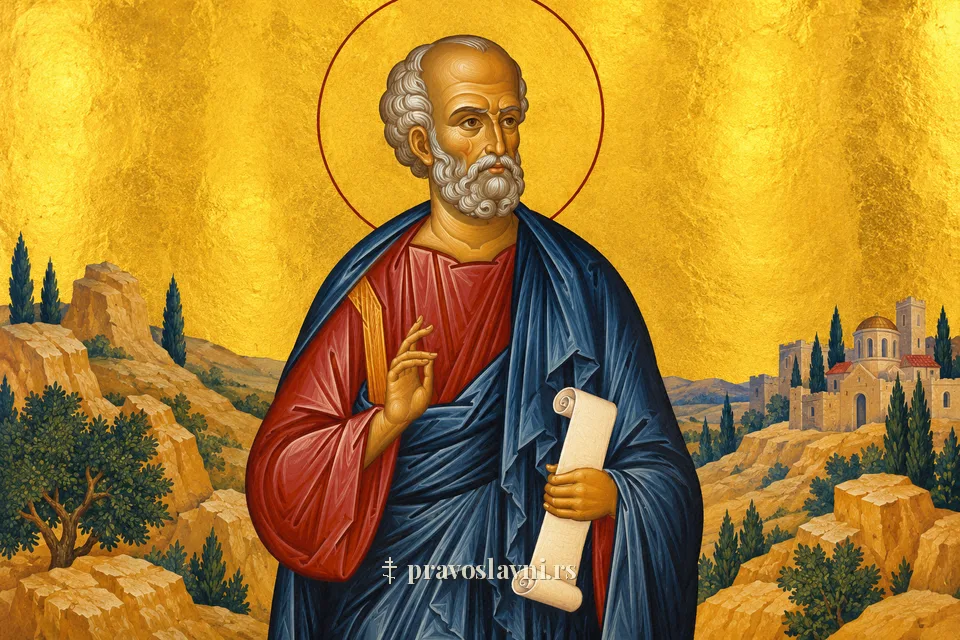
Holy Apostle Simon the Zealot
What happenedSimon was the bridegroom at the wedding in Cana of Galilee, and when Christ turned the water into wine, he left everything and followed Him.
Read the LifeOrthodox Calendar · 10 May according to the Julian calendar
Sunday, 23 May 202710 May (according to the Julian calendar)What happenedSimon was the bridegroom at the wedding in Cana of Galilee, and when Christ turned the water into wine, he left everything and followed Him.
Read the Life
You may eat meat, eggs, milk and dairy products, as well as any other food — but try to be moderate.
More about the fast →
Today the Church keeps the commemoration of a saint · Sunday — a festive day · Fourth Sunday of Pascha – Sunday of the Paralytic.
More about the feast →
“This beginning of signs Jesus did in Cana of Galilee, and manifested His glory; and His disciples believed in Him.”
— Jn 2:11“Zealot means one who is zealous” — with these words the Prologue explains the surname of the Apostle Simon, who set out after Christ from his own wedding.
Simon was from Cana of Galilee, and his Life says that, since Cana is not far from Nazareth, he knew Christ and His Mother personally. At the wedding at which he was the bridegroom, the guests were Jesus, His Mother and the disciples. When the wine ran out, Christ turned water into wine. The miracle moved him: he left his house, his bride and, according to the Prologue, his parents, in order to follow the Lord. He was numbered among the Twelve, and he bore the name Zealot because of the fervour with which he served the Saviour and the Gospel.
Together with the apostles he received the Holy Spirit, according to his Life in the form of tongues of fire, and then he preached in Mauritania in Africa; the Life adds Britain as well. He brought many to the faith. Unbelievers inflicted torments on him and in the end, as once they had done to his Lord, crucified him on a cross. The Akathist, a hymn in his honour written down alongside the Life, states that he was crucified in Iberia and buried at Pitsunda. According to the Akathist, monks from the Holy Mountain (Mount Athos) came to the restored monastery that bears his name, and healings are granted at his relics.
Simon bears witness that a single meeting with Christ can turn a whole life around, when a person does not hesitate to follow Him.
The Holy Apostle Simon was from Cana of Galilee. The Life notes that Cana is not far from Nazareth, and so Simon knew Christ and His Mother personally. At the wedding in Cana, at which Simon was the bridegroom, Jesus, His Mother and the disciples were among the guests. The wine ran out, and Christ turned water into wine.
That miracle decided Simon's life. He left his home, his bride and — as the Prologue adds — his parents, and followed Christ. He became one of the Twelve Apostles.
He received his name on account of his zeal. “Zealot means one who is zealous,” says the Prologue; he was called this because he burned with zeal for the Saviour and His Gospel, as both sources explain. With the other apostles he received the Holy Spirit — the Life says, in the form of tongues of fire.
He preached the Gospel in Mauretania in Africa, and the Life says that he also preached in Britain. He converted many to the Christian faith. Like his Teacher, he ended his life on a cross, after unbelievers had first tortured him.
The Akathist, a hymn in his honour written down on the page of the Life, adds more lands: Egypt, Syria, Spain, Persia, Armenia and Iveria, and sings that he tamed the wildness of the Britons. According to the Akathist, he was crucified in Iveria and buried in Pitsunda, and he is called the founder of the Iverian Church. The Akathist also sings of how at the Dormition of the Theotokos he was brought on a cloud to receive her blessing and how he saw her empty tomb in Gethsemane.
The Akathist also sings of the monastery that bears his name: it has been restored, and monks from the Holy Mountain have come to it. According to the Akathist, at the apostle's relics the faithful receive healings.
A single meeting with Christ in Cana turned a bridegroom into an apostle. Simon did not hesitate: he left everything at once and gave his zeal to the Gospel, even to a martyr's death.
Venerable Isidora was a nun in the women's monastery of Tabennisi; the Prologue says that she lived in the fourth century, and her Life that there were forty sisters in the monastery. She pretended to be mad, so that no one would notice how greatly she laboured in asceticism and how virtuous she was. Her Life says that on her head, instead of the black covering that the others wore, she had an ordinary rag. She ate only leftovers and crumbs, and according to her Life she even drank the water in which the dishes had been washed. She did the dirtiest work and served everyone from morning till dark. All the sisters despised her, and her Life says that, though insulted and beaten, she never answered back or complained. An angel revealed her secret to the great ascetic Pitirim, telling him, according to her Life, that she was greater than he, because in contempt she served everyone while remaining faithful to God. Pitirim came to the monastery, and when the sisters brought from the kitchen the one they called mad, the elder fell face down before her and asked her to bless him, and she answered him with the same bow. To the sisters he said: “You are the mad ones; and she is better even than you”, and he prayed that at the Judgement he might be found equal to her. The sisters repented and asked forgiveness, and from then on they all honoured her. In order to escape from honour, after a few days she secretly left the monastery, and where she reposed is not known; the Prologue gives about the year 365.


