Feast of the day
Translation of the Relics of St Nicholas the Wonderworker
What happenedThe relics of St Nicholas were taken from the devastated city of Myra in Lycia to the Italian city of Bari, where healings soon began.
Read the LifeOrthodox Calendar · 9 May according to the Julian calendar
Saturday, 22 May 20279 May (according to the Julian calendar)Save your slava — you'll get a reminder a week and a day before.
Send a greeting card →What happenedThe relics of St Nicholas were taken from the devastated city of Myra in Lycia to the Italian city of Bari, where healings soon began.
Read the Life
You may eat meat, eggs, milk and dairy products, as well as any other food — but try to be moderate.
More about the fast →
Many families celebrate their Krsna slava (family patron saint's day) today
More about the feast →
“For we are to God the fragrance of Christ among those who are being saved and among those who are perishing.”
— 2 Cor 2:15Sung at the Slava (family patron saint's feast) and on the saint's feast day.
The day of bright festival hath come: the city of Bari rejoiceth, and with it the whole world exulteth in hymns and spiritual songs; for today is the sacred festival of the translation of the precious and much-healing relics of the hierarch and wonderworker Nicholas, which hath shone forth like the unsetting sun with radiant beams, dispelling the darkness of temptations and misfortunes from them that cry with faith: Save us, as our great intercessor, O Nicholas.
Translation: pravoslavni.rs
One hundred and eleven people healed — that, according to the Life, is how many there were when St Nicholas appeared to a certain monk in Bari and said that he had come to that city by the will of God.
Until the year 1087 his relics rested at Myra in Lycia. When the Muslims, according to the Life from Cherson to Antioch and Jerusalem, were laying the lands waste, Myra was left desolate, and the holy shrine was left with no one to care for it. The Life says that God allowed this so that the relics would not remain without honour and so that the West too would receive the saint's blessing. The translation took place in the time of the Emperor Alexius Comnenus and Patriarch Nicholas Grammaticus.
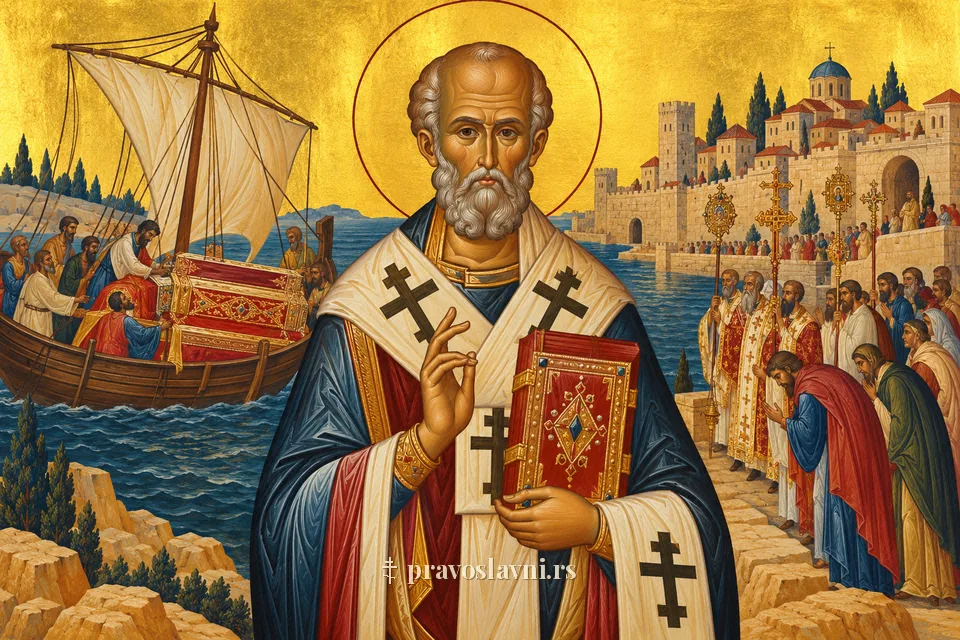
The prompting came from the saint himself, who appeared in a dream to a respected priest of Bari, a city which at that time, according to the Prologue, was Orthodox. The Life describes how the men of Bari, in the guise of grain merchants, arrived at Myra, where the monks showed them the tomb, and how they brought the relics, from which myrrh was flowing, to Bari on the evening of 9 May. The city received them solemnly and placed them in the church of St John the Forerunner by the sea, and in the third year, again on 9 May, they were translated to the new church of St Nicholas. For this reason the feast, as the Life explains, commemorates two translations.
The healings began in the very first days: the lame, the blind, the deaf and the possessed were made well. The myrrh from the relics, the Life says, flows to this day. On the same day the Prologue also remembers the Serbian King Stefan Dečanski, to whom St Nicholas restored his sight after five years of blindness.
St Nicholas is not bound to one place. When his resting place was laid waste, he himself led his relics to a new home, and from there healing spread to many.
The feast which the Church celebrates on 9 May (according to the Julian calendar) remembers, according to the Life, two translations of the same relics. The first was in the year 1087, in the time of the Emperor Alexius Comnenus and Patriarch Nicholas Grammaticus: the relics of St Nicholas were translated from Myra in Lycia — in the Prologue, Myra of Lycia — to Bari, in Italy, and placed in the church of St John the Forerunner by the sea. The second translation took place in Bari itself, when the citizens built for the saint a large and richly adorned church, and prepared for the relics a gilded silver reliquary set with precious stones. In the third year after their arrival, again on 9 May, archbishops and bishops translated them there and placed them in the altar. A part of the hand, according to the Life, remained in the old reliquary, in the first church.
The Prologue and the Life state that the occasion for the translation was a Muslim invasion; the Life calls them Ishmaelites and says that they ravaged the lands from Cherson to Antioch and Jerusalem and destroyed cities, churches and monasteries. In deserted Myra, according to the Life, the saint's relics were left without care and honour. In all this the Life sees God's purpose: that the holy thing should not remain neglected and that the saint's blessing should reach the West as well.
The prompting, according to both sources, was given by the saint himself. He appeared in a dream to a respected priest in Bari and instructed that the relics be translated to that city. The Prologue notes that Bari was Orthodox at that time and that it came under an Orthodox patriarch.
According to the Life, the priest laid his vision before the clergy and the people, and three ships set out on the journey, and the men on them, among whom there were also priests, were chosen for their piety and presented themselves as grain merchants. They sold the grain in Antioch and there heard that the Venetians too were preparing for the same undertaking, so they made haste, and they entered Myra armed, because they expected resistance. The tomb beneath the paved floor of the church was shown to them by four monks, two of whom set out with the relics for Italy. From 11 April until the evening of 9 May the relics were on their way, and in Bari they were solemnly received by bishops, clergy, monks and the people.
“At the translation of the saint's relics many miracles take place,” says the Prologue. The Life records that myrrh from the relics filled the reliquary while still in Myra and that the men of Bari collected it, and that it flows to this day and is given to the sick; both sources bear witness to many miracles from touching the relics and the myrrh.
The Life even counts the healings in Bari: first forty-seven people, then twenty-two and twenty-nine, among them the lame, the blind, the deaf and the possessed, and then also a deaf-mute who had been ill for five years. The saint himself, according to the Life, appeared to a certain monk and said that he had come by God's will and that he had healed a hundred and eleven people, and in a later vision he asked that his relics should rest beneath the holy altar table.
On the same day the Prologue also remembers the Serbian King Stefan Dečanski, to whom St Nicholas restored his sight after five years of blindness.
The saint himself took care that his relics should not remain in neglected Myra and led them to a new home, from where healing spread to many. His intercession is not tied to one place.
The holy prophet Isaiah was born in Jerusalem and was of royal descent: his father Amoz was the brother of Amaziah, King of Judah. His Life places him at about 760 years before Christ, while the Prologue says that he prophesied about 700 years before Christ; according to his Life, he prophesied in the days of the kings Uzziah, Jotham, Ahaz, Hezekiah and Manasseh. He saw the Lord of hosts on a high throne, surrounded by six-winged seraphim who, according to the Prologue, cried out: “Holy, holy, holy is the Lord of hosts.” His Life says that a seraph cleansed his lips with a live coal and that he was then sent to the people, and that he lived in voluntary poverty, wore sackcloth and fasted. In order to warn the people to rely on God, and not on Egypt and Ethiopia, he walked naked through Jerusalem for three days. He foretold the attack of Sennacherib, and according to his Life he healed King Hezekiah and promised him fifteen more years of life. He prophesied the Incarnation, the conception by the Virgin, John the Forerunner and events from the life of Christ. By his prayer the besieged and thirsty Jerusalem received water, which flowed from beneath Mount Zion; the spring was named Siloam, which means “sent”, and in it, later, at the word of Christ, the man born blind washed. Under King Manasseh he denounced pagan customs and compared the elders to Sodom and Gomorrah. The price of that boldness was his life: the prophet was taken outside the city and put to death with a saw. His Life says that he was buried near the spring of Siloam. Isaiah stood by the truth of God before kings and clearly foretold Christ, and he paid for his witness with his life.
Separate page: Holy Prophet Isaiah →
In Spain, according to the Prologue, the holy martyr Christopher is especially venerated; the faithful call upon this great wonderworker when pestilence and plague threaten. His Life says that before his baptism he was called Reprebus and that he was taken prisoner in war. According to his Life, he was unable to speak, but after he had prayed an angel touched his mouth and he began to speak. He denounced the pagans who persecuted Christians, and so the governor Bacchus beat him. Under the Emperor Decius two hundred soldiers were sent to bring him in, and on the way, when they saw how his dry staff blossomed and how he multiplied their little bread, they came to believe. In Antioch Bishop Babylas baptised him and the soldiers, and it was then that he received the name Christopher. The Emperor, according to his Life, sent two women, Callinica and Aquilina, to seduce him, but he converted them, and they too suffered as martyrs; the two hundred converted soldiers were also put to death. His Life records that he remained unharmed on a red-hot iron bed, which brought many of those who were watching to the faith, and that an angel delivered him from the well into which he had been thrown with a stone. In the end he was beheaded; the Prologue says that he suffered for Christ and was glorified in the year 249. Peter, who was bishop in Attalia, ransomed the martyr's body, according to his Life, and buried it there.