Saint of the day
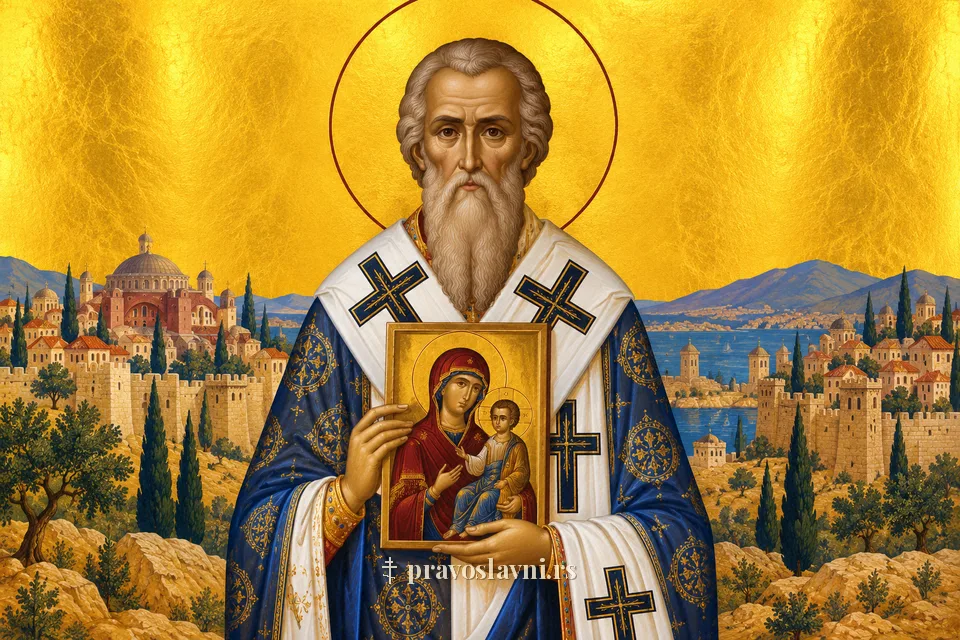
Venerable Michael the Confessor, Bishop of Synnada
What happenedSt Michael, Bishop of Synnada, chose to go into exile and poverty rather than renounce the veneration of the holy icons.
Read the LifeOrthodox Calendar · 23 May according to the Julian calendar
Saturday, 5 June 202723 May (according to the Julian calendar)What happenedSt Michael, Bishop of Synnada, chose to go into exile and poverty rather than renounce the veneration of the holy icons.
Read the Life
You may eat meat, eggs, milk and dairy products, as well as any other food — but try to be moderate.
More about the fast →
Today the Church keeps the commemoration of a saint · not a Red Letter day.
More about the feast →
“And he prayed again, and the heaven gave rain, and the earth produced its fruit.”
— Jas 5:18When Emperor Leo the Armenian persecuted the Church on account of the icons, Michael, Bishop of Synnada, did not keep silent. According to his Life, he publicly denounced the heretics, and before the imperial court he declared that he honours the icons and bows down before them, while he considers the emperor's order worthy of contempt. His Life records his words: “I honour the holy icons of my Saviour Jesus Christ and of the Most Pure Virgin”.
The emperor had already driven out Patriarch Nicephorus and the Orthodox bishops, and Michael, for his faithfulness to the icons, was deprived of his see and sent into exile. According to his Life, they moved him from place to place, and he died in the year 818, poor and in want, faithful to Orthodoxy to the end.
He served Christ from childhood. His Life says that as a young man he became a monk together with Theophylact of Nicomedia. From those years both sources remember a miracle with water in a time of drought: according to the Prologue they obtained rain by their prayers, while according to the Life a copper vessel in which there was no water began to give it. Valuing his ascetic labour and his virginal purity, Patriarch Tarasius appointed him Bishop of Synnada. The Prologue adds that he took part in the Seventh Ecumenical Council and was the emperor's envoy for the peace negotiations with Caliph Harun al-Rashid.
His Life says that he received a double crown, as a hierarch and as a confessor. His life teaches that faithfulness to the truth is worth more than an emperor's favour.
When iconoclasm gained strength once more, Michael, Bishop of Synnada, did not consent to keep silent. According to his Life, he denounced the heretics publicly, so he was brought before the court of the Emperor Leo the Armenian. There, as his Life records, he declared that he honoured the holy icons and bowed down before them, and that he considered the Emperor's order worthy of contempt. His Life also preserves his words: “I honour the holy icons of my Saviour Jesus Christ and of the Most Pure Virgin”.
The Emperor was already persecuting the Church and had sent Patriarch Nicephorus and the Orthodox bishops into exile. The same awaited Michael: since he would not renounce the icons, his see was taken from him, and he himself was banished. His Life says that they moved him from place to place and that he endured many torments. He died in the year 818, poor and in want, but unshaken in Orthodoxy.
His Life explains the background. The Seventh Ecumenical Council condemned the iconoclast heresy, but after the death of Patriarch Tarasius, in the time of the holy Patriarch Nicephorus, it raised its head again. The Prologue records that Michael himself took part in that council.
Michael served Christ from childhood. His Life says that he received the monastic tonsure while still a young man, together with Theophylact of Nicomedia, and that Patriarch Tarasius sent them to a monastery on the shore of the Black Sea. The same patriarch later, valuing his ascetic struggle and virginal purity, chose him and consecrated him Bishop of Synnada, and Theophylact, according to his Life, Metropolitan of Nicomedia. Of both of them his Life says that they were good shepherds of Christ's flock. The Prologue also records that the Emperor entrusted him with a mission of peace: Michael negotiated in the Emperor's name with the Caliph Harun al-Rashid.
Both sources also remember a miracle from his years of ascetic struggle. The Prologue says that in a drought Michael and Theophylact obtained rain by their prayer. His Life, however, tells of a harvest in great heat, when from a copper vessel, empty until then, there flowed as much water as they needed. His Life compares that miracle with the water that God gave from the rock in the wilderness and with the water from the jawbone that Samson received.
His Life says that Michael received a double crown, as a hierarch and as a confessor. He chose exile and poverty rather than the Emperor's favour, because faithfulness to Orthodoxy was dearer to him than anything else.


