Friday04June 202722 May (according to the Julian calendar)‹›
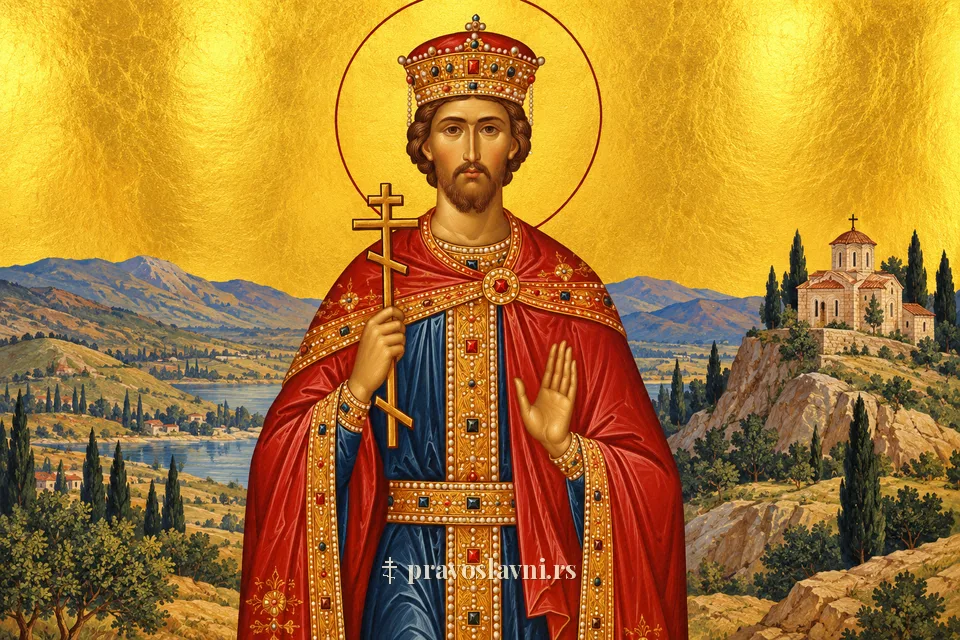
Illustration
Saint of the day
Holy Martyr Jovan Vladimir, Prince of Serbia
What happenedSt Jovan Vladimir, the meek ruler of Duklja, asked that a wooden cross be sent to him by the hands of clergy, and then suffered a martyr's death at the hand of a traitor.
“No one takes it from Me, but I lay it down of Myself. I have power to lay it down, and I have power to take it again. This command I have received from My Father.”
When Ivan Vladislav treacherously summoned him, St Jovan Vladimir, according to his Life, refused gold and silver, because Christ was crucified on wood. He asked that a wooden cross be brought to him by men in holy orders, and Vladislav sent two bishops and one hermit with the cross.
Vladimir came of a princely family, and the Prologue and his Life call him King of Serbia. According to his Life, he ruled Duklja, with his seat at Krajina on Lake Skadar. He was a wise and merciful ruler, he built churches and fought against heretics and Bogomils, and the Life says that towards the Bogomils he used mercy and his knowledge of Holy Scripture, and in this way brought them back to Orthodoxy.
When the Bulgarian Tsar Samuel attacked his land, Vladimir was tricked and ended up in a dungeon. There an angel appeared to him and foretold his martyrdom. Samuel's daughter Kosara came to love him and begged his freedom from her father, and Samuel gave her to him as his wife. The Life adds that he also gave him back his land, and that Vladimir and Kosara, at his prompting, lived in chastity. According to the Life, in a grove near his town he saw an eagle carrying a shining cross; on that spot he built a church and placed the cross in it.
Later Samuel's successor, Gavril Radomir, was killed by his kinsman Ivan Vladislav, who then summoned Vladimir as well. According to the Life, at Prespa Vladislav's sword at first could not harm him, and so Vladimir himself handed over his own sword and was beheaded with the words: “Into Your hands, O Lord, I commit my spirit!” He was killed in the year 1015. According to the Life, three years later Vladislav perished beneath the walls of Drač (Dyrrachium), after catching sight of an armed warrior who looked like St Vladimir.
According to the Life, Kosara carried his incorrupt body to Krajina, where she herself also became a nun. The incorrupt relics are today in the Monastery of St John near Elbasan, where many miracles have been recorded. The Life says that his cross is kept at Velji Mikulići near Bar and that every year it is carried up to the summit of Mount Rumija. The meek ruler laid down his life as a good shepherd, and God glorified him with miracles.
Full Life
A meek ruler
St Jovan Vladimir came from a princely family: his grandfather was Hvalimir, and his father Petrislav. The Prologue and his Life call him King of Serbia. The Prologue says that he was from Zahumlje, and according to his Life he ruled Zeta, that is Duklja, then Zahumlje and Prevala, with his seat in Krajina, beside the church of the Most Pure Virgin Mary, on the western side of Lake Skadar. He began to rule, according to his Life, in the second half of the 10th century.
He ruled wisely and mercifully, built churches and struggled against heretics and Bogomils. His Life says that towards the Bogomils he used mercy and knowledge of Holy Scripture and in this way brought them back to Orthodoxy, and that he built monasteries, hospitals and guesthouses. It describes him as a meek, humble and God-fearing man, and he is also praised by the Priest of Duklja and by the Byzantine historian Cedrenus, according to whom he was just, peace-loving and full of virtues.
The prison and Kosara
Tsar Samuil of Bulgaria attacked his land. According to his Life, Vladimir withdrew with his army to Mount Oblik, which is also called Kosogor, and said to the army: “The good shepherd gives his life for his sheep.” His Life says that there were poisonous snakes on Kosogor, but that after his prayer they no longer bit anyone. He was taken captive through deceit, for, as his Life says, the prince of that place betrayed him, and Samuil kept him in prison, according to his Life in Prespa. There an angel appeared to him and foretold his martyrdom; according to his Life, the angel also told him that he would be set free.
Samuil's daughter Kosara, whom the Life also calls Theodora, came to love him and begged her father to set him free. Samuil gave her to him as his wife; the Life adds that he gave him back his land and added Drač (Durrës) to it, and gave Trebinje back to his uncle Dragimir. According to the Life, at Vladimir's urging they lived in chastity.
His Life also records a sign: in a grove near his town he saw an eagle that was carrying a shining cross and set it down on the ground. On that spot he built a church and placed the cross in it.
The wooden cross
Samuil's successor was Gavrilo Radomir. He was killed by his kinsman Jovan Vladislav, who then treacherously invited Vladimir to come to him. His Life says that Vladimir recalled that Christ was crucified on wood, so he wanted neither gold nor silver, and asked that a wooden cross be sent to him by the hands of clergy. Vladislav sent two bishops and a hermit with a wooden cross.
In Prespa, according to his Life, Vladislav's sword at first could not wound him. Then Vladimir himself handed over his own sword, saying that he was ready to die, and he was beheaded with the words: “Into Your hands, O Lord, I commit my spirit!” He was killed in the year 1015, according to his Life on 22 May by the old calendar.
The relics and the cross
According to his Life, the bishops and clergy buried him in a church beside Lake Prespa, where healings took place, and a light used to appear over the grave. Kosara was allowed to translate the body to Krajina, to the church of the Most Holy Theotokos; it was incorrupt and fragrant, with the cross in its hand. Kosara became a nun there and was buried beside her husband. Vladislav, according to the Life, perished before Drač in the year 1018, after he caught sight of an armed warrior who looked like St Vladimir.
His Life says that around the year 1215, in the time of Stefan the First-Crowned, the relics were translated to Drač, and afterwards to the monastery of St John near Elbasan, whose church was restored in 1381 by the Albanian nobleman Karl Thopia. The holy body, incorrupt, is kept to this day in the monastery of St John beside Elbasan, where many miracles have taken place over it. In the year 1925 a church of which he is the ktetor (founder) was built at the monastery of St Naum on Lake Ohrid.
His Life also speaks of his cross of yew wood, which was covered in silver in the late 16th century. It is kept by the Andrović family from Velji Mikulići near Bar and carried every year to the summit of Rumija, and since 1999 the cross has been displayed in the church of St Nicholas in Velji Mikulići. His Life also mentions Vladimir's endowment (zadužbina) on Rumija, the church of the Holy Trinity, which the Turks pulled down; it was built again in the year 2005
St Jovan Vladimir laid down his life as a good shepherd and chose the wooden cross of Christ, and God glorified him with incorrupt relics and miracles.
Other saints of the day
Holy Martyr Basiliscus
According to the Prologue, St Basiliscus was a kinsman of St Theodore the Tyro. He was imprisoned with Eutropius and Cleonicus, who were crucified before him, while he remained a prisoner for a long time. He prayed that he might end his life as a martyr. The Lord appeared to him, assured him that his prayer would be heard, and allowed him to go home and see his mother and brothers for the last time. Under the governor Agrippa many came to believe in Christ because of the miracles which God worked through him on the way. Called upon to offer sacrifice to Apollo, he refused, and according to the Prologue he said: “Apollo means destroyer!” At his prayer the idol was shattered, and fire from heaven burned down the temple. Agrippa put this down to sorcery and ordered that he be beheaded in Comana. Afterwards Agrippa went mad, found a little of the martyr's blood, was healed by it and became a Christian. Marinus, a man of that city, built a church over his relics, where many were healed.