Thursday03June 202721 May (according to the Julian calendar)‹›
Illustration
Great feast
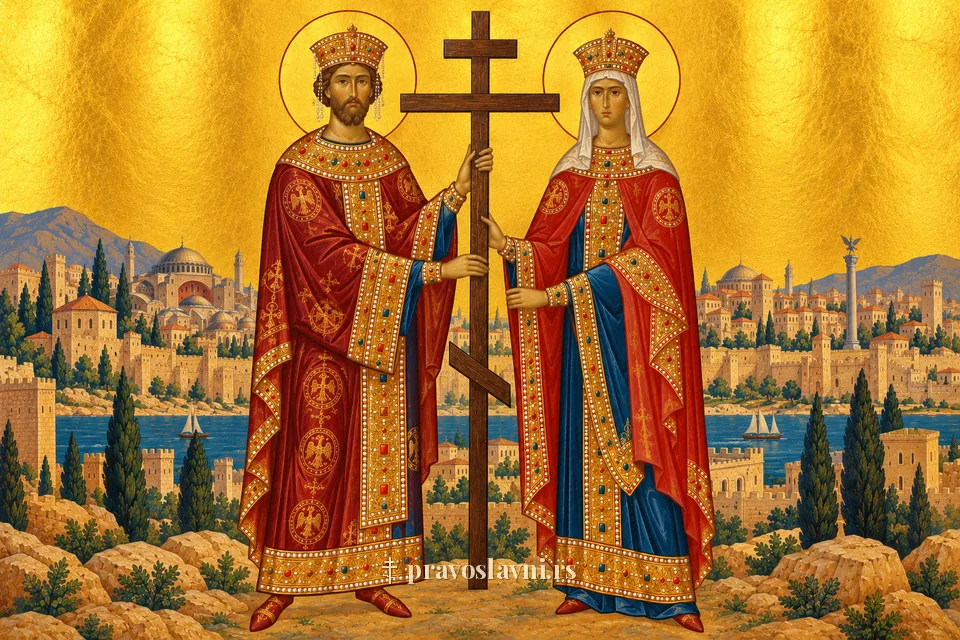
Holy Emperor Constantine and Empress Helen
What happenedThe holy Emperor Constantine put an end to the persecution of Christians and convened the First Ecumenical Council, and his mother, Empress Helen, found the Precious Cross in Jerusalem.
Sung at the Slava (family patron saint's feast) and on the saint's feast day.
Having beheld the image of Thy Cross in the heavens, and like Paul having received his calling not from men, Thine apostle among kings, O Lord, placed the reigning city in Thy hand: preserve it ever in peace through the prayers of the Theotokos, O only Lover of mankind.
On this day the Church celebrates the Holy Emperor Constantine and his mother, Empress Helen. Constantine was called Equal-to-the-Apostles while he was still alive.
The faithful, by folk custom, go to church on that day, light a candle in memory of all the martyrs and, as far as they can, devote the day to prayer. By folk custom, in Niš this is the city's Slava (patron saint's day), because Constantine was born in that city. By folk custom, silversmiths (kujundžije) and railway workers keep this feast as their guild Slava.
Before the battle with Maxentius, the tyrant in Rome, Emperor Constantine saw in the sky a shining cross of stars with the inscription “By this, conquer!” He ordered such a cross to be made and carried before his army, and he defeated an enemy far greater in number. Maxentius drowned in the Tiber, and Constantine entered Rome as victor.
He was the son of Constantius and Helen. According to his Life, he grew up at the court of Diocletian in Nicomedia, and from his father, who did not serve idols, he learned to be well disposed towards Christians. In the year 313, in Milan, he issued the edict by which the persecution of Christians came to an end. He fell ill with leprosy, and the cure proposed to him by the pagan priests, bathing in the blood of children, he would not even hear of. The Apostles Peter and Paul then directed him to Bishop Sylvester. According to the Prologue he was baptised by Sylvester, while according to his Life the baptism was postponed; he was healed of the leprosy. In the year 325 he summoned the First Ecumenical Council in Nicaea, which condemned Arius and confirmed the Orthodox faith.
His mother, Empress Helen, went to Jerusalem and found the Precious Cross of the Lord. According to the Life, she found the Tomb of the Lord buried under earth, and on the hill a temple of Venus, which she ordered to be pulled down. The Life says that three crosses were found, and that the true one was recognised when a dead man laid upon it came back to life. The old man Judas, who, according to the Life, showed where the Cross lay, was baptised as Cyriacus. According to the Life, the first Exaltation of the Cross took place in the year 326, and since then the Church has celebrated it on 14 September. The Church of the Resurrection on Golgotha and many other churches in the Holy Land are her work.
On the Bosphorus, on the site of ancient Byzantium, Constantine raised a new capital, Constantinople. Helen reposed in the year 327, in her eightieth year, and Constantine ten years after her, in Nicomedia, in his sixty-fifth year. He was buried in the Church of the Holy Apostles in Constantinople, which, according to his Life, he himself had built. The first Christian emperor put a stop to the persecution and defended Orthodoxy, and his mother found the Cross of the Lord and adorned the Holy Land with churches.
Full Life
An emperor under the sign of the cross
Constantine was the son of Constantius and Helen. The Prologue says that Constantius also had children from another marriage, and with Helen only Constantine. According to his Life, he grew up at the court of Diocletian in Nicomedia as a pledge of his father's loyalty. His father did not serve idols, so from childhood he learned to be well disposed towards Christians. His Life says that after his father's death, in the year 306, he was proclaimed Emperor of Gaul and Britain.
The Prologue mentions three great wars that he waged: with the Byzantines, with the Scythians on the Danube and with Maxentius, who was tyrannising Rome. Before the battle with Maxentius he saw in the sky a shining cross of stars with the inscription “By this, conquer!” His Life places this in the year 312 and says that before it he had prayed to God, and that Christ then appeared to him in a dream and commanded him to make the sign of the cross and carry it before the army. Constantine had a cross made such as he had seen and carried it before the army; according to his Life, the sign was also put on the banners, shields and helmets. He defeated a much more numerous enemy, and Maxentius drowned in the Tiber; his Life says that the bridge collapsed by the power of God. Constantine entered Rome as victor.
In the year 313, in Milan, he issued the edict by which the persecution of Christians ceased. His Life adds that he abolished crucifixion and the bloody games of the circus and returned to the Church the property that had been taken from her.
Healing and faith
Constantine fell ill with leprosy. The remedy that the pagan priests offered him was to bathe in the blood of children, and Constantine rejected it. According to his Life, he said: “It is better that I alone should bear the illness than that I should shed the blood of so many little children.” The way to healing was shown to him by the Apostles Peter and Paul, who appeared to him and directed him to Bishop Sylvester, who according to his Life was hiding on Mount Soracte. According to the Prologue Sylvester baptised him, while according to his Life the baptism was postponed. He was healed of the leprosy.
His Life also tells of Licinius, Constantine's brother-in-law, who signed the Edict of Milan and then began to persecute Christians. Constantine defeated him at Adrianople in the year 323 and became the sole ruler of the empire.
In the year 325 he convened in Nicaea the First Ecumenical Council, which condemned Arius and confirmed the Orthodox faith. According to his Life, there were 318 bishops at the council and the Symbol of Faith (the Creed) was composed, and Alexander of Alexandria and the deacon Athanasius stood out.
Empress Helen and the Cross of the Lord
Empress Helen went to Jerusalem and found the Precious Cross of the Lord. The Life says that Constantine sent her with gifts and with authority. She found the Holy Land desolate: the Tomb of the Lord was buried under earth, and on the hill stood a temple of Venus. She ordered the temple to be pulled down and the ground to be dug, and Patriarch Macarius served a service of supplication. An old Jew named Judas revealed, according to the Life, that the Cross lay beneath that temple. Three crosses, the inscription and the nails were found, and the Tomb of the Lord and Golgotha were uncovered. The true Cross was recognised when a dead man who was laid upon it came back to life. Judas was baptised with the name Cyriacus and later became Patriarch of Jerusalem. According to the Life, the first Exaltation of the Cross was in the year 326, and since then the Church has celebrated the Exaltation on 14 September.
The Church of the Resurrection on Golgotha is her work, as are many other churches in the Holy Land. The Life lists eighteen, among them those over the cave of the Nativity, on the Mount of Olives, in Gethsemane and at the Oak of Mamre, and it says that she brought the Emperor a part of the Cross and the nails.
The new capital and the end
On the Bosphorus, on the site of old Byzantium, Constantine built a new capital, Constantinople. According to his Life, he built churches in it to the true God, and there were no pagan temples. He also built the Church of the Holy Apostles.
Helen reposed in the year 327, in her eightieth year. Constantine died ten years after his mother, in Nicomedia, in the sixty-fifth year of his life; his Life gives the year 337. According to his Life, his last words were: “Now I feel truly blessed, for I have firm faith that I have partaken of the Divine light.” He was buried, by his own wish, in the Church of the Holy Apostles in Constantinople.
Other saints of the day
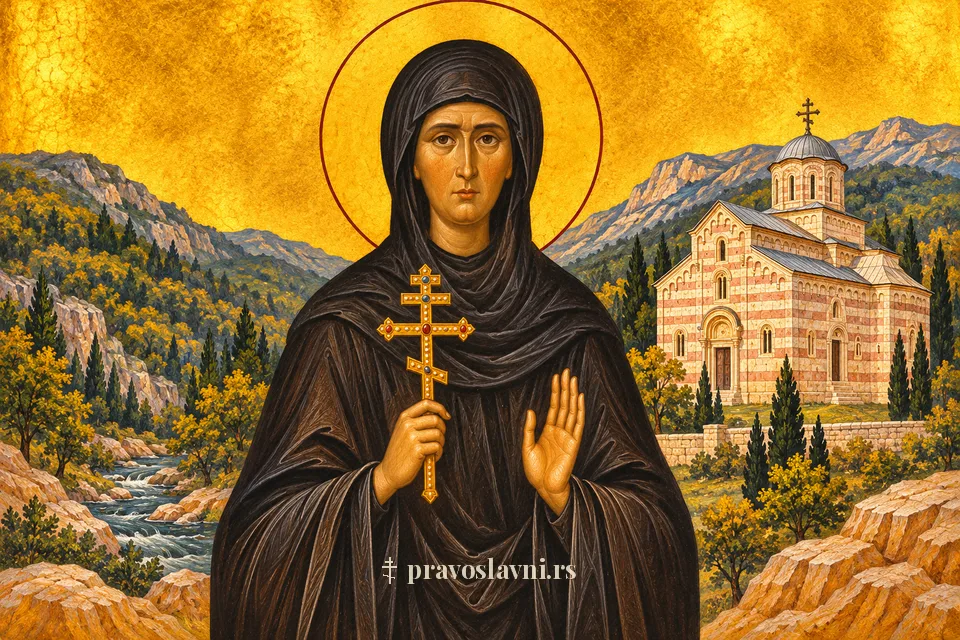
Venerable Jelena of Dečani
The relics of Venerable Jelena rest in Dečani, where she was also buried. Her Life remembers an attack by the Turks on the monastery as well: fire then burst out of two tombs, hers and the tomb of the holy King Stefan, and drove the attackers away. Stefan Dečanski was her brother, and according to her Life her name in the world was Neda. Her monastic path, as her Life describes it, did not begin by her own will. Her husband, the Bulgarian Tsar Shishman, sent her by force to a Bulgarian monastery, because he was looking for a pretext for war with Serbia. She gained her freedom only when the Serbian army defeated Shishman. Then she crossed over into Serbia, received monasticism and the name Jelena, and lived the ascetic life in the hermitages around Dečani. She died in the middle of the fourteenth century; the exact year, her Life says, is not known. Her portrait, preserved to this day, is in the church at Gornji Matejevac near Niš. Budisavci near Klina in Metohija, today a metochion of the Patriarchate of Peć, is according to her Life her endowment (zadužbina); it was built at the same time as Dečani, but is far more modest in size.