Saint of the day
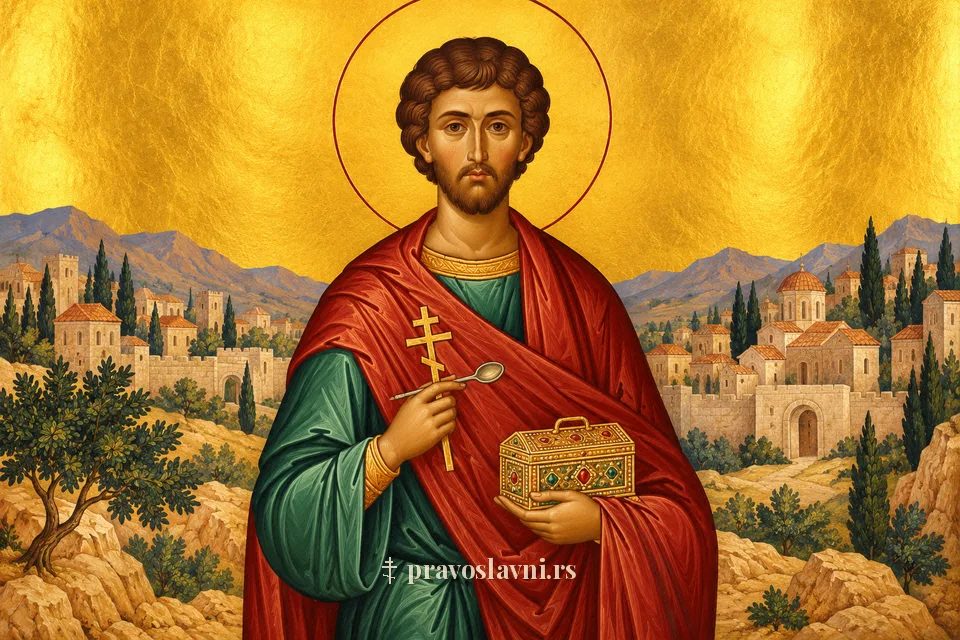
Holy Martyr Thalelaeus
What happenedGod preserved the martyr Thalelaeus, a young physician from Lebanon, amid his torments, and his executioners Alexander and Asterius came to believe in Christ.
Read the LifeOrthodox Calendar · 20 May according to the Julian calendar
Wednesday, 2 June 202720 May (according to the Julian calendar)What happenedGod preserved the martyr Thalelaeus, a young physician from Lebanon, amid his torments, and his executioners Alexander and Asterius came to believe in Christ.
Read the Life
No meat, dairy products, eggs or fish — oil and wine are allowed.
This is a recommendation — for your own fast, consult your priest or spiritual father.More about the fast →
Today the Church keeps the commemoration of a saint · Leavetaking of Mid-Pentecost.
More about the feast →
“And heal the sick there, and say to them, ”The kingdom of God has come near to you.”“
— Lk 10:9The Prologue records that St Thalelaeus begged God not to cut short his torments all at once. The attempts of the torturers remained without success. The water into which they threw him did not drown him, and the wild beasts before which he was brought out, according to his Life a she-bear, a lioness and a lion, did not harm him.
Yet the greatest miracle took place in the hearts of others. Two executioners, Alexander and Asterius, were supposed to hang him on a tree, but God darkened their eyes, and instead of the martyr they lifted up a log. When they were flogged for this, both of them confessed Christ and were beheaded. The judge, who went at the martyr himself, remained unable to move until Thalelaeus prayed for his healing.
Thalelaeus was a young man from Lebanon, eighteen years old, the son of Berucius and Romylia, and a physician by profession. His Life says that he studied medicine under the chief physician Macarius and that he took no payment for healing. He suffered in the time of Emperor Numerian. According to his Life, this was not his first trial: he had already been seized and tortured before, but had managed to escape. He ended his life in the year 284, beheaded by the sword.
The verses of the Prologue sing of the joy with which he bore one torment after another. He who healed bodies without payment became a physician of souls, for by his patience he brought even his own torturers to Christ.
“I am a Christian, my name is Thalelaeus, and I come from Lebanon,” said the martyr, according to his Life, when they brought him out to be tried. To the governor he at once made this clear as well: “I will never offer sacrifice to your gods, nor will I bow down to the demons whom you serve.”
Behind those words stood a young man of eighteen. His parents were Beroucius and Romylia, and his Life adds that his father was a military commander and his brother a subdeacon. Thalelaeus was a physician: according to his Life, he studied medicine under the chief physician Macarius, and he treated the sick free of charge, whatever illness they suffered from. He suffered in the time of the Emperor Numerian.
His Life says that this was not his first trial. When the Christians of Lebanon scattered across the mountains and deserts, he was caught and tortured, but he escaped. They found him again near Anazarbus, under a wild olive tree.
Both sources remember his unusual prayer: he did not ask God for a swift end. The Prologue says that he prayed for the tortures to last, and his Life that he might not die before he had brought the whole martyr's struggle to its end.
They threw him into the water, according to his Life into the sea, and he came back before the judge alive; his Life describes him on the shore, in white clothing. Nor were the wild beasts able to harm him. According to his Life, they were a she-bear, a lioness and a lion, and both sources say that, instead of attacking him, they licked his feet.
The end came in the year 284, when he was beheaded with the sword; his Life says that he prayed before that.
The suffering of Thalelaeus also changed the people around him. The judge ordered the executioners Alexander and Asterius to bore through his legs, pass a rope through them and hang him from a tree. The Prologue mentions the knees, and his Life the ankles. God, however, darkened their eyes, so that, according to both sources, they raised a log onto the tree, convinced that it was the martyr. Punished with scourging, both of them confessed Christ under the blows; the Prologue records their cry: “As our Lord lives, from now on we too become Christians, we believe in Christ, and we suffer for Him!” They were beheaded with the sword.
The judge himself wanted after that to finish what had been begun, but he was overcome by weakness. According to the Prologue, his hands grew stiff, while according to the Life he at first could not rise from his seat, and then his hands withered. He recovered only when Thalelaeus prayed for him.
It went otherwise with the sorcerer Urbicius, who, according to the Life, advised that the martyr be thrown to the wild beasts: the people threw him to the beasts instead.
The verses of the Prologue say that in his tortures he prayed for strength and that he passed joyfully from one torment to the next. The physician who healed bodies free of charge became a physician of souls: his endurance brought to Christ even the people who were torturing him.
Venerable Stefan of Piperi was born in the region of Nikšić. As a young man, according to his Life, he went to the Morača Monastery, whose church is dedicated to the Dormition of the Most Holy Theotokos, and there he became a monk, and afterwards a hierodeacon and a hieromonk. Later he became abbot of Morača. The Turks drove him out of there; his Life says that in the seventeenth century Turks and Albanians attacked the monastery and threatened to kill him, so he withdrew, and the brotherhood chose a new abbot. He found shelter in Rovca; that place bears the name Ćelište to this day, and his Life says that his cell was a small cave. His Life says that he spent seven years there; his food, nothing but dry bread, was brought to him by shepherds, and the apparitions which the demons sent him he overcame by faith, fasting and prayer. Then he moved to Piperi and lived there in his cell until his death. According to his Life, he built the Church of the Nativity of the Most Holy Theotokos and gathered a few monks, and he spent thirty-seven years in Piperi teaching the people and calling them especially to repentance. He reposed on 20 May (according to the Julian calendar) in the year 1697 and was buried, according to his Life, beside the altar. Four years after his death, in 1701, as his Life says, a light shone upon the grave; when they opened it, the body was without any trace of decay and was fragrant. His relics rest in Piperi, where many miracles take place; his Life says that not only Orthodox Serbs but also Albanians and Turks came to venerate them.