Saint of the day
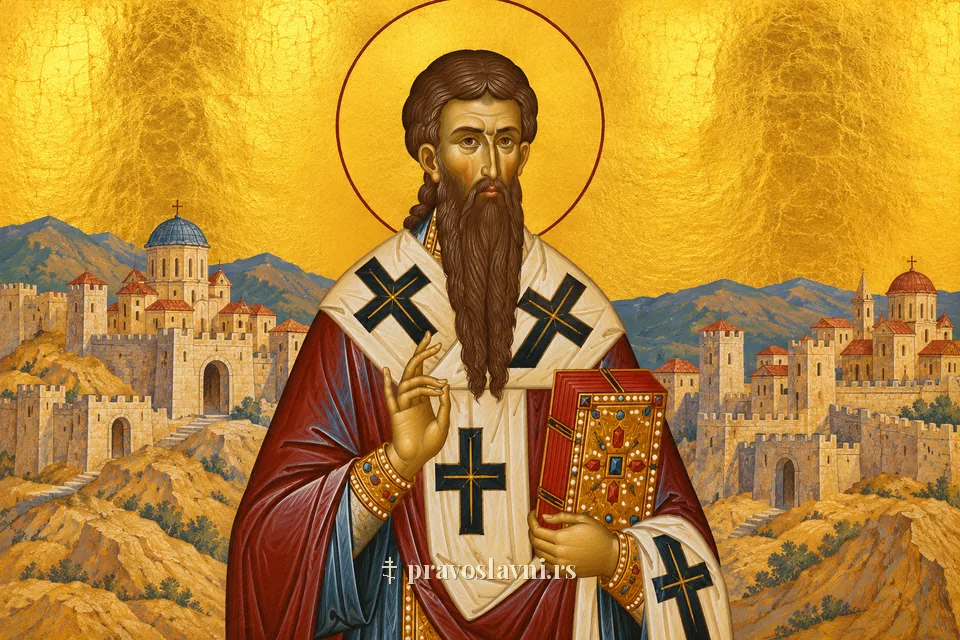
Holy Apostle Hermas
What happenedThe Apostle Hermas, a rich man who had become poor because of his sins, was given by God an angel of repentance and received from him twelve commandments.
Read the LifeOrthodox Calendar · 31 May according to the Julian calendar
Sunday, 13 June 202731 May (according to the Julian calendar)What happenedThe Apostle Hermas, a rich man who had become poor because of his sins, was given by God an angel of repentance and received from him twelve commandments.
Read the Life
You may eat meat, eggs, milk and dairy products, as well as any other food — but try to be moderate.
More about the fast →
Today the Church keeps the commemoration of a saint · Sunday — a festive day · Seventh Sunday of Pascha – Sunday of the Holy Fathers of the First Ecumenical Council.
More about the feast →
“Repent therefore and be converted, that your sins may be blotted out.”
— Acts 3:19Hermas lost his wealth because of sin, his own and that of his sons. It was in that very poverty, at prayer, that he received a companion for the rest of his life: there appeared before him the angel of repentance, in white and with a staff.
The angel left him twelve commandments. They call for faith in God and the fear of God, with which there is no need to be afraid of the devil. They call for prayer that springs from the heart and is full of faith, for purity in thoughts too, for love of the truth, a simple life, good deeds and the avoidance of every evil desire. The angel also revealed to him that two spirits stand beside every person, a good one and an evil one, and taught him patience, caution in the face of sorrow, which goes together with doubt and anger, and the testing of prophecies.
What the angel revealed to him Hermas wrote down in the instructive book “The Shepherd”. This Greek, who lived for many years in Rome, is according to the Prologue one of the Seventy Apostles, and the Apostle Paul mentions him in the Epistle to the Romans (Rom 16:14). Later he was bishop in Philippopolis, and he ended his life as a martyr, though the sources do not say where or when.
St Hermas shows that even a fall into sin and misery is not the end: God does not abandon the one who repents, but sends him help to rise again.
Hermas left behind an edifying book, “The Shepherd”, which arose from the revelations given to him by an angel of God. By origin he was a Greek, and he spent many years in Rome. The Apostle Paul mentions him in the Epistle to the Romans (Rom 16:14), and the Prologue counts him among the Seventy Apostles. Later he was bishop in Philippopolis, and he ended his life as a martyr; the sources do not give the time and place of his suffering.
Before he taught others, Hermas himself went through a fall. He was a wealthy man, but he lost everything and was left in the greatest poverty, through his own fault, but also through the fault of his sons. Then, at the hour of prayer, a visitor appeared to him, dressed in white, with a staff in his hand. He introduced himself as the angel of repentance and said that he had been sent to him as a companion for the whole of the rest of his life. From him Hermas received twelve commandments.
The foundation of all the commandments is faith in God. With it goes the fear of God, which sets a man free from fear of the devil; the angel puts it briefly: “To fear God and not to fear the devil.” Prayer too, according to his teaching, should be sincere, from the very depths of the heart and full of faith, and the Life adds that the one who prays should expect that he will be heard.
Other commandments guard a man's heart. The angel asks for purity not only in deeds but also in thoughts, and warns that a man should defend himself against every evil desire. He also asks for love of the truth instead of falsehood, and for a life that is simple and guileless; here the Life adds that no one should be slandered and that alms should be given to everyone who asks. And faith should be seen in deeds: evil is abandoned, and good is done.
Hermas also learned that a man is not alone in his inner struggle, because beside every person there stand two spirits, a good one and an evil one. That is why patience is needed, and according to the Life generosity of soul as well. One must also be on guard against sorrow, which goes hand in hand with doubt and anger; the Life gives that commandment in these words: “To guard against sorrow, as the sister of doubt and anger.” Prophecies, finally, should not be accepted lightly, because there are false ones too, and so they ought to be tested.
Hermas fell because of sin, but God did not abandon him. In place of the wealth he had lost he received the angel of repentance as a companion to the end of his life, and twelve commandments as a signpost. Faith, a pure heart, patience and prayer remain the path by which a man returns from his fall to God.
Hermias was an old soldier of the Emperor, according to his Life already grey-haired, who suffered for Christ in deep old age. His Life says that in the time of the Emperor Antoninus the governor Sebastian was sent to torture Christians and that he found Hermias in Comana in Cappadocia. The judge tried to persuade him to offer sacrifice to the idols, promising him, according to his Life, the Emperor's friendship and honours. Hermias, according to his Life, answered that he served the immortal Christ, Whose Kingdom is eternal, and that he had formerly served Him in secret, but now did so openly. His Life adds that he refused the mercy that was offered him on account of his old age and asked for mercy from God. He was subjected to severe tortures, but God protected him: he came out of the fiery furnace unharmed, and the deadly poison that a certain sorcerer prepared for him did him no harm. In this way the very sorcerer who had prepared the poison became a Christian: amazed by what he had seen, he declared his faith and for it at once lost his head. When they gave him vinegar mixed with gall, his Life records that he said: “This bitterness is like honey to me for the sake of my God.” To those around him who had gone blind Hermias restored their sight by prayer and the touch of his hands. In the end he was beheaded. The Christian community took the body in secret and gave it an honourable grave, and the relics afterwards healed the sick and the afflicted. He suffered in the year 166.


