Thursday17June 20274 June (according to the Julian calendar)‹›
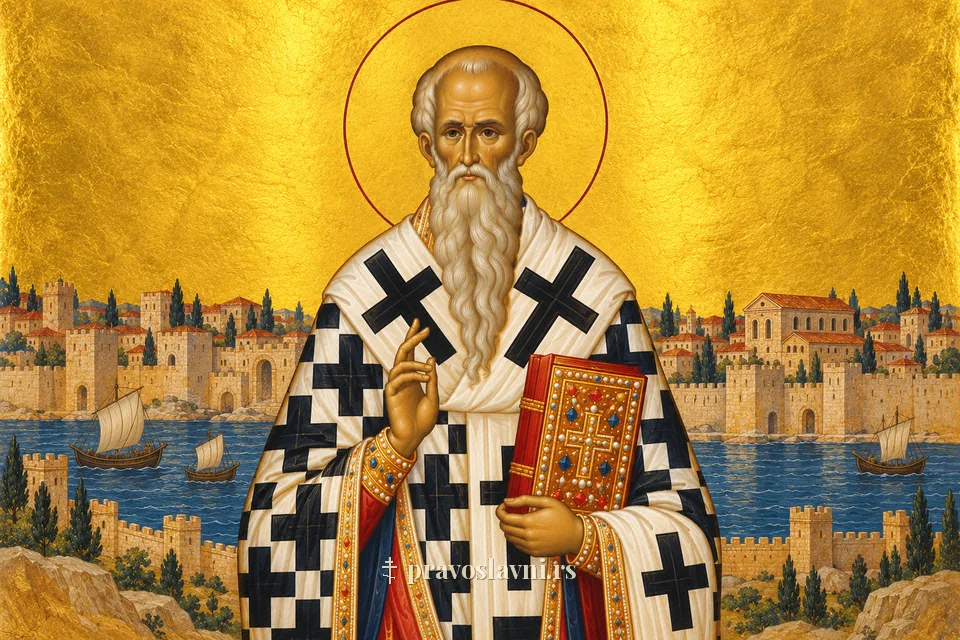
Illustration
Saint of the day
St Metrophanes, Patriarch of Constantinople
What happenedMetrophanes, nephew of the Roman Emperor Probus, became the first Patriarch of Constantinople, and before his death pointed to Athanasius as a future champion of the faith.
When Constantinople received its first patriarch, it was Metrophanes, by then already one hundred and seventeen years old; the title was given to him by the First Ecumenical Council at the request of Emperor Constantine. The emperor loved him as a father, and his Life says that this is also what he called him, that he marvelled at his virtue and wisdom and that he took him with him to Rome. That emperor, according to the Life, moved the capital to Byzantium, which was named New Rome and Constantinople.
Metrophanes was of an imperial family: his father Dometius was the brother of the Roman Emperor Probus. When he became a Christian, Dometius left Rome for Byzantium because of the persecution. There Bishop Titus ordained him a priest, and after the death of Titus Dometius became bishop. He was succeeded by his son Probus, and after Probus by Metrophanes.
Because of his old age and weakness Metrophanes was unable to come to the Council in the year 325, and so he sent the chorepiscopus Alexander. Since God had revealed to him that he would die in ten days, he named Alexander as his successor, and according to his Life he foretold that after him would come Paul, at that time a reader. Pointing to the archdeacon Athanasius, he told Alexander of Alexandria that he was leaving behind him a worthy successor, and to Athanasius, according to the Life, he foretold a struggle against Arianism and sufferings. He died ten days later, in the year 325.
St Metrophanes teaches wisdom, humility and faith, and bears witness that God guides the Church by the Holy Spirit.
Full Life
From an imperial family
The father of Metrophanes, Dometius, was the brother of the Roman Emperor Probus. He became a Christian and, because of the persecution in Rome, went away to Byzantium, according to the Life with his sons Probus and Metrophanes. The bishop there, Titus, ordained Dometius a priest. When Titus died, Dometius became bishop, after him his son Probus, and then Metrophanes.
The first patriarch of the new city
Emperor Constantine loved Metrophanes as a father. The Life says that he marvelled at his virtue and wisdom, called him father and took him with him to Rome. That Emperor, according to the Life, moved the capital to Byzantium because of its beauty and its position between Europe and Asia, on the Bosphorus, and the city was named New Rome, Constantinople and Tsarigrad, the City of the Emperor.
When the First Ecumenical Council was summoned in the year 325, Metrophanes was one hundred and seventeen years old and was too weak to come. In his place he sent the chorepiscopus Alexander, who, according to the Life, laboured for the peace of the Church in Thrace and Illyria and opposed Arius. Through the efforts of the Emperor the Council gave Metrophanes the title of patriarch, and so he became the first Patriarch of Constantinople.
Prophetic words on his deathbed
The Life tells that after the Council Constantine asked the fathers to visit Metrophanes, who was on his deathbed. God revealed to him that he would die in ten days. He named Alexander as his successor, and the Life adds that he foretold that after Alexander would come Paul, who was then a reader.
To Alexander of Alexandria he said: “O brother, a most excellent successor you will leave behind!” and he pointed to Athanasius, who was then the archdeacon of Alexandria. According to the Life, he took him by the hand and said: “Here is a brave soldier of Christ; he will succeed you.” He foretold to him the struggle against Arianism and the sufferings that awaited him. Metrophanes died ten days later, in the year 325, at the age of one hundred and seventeen.
What he leaves us
The Life presents him as a model of wisdom, humility and faith. A man of imperial family, who went away from persecution together with his father, became the first patriarch of the new Christian capital. And his last words bear witness that God guides the Church by the Holy Spirit and takes care of her future.
Other saints of the day
Holy Myrrh-bearers Martha and Mary
Martha and Mary were the sisters of Lazarus, and their Life says that they lived in Bethany, near the Mount of Olives. According to their Life, they believed in Christ even before He raised their brother from the dead. Christ had stayed in their home before, and it was then that He spoke of the one thing that is needed (Lk 10:38–42). Six days before the Passover, at the supper in Bethany in the house of Simon the leper, Martha took care of the table, while Mary anointed the feet of Christ with precious myrrh and wiped them with her hair (Jn 12:1–8). After the Ascension Lazarus preached the Gospel in various places, and his sisters helped him. Their Life records: “Both of them ended their lives in peace, but it is not known where.” They have remained in the memory of the Church as faithful friends of Christ, who received Him into their home and helped the spreading of the Gospel.
Joanikije, whom his Life also calls “of Boka”, was born in 1890 at Stoliv in the Bay of Kotor and at baptism received the name Jovan, while the Lipovac family comes by origin from Cuce. He was educated in Prčanj, Kotor and Zadar and at the Faculty of Philosophy in Belgrade. He was ordained in 1912 in Kotor, served as a priest in Kotor and Petrovac and as a military chaplain, and then was a teacher in Cetinje and in Belgrade. He was tonsured a monk in 1940 at Rakovica and in the same year was chosen as Metropolitan of Montenegro and the Littoral, and he was enthroned in Cetinje in 1941 Towards the end of the war he left Cetinje with a great column of priests and people. He was captured, imprisoned and taken to Serbia, where, according to testimonies, after being tortured he was killed in the middle of June 1945 at Bukulja, near Aranđelovac. His grave is not known. Patriarch Gavrilo served a memorial service for him when he learned of his disappearance. His Life quotes his words: “Love is what is needed.”
The holy hieromartyr Đorđe Bogić was born in the year 1911 He finished grammar school in Nova Gradiška and the seminary in Sarajevo, and he was ordained a priest in Pakrac in 1934 He served in two parishes, and in 1940 he was moved to Našice, where the war found him. On the night of 17 June 1941 the Ustaše took him out of his house, supposedly for questioning, and led him outside the town. By a chapel near Našice he was tortured and in the end killed. The next day Roma from the surrounding area took his body and buried it in the nearby cemetery.