Thursday01July 202718 June (according to the Julian calendar)‹›
Illustration
Saints of the day
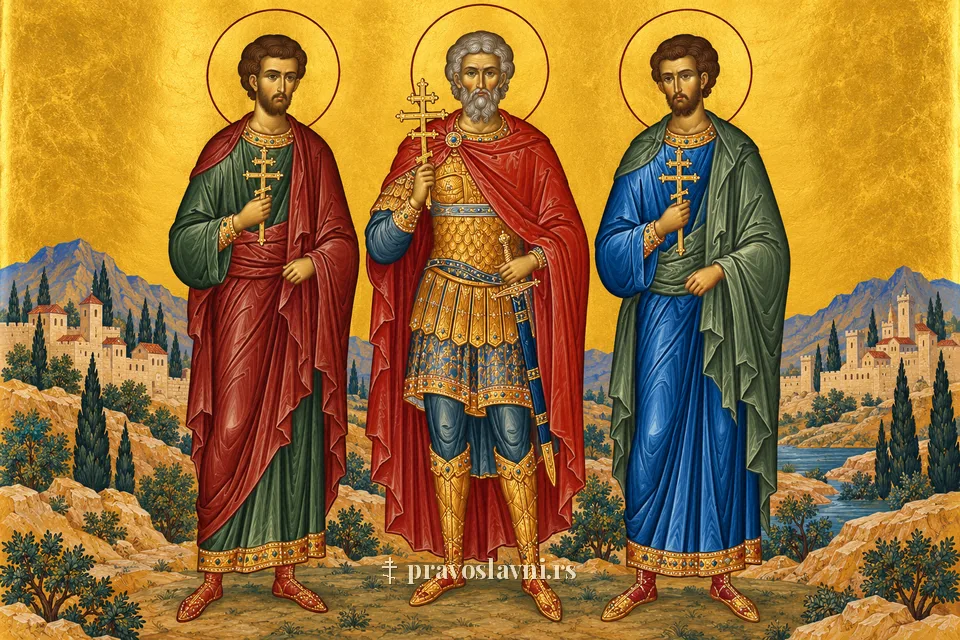
Holy Martyrs Leontius, Hypatius and Theodulus
What happenedIn Tripoli the military commander Leontius brought to Christ the tribune Hypatius and the soldier Theodulus, who had been sent to arrest him, and all three suffered for the faith.
The tribune Hypatius set out with a detachment to arrest the military commander Leontius in Tripoli, and he became a Christian. Leontius was from Hellas and commanded an army in the time of Emperor Vespasian; his Life remembers his strength and his victories. Hypatius was sent by Adrian, the governor of Phoenicia and a fierce persecutor of Christians, because Leontius, according to the Life, had turned many away from idols and brought them to the faith.
On the way Hypatius fell gravely ill with a fever. An angel told him to call three times, together with his soldiers, upon the God of Leontius, and he cried out: “O God of Leontius, help me!” He was healed that very hour, and the miracle, according to the Prologue, moved the soldier Theodulus most of all.
Hypatius and Theodulus went to Leontius. He received them as guests and told them that he was a Christian, and they asked to become Christians themselves. Leontius prayed, a bright cloud sprinkled them with dew, and they were baptised in the name of the Holy Trinity.
When Adrian came to the city and learned that Hypatius and Theodulus had become Christians, he ordered them to be beheaded. Leontius, according to the Life, would not offer sacrifice to the gods even for a reward. He was tortured, but an angel comforted him; in the end he was killed, and his body was thrown outside the city. The witness Notarius left a record of Leontius's martyrdom in his tomb. The Prologue places the martyrdom in the year 73.
Full Life
The Commander from Tripoli
Leontius was a Roman military commander in the Phoenician city of Tripoli in the time of Emperor Vespasian. By birth he was from Hellas — the Life says, from Greece — a man of large build, strong and brave in battle; the Life adds that he had won many victories and that he was wise and learned. But he did not serve the emperor alone. According to the Life, he served Christ, lived chastely and was generous to the poor, the hungry, the naked and travellers. He turned many away from sacrifices to idols and brought them to the faith.
A Pursuit That Ended in Baptism
Adrian, the governor of Phoenicia and a fierce persecutor of Christians, sent a detachment to fetch him, at the head of which was the tribune Hypatius. On the way Hypatius fell gravely ill with a fever, and so the expedition came to a halt; the Life says that he thought the gods were punishing him and that for three days he ate nothing. Then an angel appeared to him — according to the Life, in a dream — and told him to call three times, together with his soldiers, upon the God of Leontius. The Prologue records his cry: “O God of Leontius, help me!” He was healed that very hour. The miracle shook the soldiers, and according to the Prologue Theodulus most of all.
Hypatius and Theodulus went on ahead to Leontius. He received them as guests and told them that he was a Christian — according to the Life, also that he knew they had come to seize him. Both of them came to love Christ and asked that they too might become Christians. Leontius prayed, and a bright cloud came down and bedewed them. He pronounced the words of baptism in the name of the Holy Trinity; the Prologue says that the Holy Spirit Himself baptised them. The Life adds the white garments of the newly baptised and the candles that were carried before them.
Three Confessors
The Life relates that the other soldiers and the citizens were enraged and demanded that the newly baptised be burned, and so the city was in turmoil. After two days Adrian arrived and threw all three into prison. When he learned that Hypatius and Theodulus had become Christians, he ordered that they be beaten and then beheaded. According to the Life, they went to their death singing.
To Leontius, according to the Life, Adrian offered a reward if he would offer sacrifice to the gods, and he answered him that it would be better for Adrian himself to accept Christ. The Life records his words: “I will never forsake my God, the Creator of heaven, earth, the sea and all that is in them.” He was cruelly tortured, but he remained firm; he prayed that God would not forsake him, and an angel comforted him — according to the Life, in the prison. In the end he was killed, and his body was thrown outside the city. The faithful, according to the Life, took it and buried it near the harbour of Tripoli.
A Testimony on Leaden Tablets
The martyrdom of Leontius has been preserved thanks to Notarius, a witness who was present at it; the leaden tablets bearing that record remained in the martyr's tomb. The Prologue places the martyrdom in the year 73.
The hymn in the Prologue praises Leontius because he did not renounce God in the face of torture, or of mockery, or of the emperor's might: suffering strengthened his faith, Christ stood beside him, and he gave his life in order to live eternally. The cry of Hypatius remains a lesson for all: to call upon God in time of trouble.