Red Letter day (great feast)noSunday — a festive day
Slavanone
Sunday11July 202728 June (according to the Julian calendar)‹›
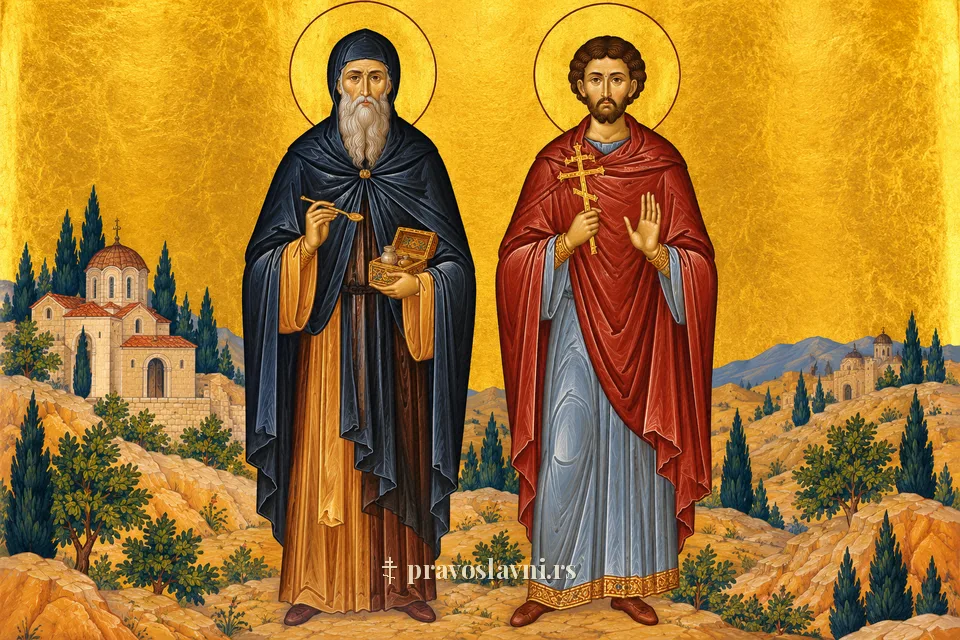
Illustration
Feast of the day
Translation of the Relics of the Holy Unmercenaries Cyrus and John
What happenedCyril, Patriarch of Alexandria, translated the relics of the Holy Unmercenaries Cyrus and John to Menouthis, an old pagan shrine, which in this way became a place of healing.
Sts Cyrus and John were unmercenary physicians, who healed without payment. They suffered for Christ in the time of Emperor Diocletian, in the city of Canopus near Alexandria. According to the Life, the Christians buried them secretly, and the relics were found much later, in the time of Emperor Arcadius, when churches could be built freely.
Not far away was Menouthis, an ancient place of idol-worship, in which demons had made their dwelling. Patriarch Theophilus wished to cleanse that place, but he did not succeed. Later Cyril, Patriarch of Alexandria, prayed to God, and an angel told him that the place would be cleansed if he translated the relics of Sts Cyrus and John there. Cyril translated the relics to Menouthis and built a church in their name. The unclean spirits departed from there, and Menouthis became a place where people came for health. The Prologue links the healings that followed with the year 412.
At the relics there were healed Ammonius, the son of the governor of Alexandria, the blind Theodore, Eugenius, who was sick with dropsy, and many others. The Life records that the saints appeared in visions and enjoined works of humility on those who were healed, and that healings also came through the oil of the lamps and the candles that burned before the relics. So the saints who in their lifetime had healed without payment went on healing after death as well.
On that day the Prologue defends God's working through material things: relics, icons and the Cross.
Full Life
The Unmercenaries from Canopus
Sts Cyrus and John were unmercenary physicians — they healed without payment. They suffered for Christ in the time of the Emperor Diocletian. The place of their suffering, the town of Canopus, lay near Alexandria; the Life says, twelve stadia from it. Their main commemoration is on 31 January (according to the Julian calendar).
The Life says that the faithful buried them in secret. The relics were found much later, when churches could be built freely: after the death of the Emperor Theodosius, in the time of the Emperor Arcadius, Theophilus, Patriarch of Alexandria, wished to build a church of the holy Apostles in Canopus.
The cleansing of Menouthis
Not far from there was Menouthis, a place where idols had been worshipped from ancient times and where, according to both sources, demons dwelt. Patriarch Theophilus wished to cleanse that place, but he did not succeed in it. Later Cyril, Patriarch of Alexandria, prayed to God, and an angel told him that the place would be cleansed if he translated the relics of Sts Cyrus and John there. Cyril translated the relics to Menouthis and built a church in their name. There was no longer any place there for the demons, and the sick began to come for healing. The Life says that this account is taken from the Life of St Cyril of Alexandria.
Healings at the relics
The Prologue connects the healings that followed with the year 412. At the relics Ammonius, the son of Julian, the governor of Alexandria, was healed, then Theodore, who was blind, Isidore of Maiuma, who was sick in the liver, Eugenius, who suffered from dropsy, as well as someone who had been poisoned, and many others.
The Life records that the saints often appeared in visions and assigned works of humility to those who were healed. Ammonius had to sweep their church, and later, when he fell into pride, to wear sackcloth and to carry water to the sick and the poor. Sometimes the remedy was simply ordinary things from the church: the oil that burned before the relics and the wax from the candles. In this way Kalos, whose leg was broken, recovered, and several other sick people too. At the tomb an eight-year-old boy was also healed, brought there by Mary from Babylon in Egypt.
The saints who healed without payment during their lifetime went on healing after death as well, teaching humility to those they heal, and a place once dedicated to idols became a place of prayer. On this day the Prologue defends God's working through material things: relics, icons and the Cross.
Other saints of the day
Holy Martyrs of Dabar-Bosnia and Mileševa
The Holy Assembly of Bishops of the Serbian Orthodox Church numbered the New Martyrs of Dabar-Bosnia and Mileševa among the saints at its regular session in May 2005 and established their common feast. The Martyrs of Glamoč and Kulen Vakuf are also included in it. Those commemorated are mainly clergy from those regions who suffered in the wars of the twentieth century, most of them in the Second World War, and some in the First. Commemorated with them are also Metropolitan Petar of Dabar-Bosnia and the Confessor Varnava, Bishop of Hvosno, who also have their own separate commemorations. Among the martyrs are eight monks of the Monastery of Žitomislić, among them the hieromonks Dositej, Konstantin and Makarije, who suffered in the Second World War. The tomb with their relics stood beside the altar of the monastery church. Those eight monks were solemnly inscribed in the diptychs as the New Martyrs of Žitomislić on 15 May 2005, at the consecration of the restored monastery. Among those named is also Nestor, Abbot of Mileševa, who was killed in 1941 Many of the priests who suffered had completed seminaries, in Sarajevo, Prizren, Cetinje and elsewhere, and served as parish priests in Bosnia, Herzegovina and the Pljevlja region.