Thursday15July 20272 July (according to the Julian calendar)‹›
Illustration
Feast of the day
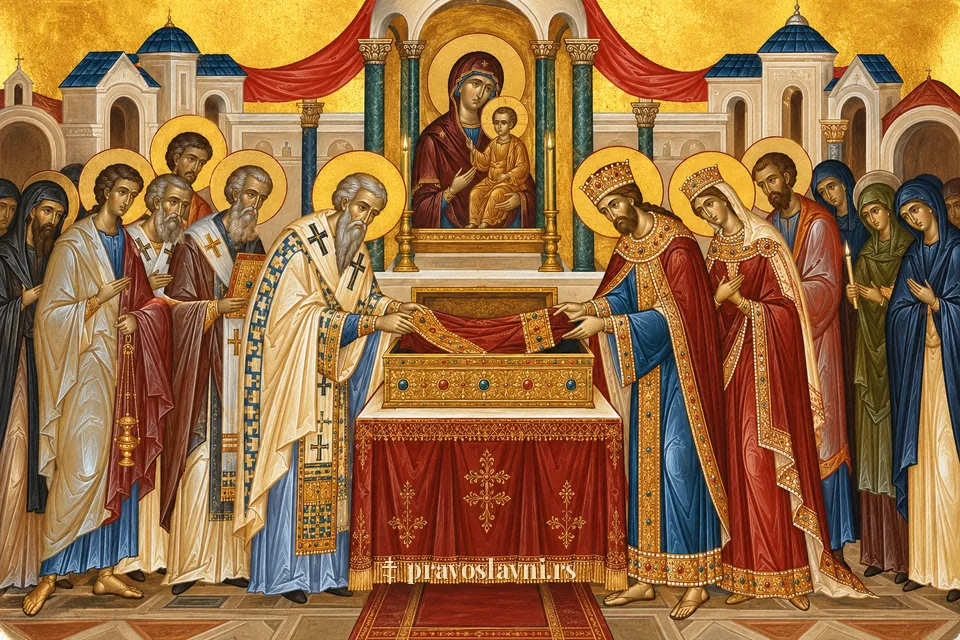
Placing of the Honourable Robe of the Most Holy Theotokos at Blachernae
What happenedThe Robe of the Most Holy Theotokos, brought from the Holy Land to Constantinople, was solemnly placed in the Church of Blachernae in the time of the Emperor Leo the Great.
The feast of the Placing of the Robe recalls the day when the garment of the Most Holy Theotokos was solemnly placed in her church at Blachernae, in Constantinople. This was in the time of Emperor Leo the Great and Empress Verina.
The robe was found by two distinguished brothers from Constantinople, Galbius and Candidus, on a pilgrimage to the Holy Land. Near Nazareth they stayed in the house of a woman of Jewish descent and saw that the sick were being healed in her house. According to the Life, when they adjured her by God, the woman confessed to them: “Here I keep hidden the robe of the Most Pure Virgin Mary, who gave birth to Christ God.” The robe, the Life says, had been handed down in her family from one virgin to another.
The Life also tells that the brothers secretly carried the robe away, leaving a copy in place of the real chest. In Constantinople they could not keep it hidden for long, because miracles were taking place around it. So they revealed everything to the emperor and the patriarch, and the city rejoiced. The emperor, the empress and the patriarch saw, according to the Life, that the years had done the robe no harm. Then, according to the Life, the robe was carried in procession to Blachernae and placed there. According to the Prologue, that church of the Theotokos was built by Emperor Marcian and Empress Pulcheria. The feast is celebrated on 2 July (according to the Julian calendar).
The Prologue compares the Theotokos to the bush on Horeb, in which there was fire, and yet it was not consumed.
Full Life
The pilgrimage of two brothers
In the time of the Emperor Leo the Great and the Empress Verina — the Prologue also mentions Patriarch Gennadius — two distinguished brothers from Constantinople, Galbius and Candidus, set out to venerate the holy places in the Holy Land. According to the Life, with the Emperor's permission they went first to Jerusalem and then to Galilee, to see Nazareth. They lodged in the house of a maiden of Jewish descent; the Life describes her as an elderly unmarried woman of pure life. The Prologue places that house in Nazareth, and the Life near Nazareth.
The secret chamber
In that house many sick people were healed by prayer and by touching the robe of the Theotokos, which was kept in a secret chamber. The Life lists the blind, the lame, the possessed, the deaf and the mute, who lay around the chamber, which was lit with candles and censed with incense. According to the Life, the woman at first concealed the truth. The brothers implored her: “We adjure you by the living God, devout woman, to tell us the truth!” Then she revealed to them: “Here I keep hidden the robe of the Most Pure Virgin Mary, who gave birth to Christ God.” The Life says that after the repose of the Theotokos the robe was given, by her own will, to a widow of this woman's family, that in that family it passed from virgin to virgin, and that the present guardian had no worthy heir.
The translation to Constantinople
According to the Life, in Constantinople the brothers kept the robe in a small house church of the Apostles Peter and Mark, but the miracles did not allow it to remain hidden. How it came to be there is told only by the Life: the brothers measured the chest, had one exactly like it made of old wood in Jerusalem, and on their way back, after one more night of prayer, left it in place of the real one.
The church at Blachernae
The brothers disclosed everything to the Emperor and the Patriarch, and there was great joy in the capital. According to the Life, the Emperor, the Empress and the Patriarch came to their house, opened the chest and saw that the many years had done the robe no harm. Then, according to the Life, the robe was placed, in procession and in a chest adorned with gold, silver and precious stones, in the church of the Theotokos at Blachernae. According to the Prologue, that church was built by the Emperor Marcian and the Empress Pulcheria on the shore of the bay named after the Scythian commander Blachernus, who was killed there. In memory of this the feast of the Placing of the Robe was established, on 2 July (according to the Julian calendar).
In its reflection for this day the Prologue sees the Theotokos in the bush on Horeb (Ex 3): the fire was in the bush, yet it remained whole, just as the Virgin carried God within herself and was not burned. The same grace, says the Prologue, renews and enlightens the sinful soul as well. The homily speaks of the testing of faith: “Our faith, brethren, is tested more often than a reed is shaken by the winds.”