Saint of the day
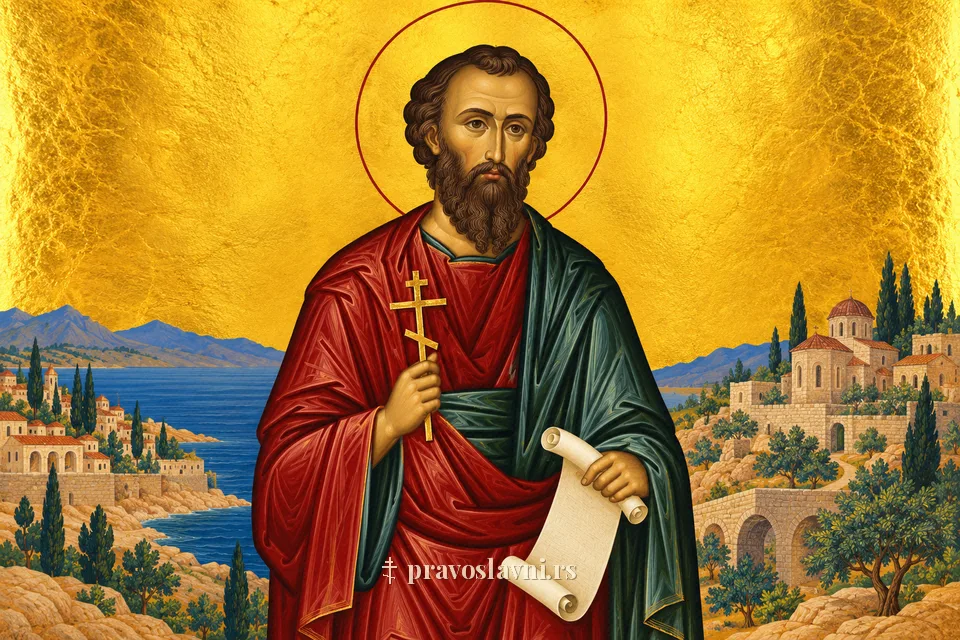
Holy Apostle Aquila
What happenedThe Holy Apostle Aquila, with his wife Priscilla, received the faith from the Apostle Paul and became his faithful helper in preaching the Gospel.
Read the LifeOrthodox Calendar · 14 July according to the Julian calendar
Tuesday, 27 July 202714 July (according to the Julian calendar)What happenedThe Holy Apostle Aquila, with his wife Priscilla, received the faith from the Apostle Paul and became his faithful helper in preaching the Gospel.
Read the Life
You may eat meat, eggs, milk and dairy products, as well as any other food — but try to be moderate.
More about the fast →
Today the Church keeps the commemoration of a saint · not a Red Letter day.
More about the feast →
“Greet Priscilla and Aquila, my fellow workers in Christ Jesus.”
— Rom 16:3The holy Apostle Aquila was a Jew by birth, according to his Life from Pontus, and he lived in Italy with his wife Priscilla. His Life numbers him among the Seventy Apostles. When the Emperor Claudius ordered the Jews to leave Rome and Italy, Aquila moved to Corinth. He supported himself by his own trade; according to his Life, he was a tent-maker, as was the Apostle Paul.
Paul found them in Corinth, stayed with them for a year and a half, instructed them in the faith and baptised them both. They accompanied him as far as Ephesus and helped him in his apostolic work. According to his Life, in Ephesus they explained the way of the Lord more accurately to the eloquent Apollos of Alexandria. Paul mentions them in his epistles: he sends greetings from them and from the church that is in their house (1 Cor 16:19), he greets them as “my fellow workers in Christ Jesus”, who risked their own necks for his life (Rom 16:3–4), and from Rome he tells Timothy to greet them (2 Tim 4:19).
After the death of Claudius they returned to Rome, and later Aquila helped St Timothy in Ephesus. His ministry as a bishop brought new churches and ordained priests, idols torn down and many people baptised. The pagans killed him in their rage, and so he departed into the Kingdom of Christ.
Aquila and Priscilla have remained an example of a married couple whose home was open to the Apostle and to the Church.
Aquila was a Jew by birth — according to his Life, from Pontus. Before he received the faith, he lived in Italy with his wife Priscilla. His Life numbers him among the seventy apostles.
When Emperor Claudius ordered the Jews to leave Rome and Italy — his Life says that this was because of disputes over whether Christ is the Messiah — Aquila moved to Corinth. He supported himself by his own trade; according to his Life, he was a tentmaker, like Paul, and so the apostle stayed with them (Acts 18:1–3).
In Corinth they were found by the Apostle Paul, who, according to his Life, had come from Athens. He stayed with them for a year and a half, instructed them in the faith and baptised them both. Then they accompanied him as far as Ephesus and helped him in his apostolic work. According to his Life, Paul sailed for Syria, and left them in Ephesus to teach until he had gone to Jerusalem.
His Life records that in Ephesus they took to themselves Apollos of Alexandria, an eloquent man who knew only the baptism of John, and explained to him the way of the Lord more accurately (Acts 18:24–28).
Paul mentions them in several epistles. In the First Epistle to the Corinthians, written from Ephesus, he sends greetings from Aquila and Priscilla and from the church that is in their house (1 Cor 16:19). In the Epistle to the Romans, written from Corinth, he greets them as “my fellow workers in Christ Jesus”, who risked their own necks for his life and to whom all the churches of the Gentiles give thanks (Rom 16:3–4). And from Rome, where he was in chains, he writes to Timothy in Ephesus and tells him to greet Priscilla and Aquila (2 Tim 4:19).
After the death of Claudius the Jews were allowed to return, and so Aquila and Priscilla went back to Rome. Later Aquila was in Ephesus and helped St Timothy. His Life says that Paul ordained him a bishop and sent him out to preach, and that he preached in Asia, Achaia and Heraclea.
As a bishop he spread the glory of the Son of God: many received baptism from him, idols were pulled down, churches were built, and he ordained priests. He ended his life as a martyr: the pagans killed him in their rage — according to his Life, after he had passed through many trials — and so he departed into the Kingdom of Christ.
The husband and wife who opened their home to the apostle, and their house to the Church, have remained an example of working with one's own hands and of readiness to risk even one's own life for the Gospel.
He was born in 1749 in Chora, on the island of Naxos, in the time of Turkish rule, and at baptism he was given the name Nicholas. A certain priest took him as a pupil after noticing that the boy was able to repeat the lessons he had listened to from outside, under the window of the school. He studied under Archimandrite Chrysanthos of Aetolia, the brother of St Cosmas, and from the age of sixteen for five years in Smyrna, where he learned Latin, French and Italian, as well as the ancient Greek language of the Fathers. He came to know monks of the Holy Mountain and St Macarius of Corinth, who became his companion for the whole of his life. In 1775 he came to the Holy Mountain (Mount Athos), to the Monastery of Dionysiou, where he was tonsured a monk with the name Nicodemus. Encouraged by Macarius, he chose the solitary life and the work of publishing the books of the holy Fathers. He wished to go to Paisius Velichkovsky in Moldavia, but a storm turned his ship back, so he remained on the Holy Mountain. He prepared the Philokalia and the Evergetinos for publication, and he also compiled the Pedalion (the Rudder), a collection of the canons of the Ecumenical and local councils with commentary. He also wrote Unseen Warfare, the New Martyrologion, commentaries on the Epistles and many services to the saints. He reposed in 1809, at about sixty years of age, after receiving Holy Communion. When they asked him whether he was at peace, he answered: “I have received Christ within myself; how should I not be at peace!”


