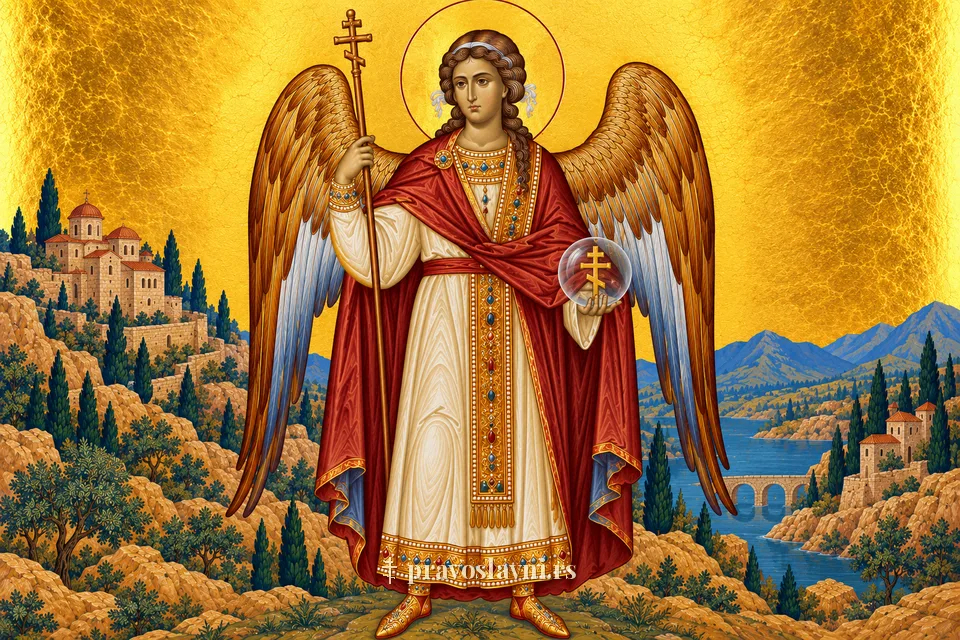
Feast of the day
Synaxis of the Archangel Gabriel
What happenedFor the second time in the year the Church celebrates the Archangel Gabriel, the herald of our salvation, remembering his appearances in the Old and New Testaments.
Read the LifeOrthodox Calendar · 13 July according to the Julian calendar
Monday, 26 July 202713 July (according to the Julian calendar)Save your slava — you'll get a reminder a week and a day before.
Send a greeting card →What happenedFor the second time in the year the Church celebrates the Archangel Gabriel, the herald of our salvation, remembering his appearances in the Old and New Testaments.
Read the Life
You may eat meat, eggs, milk and dairy products, as well as any other food — but try to be moderate.
More about the fast →
Many families celebrate their Krsna slava (family patron saint's day) today
More about the feast →
“Now in the sixth month the angel Gabriel was sent by God to a city of Galilee named Nazareth.”
— Lk 1:26Sung at the Slava (family patron saint's feast) and on the saint's feast day.
O Chief Captain of the heavenly hosts, we unworthy ones ever entreat thee, that by thy prayers thou wouldst encompass us with the shelter of the wings of thine immaterial glory, guarding us who fall down before thee and fervently cry: Deliver us from misfortunes, as commander of the Powers on high.
Translation: pravoslavni.rs
On this day the Church celebrates the Synaxis of the Holy Archangel Gabriel and remembers how many times, from the Old Testament to the Gospel, appearing and working wonders, he took part in the work of salvation. The day after the Annunciation is also dedicated to the Archangel, when his synaxis is likewise celebrated. By folk custom, the Synaxis of the Holy Archangel Gabriel is celebrated as a Krsna slava (family patron saint's day).
According to tradition, the feast was first established on the Holy Mountain in the ninth century.
On this day the Church once again celebrates the Archangel Gabriel; his chief synaxis is on 26 March (according to the Julian calendar), the day after the Annunciation. According to his Life, the synaxis was established because of his many appearances in both Testaments and because he unceasingly intercedes for Christians, so that the faithful might turn to him for shelter and help. The name Gabriel, according to his Life, means “the strength of God”.
He is the herald of births: to Anna, who was grieving over her barrenness, he announced the birth of the Virgin Mary — according to his Life, Joachim too received the same news. To Zacharias he announced the birth of John the Forerunner, and Zacharias, because he did not believe, became mute until the promise was fulfilled. In Nazareth he brought to the Virgin Mary the good tidings of the conception and birth of the Lord Jesus Christ, and to the shepherds near Bethlehem the birth of the Saviour.
He is also the interpreter of God's mysteries: to Moses, who according to the Prologue was keeping Jethro's flock, he revealed the creation of the world, and to the Prophet Daniel the kingdoms to come, the time of the Saviour's coming and, according to his Life, the end of the Babylonian captivity.
He was beside the Most Holy Virgin while she lived in the Temple, and he calmed the righteous Joseph — according to his Life, in a dream — and according to the Prologue he strengthened the Lord in Gethsemane before His Passion. To the Myrrh-bearing Women he proclaimed the Resurrection, and according to his Life he also announced to the Theotokos her own repose.
Thus the Archangel Gabriel is the messenger who, throughout the whole history of salvation, brings God's tidings to mankind.
The Archangel Gabriel has two feasts. His principal synaxis is celebrated on 26 March (according to the Julian calendar), the day after the Annunciation, and on this day the Church glorifies him again. According to his Life, the synaxis was established because the archangel appeared many times in both the Old and the New Testament and because he unceasingly intercedes for Christians; the faithful therefore turn to him, asking for shelter and support.
According to his Life, the name Gabriel means “the strength of God”. His Life sees him above all as the one who brings to people the joyful news of salvation.
To Anna, who was grieving that she had no children, he announced that she would have a daughter — the Virgin Mary; according to his Life, he declared the same joy to Joachim as well, while he was fasting in the desert. To Zacharias he announced the birth of John the Forerunner — according to his Life, appearing on the right side of the altar of incense — and when Zacharias did not believe, he remained mute right up to the fulfilment. In Nazareth he announced to the Virgin Mary that she would conceive and give birth to the Lord Jesus Christ, and to the shepherds near Bethlehem he brought the news that the Saviour had been born. That event in Nazareth the Church celebrates as the Annunciation.
The archangel also revealed what was hidden from people. He appeared to Moses in the desert — according to the Prologue, while he was keeping Jethro's flock — and revealed to him the creation of the world, which Moses wrote down in the book of Genesis; his Life adds that he also revealed to him the events from Adam and the patriarchs up to the flood and the division of the nations. To the Prophet Daniel he showed the mysteries of the kingdoms that were to come and the time of the Saviour's coming, and according to his Life also when the Babylonian captivity would end.
He appeared to the Most Holy Theotokos many times while she was living in the temple; his Life says that he guarded her and brought her food. He set the mind of the Righteous Joseph at rest with regard to Mary — according to his Life, in a dream. The Prologue says that in Gethsemane he strengthened the Lord before His passion, while his Life gives this with a reservation, as something that is held to be so.
To the Myrrh-bearing Women he announced the resurrection; his Life describes him sitting on the stone of the tomb. According to his Life, on the Mount of Olives he foretold to the Theotokos that her repose was drawing near and brought her a shining branch from paradise.
So in a single synaxis all his appearances are gathered together — from the mystery of the creation of the world to the news of the resurrection.
Venerable Stephen the Sabaite was a kinsman of St John of Damascus. According to his Life, he was born in Damascus about the year 725, and his father's name was Theodore. While still in his early youth he was tonsured a monk in the monastery of St Sabbas the Sanctified. He bears the name Sabaite from that monastery; he was a great follower of the way of life of St Sabbas and stood out among the monks of Palestine. According to his Life, he spent one period alone in the desert, where he composed church hymns. He worked many signs and wonders and foretold his own death. He reposed in the Lord in the year 794, in the sixty-ninth year of his life.


