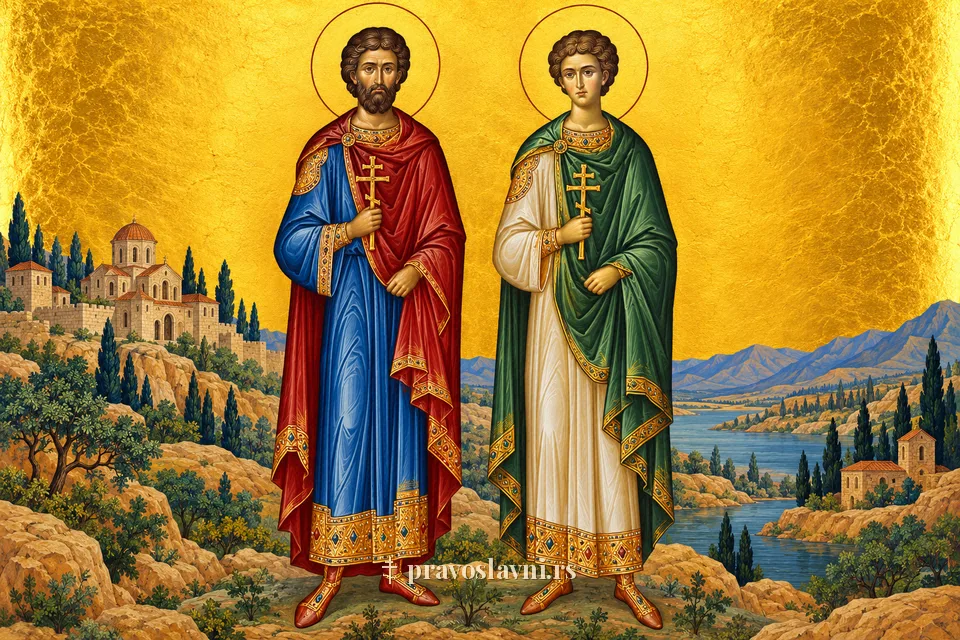
Saints of the day
Holy Martyrs Proclus and Hilary
What happenedSt Proclus and his nephew Hilary confessed Christ before the judge in the time of the Emperor Trajan and suffered for the faith.
Read the LifeOrthodox Calendar · 12 July according to the Julian calendar
Sunday, 25 July 202712 July (according to the Julian calendar)What happenedSt Proclus and his nephew Hilary confessed Christ before the judge in the time of the Emperor Trajan and suffered for the faith.
Read the Life
You may eat meat, eggs, milk and dairy products, as well as any other food — but try to be moderate.
More about the fast →
Today the Church keeps the commemoration of a saint · Sunday — a festive day · 5th Sunday after Pentecost.
More about the feast →
“So we may boldly say: ”The Lord is my helper; I will not fear. What can man do to me?”“
— Heb 13:6Sts Proclus and Hilary came from Kallippi, which the Prologue places in Asia, and their Life near Ancyra. Proclus was Hilary's uncle, and according to their Life everyone in their family was a Christian.
When, in the time of the Emperor Trajan, he was brought to trial — according to the Life, before the governor Maximus — Proclus would not agree either to offer sacrifice to the idols or to deny Christ. To the question about his family he answered: “my family is Christ, and my hope is my God.” He did not give way to threats: a Christian, he used to say, ought to fear breaking God's commandment more than the punishment of men. The Life records his words: “It is better to fear God than men.” The Life also tells that, while Proclus was praying, an invisible power stopped the governor's chariot, and the governor had to write that the God of Proclus is the only true God. He bore many tortures without a groan.
During the tortures his uncle was joined by Hilary, who of his own free will said to the judge: “I too am a Christian.” According to the Life, an angel of the Lord encouraged him in the prison.
According to the Prologue, Proclus was crucified on a cross. According to the Life, three days after that Hilary confessed the faith once more and was beheaded, and the faithful buried them one beside the other. In this way uncle and nephew set the fear of God above the fear of men.
Proclus and Hilary were natives of Kallippi, which the Prologue places in Asia, and their Life in the neighbourhood of Ancyra. Proclus was Hilary's uncle, his father's brother. Their Life also passes on Hilary's testimony about their household: they were all Christians, and they all remained worshippers of Christ until death.
The trial came in the time of Emperor Trajan. According to their Life, Proclus was tried by the governor Maximus, and Proclus refused both to sacrifice to the idols and to renounce Christ. To the question about his origin he gave an answer that holds his whole life: “my kindred is Christ, and my hope is my God.” The earthly origin about which the judge was asking him was no longer the measure for him: his true kindred was Christ.
Nor did threats make him waver. He used to say that a Christian ought to fear breaking God's commandment more than the punishment that men impose; according to their Life, eternal punishment was more terrible to him than temporary torments. Their Life also attributes these words to him: “It is better to fear God than men.” And again: “Even if I die, I shall still be alive again.”
According to their Life, while Proclus was walking behind the governor's chariot and praying, an invisible power stopped it: neither the horses nor the soldiers could move. The journey was continued only when the governor acknowledged in writing that the God Whom Proclus confesses is the one true God. Proclus, according to their Life, bore many torments without a groan.
During his uncle's torments Hilary joined him: of his own free will he stepped before the judge and declared: “I too am a Christian.” According to their Life, he was shut up in prison; there he sang a psalm and fell asleep, and an angel of the Lord appeared to him and encouraged him.
According to the Prologue, Proclus was crucified on a cross. Their Life states that he suffered on 12 July (according to the Julian calendar). His grave, according to their Life, was provided by the secret care of the faithful. According to their Life, three days later Hilary was brought out again for questioning and once more he confessed Christ. He was beheaded with the sword — their Life adds, outside the city — on 15 July (according to the Julian calendar). According to their Life, they laid him by night in a grave beside Proclus. Like everyone in the family from which he came, Hilary remained faithful to Christ to the end.
So uncle and nephew, one after the other, showed that the fear of God is stronger than the fear of men.
The icon first belonged to St John of Damascus, a zealous defender of the holy icons. The iconoclast Emperor Leo III the Isaurian falsely accused him before the caliph of Damascus, and the caliph ordered that his right hand be cut off in public. That evening John asked for the severed hand, put it to the wrist and prayed before the icon until sleep overcame him; then the Theotokos, who appeared to him, healed him, and a scar remained as a sign. As a sign of gratitude he fastened a silver hand to the icon, and so the icon came to be called Trojeručica, “Of the Three Hands”. When his innocence had been shown, John nevertheless left the court and Damascus, was tonsured a monk and took the icon to the Lavra of St Sabbas the Sanctified, where it remained until the thirteenth century. Then it was given to St Sava, the first Serbian archbishop, together with the icon of the Milk-giver, and he brought it to Serbia. It is told that later, in troubled times, the icon came by itself, on a donkey, from Serbia to the Holy Mountain (Mount Athos), where the monks of Hilandar received it and placed it in the main church of the Entry of the Theotokos into the Temple. According to tradition, when the brotherhood was in dispute over the election of an abbot, the icon three times moved by itself to the abbot's throne, although it was returned to the altar each time. For this reason it is regarded as the abbess of Hilandar: Hilandar is governed not by an abbot but by pro-abbots, and the monks take a blessing from the icon and bow down before it.
Separate page: Icon of the Mother of God “Of the Three Hands” (Trojeručica) →


