Saint of the day
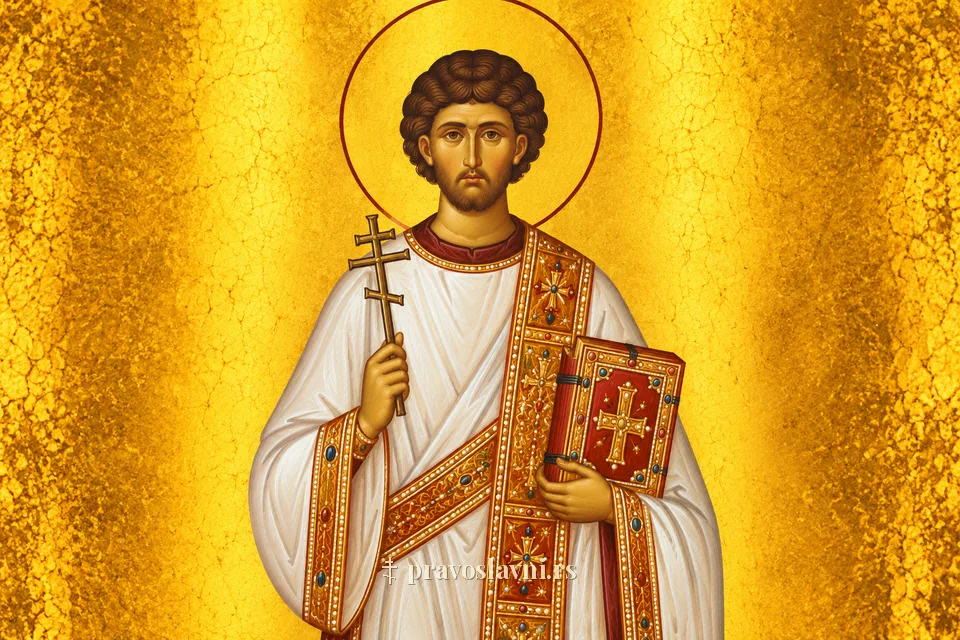
Holy Martyr and Archdeacon Euplus
What happenedThe holy deacon Euplus of Catania in Sicily suffered for Christ under Diocletian because he read and preached the Holy Gospel.
Read the LifeOrthodox Calendar · 11 August according to the Julian calendar
Tuesday, 24 August 202711 August (according to the Julian calendar)What happenedThe holy deacon Euplus of Catania in Sicily suffered for Christ under Diocletian because he read and preached the Holy Gospel.
Read the Life
No meat, dairy products, eggs, fish or oil — food cooked in water.
This is a recommendation — for your own fast, consult your priest or spiritual father.More about the fast →
Today the Church keeps the commemoration of a saint · not a Red Letter day.
More about the feast →
“For I am not ashamed of the gospel of Christ, for it is the power of God to salvation for everyone who believes, for the Jew first and also for the Greek.”
— Rom 1:16St Euplus was a deacon in Catania in Sicily. Emperor Diocletian, according to the Life together with Maximian, sent Pentagurus to Sicily to root out the Christians, but he did not find them, because the few Christians there were in hiding.
Euplus was denounced for carrying a book and reading it to the Christians, and that book was the Holy Gospel. According to the Life, before the governor Calvisian he confessed the Lord Jesus Christ, the Creator of heaven and earth, and said: “For me the torments will be a bright crown, but for you darkness and perdition.” They hung the Gospel around his neck and shut him up for seven days without food. The Life says that in the prison, after his prayer, a spring of water flowed forth.
Then he was tortured, and according to the Prologue he rebuked his torturer with the words: “you fool, do you not see that these torments are like a cobweb to me because of God's help?” According to the Life, in his torments he heard a voice from heaven which encouraged him. Even at the place of execution the Holy Gospel was in his hands: he read to the people from it and taught them, and so many came to believe. He was beheaded, according to the Prologue in the year 304. The Life says that many were healed at his grave, and the Prologue that his relics rest in a village near Naples and work miracles.
Euplus loved the Holy Gospel to the very end: he carried it, read it and preached it even in the very hour of his death.
Euplus was a deacon in Catania in Sicily. Emperor Diocletian, according to the Life together with Maximian, sent Pentagurus to Sicily to root out the Christians. He did not find them, because the few Christians there were in hiding.
Euplus was denounced for carrying a book and reading it to the Christians, and that book was the Holy Gospel. The Life says that the soldiers found him in a humble house, while he was reading and explaining the Holy Gospel to the Christians. Before the governor Calvisian, as the Life records, he asked: “Who are your gods, that I should honour them?” Then he confessed the Lord Jesus Christ, the Creator of heaven and earth. The Life also gives his words to the governor: “For me the torments will be a bright crown, but for you darkness and perdition.”
They hung the Gospel around his neck and shut him in prison for seven days without food, and according to the Life without water as well. The Life says that in his thirst he prayed and that a spring of water welled up in the prison.
Then he was tortured. According to the Life, in his torments he prayed and heard a voice from heaven: “Be of good courage, Euplus, and be strong!” He mocked his torturer; according to the Prologue, he said to him: “you fool, do you not see that these torments are like a spider's web to me, because of God's help?”
Even at the place of execution the Holy Gospel was in his hands: he read from it to the people and taught them, and so many came to believe. Then he was beheaded, according to the Prologue in the year 304. According to the Life, the Christians laid his body and head in a separate tomb, at which many received healing. The Prologue says that his relics rest in a village near Naples and that they work miracles.
He did not hide as the others did, nor did he give up the book when they seized him. The Gospel which they hung around his neck became the sign of his faithfulness.
Euplus carried, read and preached the Gospel to his last hour. Neither prison nor torments separated him from the book that he loved, and from it he taught others even at the place of execution.
St Niphon was a Greek, according to his Life the son of Manuel and Maria, and was baptised Nicholas. He received the monastic tonsure and the name Niphon while young, according to his Life from the hermit Anthony in Epidaurus; he also studied under the elder Zacharias, earned his bread by copying books, and loved silence and the Scriptures most of all. He lived the ascetic life in several monasteries of the Holy Mountain, above all in Vatopedi and Dionysiou, and according to the Prologue the monks of the Holy Mountain valued him for his wisdom and meekness. He did not seek the office of a hierarch: unwillingly he became the hierarch of Thessalonica, according to the Prologue as bishop and according to his Life as metropolitan, and the people, according to his Life, called him Chrysostom because of his sermons, his mercy towards the poor and his visiting of the sick. Two years later, in Constantinople, he was elected patriarch. The Sultan sent him into exile in Adrianople, from where the Wallachian prince Radu freed him and brought him to be Archbishop of Wallachia. A conflict arose when Radu gave his sister in marriage to the Moldavian prince Bogdan, although Bogdan's wife was still alive: Niphon condemned that marriage and left Wallachia. He spent the rest of his life in Dionysiou, where, according to his Life, he hid his rank and worked as a muleteer, until his holiness was revealed. The prayer of absolution read over the departed comes from him. After his death drought and famine pressed hard upon Wallachia, and Radu fell ill and died. A Wallachian council, according to his Life, established a feast and a service in his honour.
Separate page: Venerable Niphon, Patriarch of Constantinople →


