Saint of the day
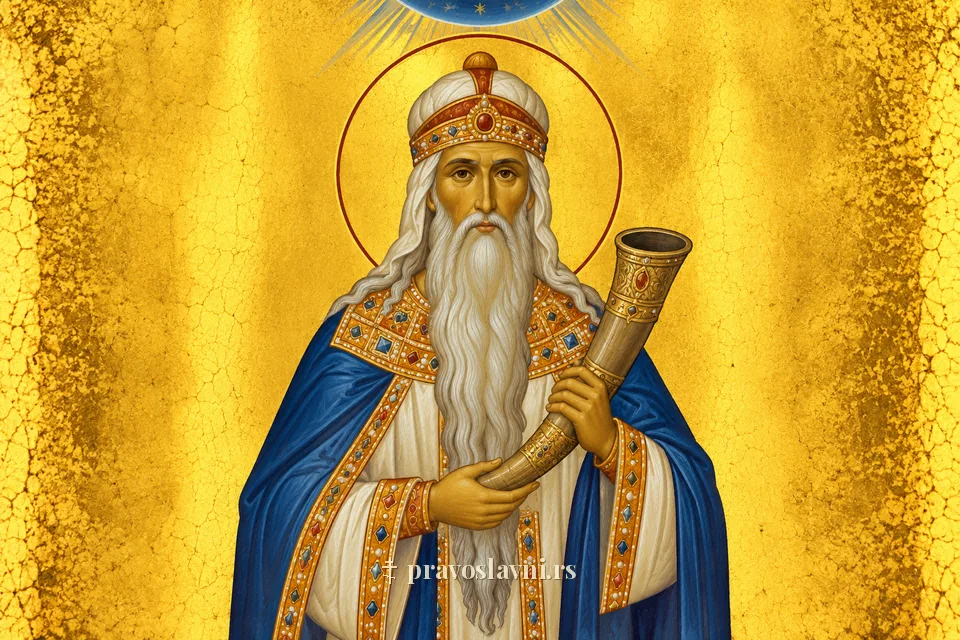
Holy Prophet Samuel
What happenedThe boy Samuel answered God's call by night in Shiloh and became a prophet, a priest and the last judge of Israel.
Read the LifeOrthodox Calendar · 20 August according to the Julian calendar
Thursday, 2 September 202720 August (according to the Julian calendar)What happenedThe boy Samuel answered God's call by night in Shiloh and became a prophet, a priest and the last judge of Israel.
Read the Life
You may eat meat, eggs, milk and dairy products, as well as any other food — but try to be moderate.
More about the fast →
Today the Church keeps the commemoration of a saint · not a Red Letter day.
More about the feast →
“Now the LORD came and stood and called as at other times, ”Samuel! Samuel!” And Samuel answered, “Speak, for Your servant hears.”“
— 1 Sam 3:10By night, in Shiloh, a boy of about twelve heard someone calling him. It was the Lord who was calling him, and the boy's name was Samuel. With that call there began the path of the prophet who would anoint the first two kings of Israel.
Samuel was the son of Elkanah and Hannah of Ramah, of the tribe of Levi. He was born as an answer to the prayers of his mother, who for a long time had no children and who had promised him to God beforehand. That is why, while still a small child, he was taken to Shiloh to serve at the tabernacle. The first revelation that he received was a hard one: the house of Eli would be punished for the iniquities of his sons. The word was fulfilled when the Philistines defeated Israel and carried off the ark.
After twenty years under the Philistines, Samuel called the people to repentance. The people cast away their idols, and God gave them victory over the enemy. Samuel was at that time prophet, priest and judge. In his old age, although he warned the people not to ask for a king, by God's permission he anointed Saul. When Saul was rejected because of his disobedience, Samuel grieved for him, and afterwards in Bethlehem he anointed David, the youngest son of Jesse.
Before his death he took leave of the people. He died in deep old age and was buried in Ramah, and all Israel mourned for him.
Samuel's life teaches that what is given to God from childhood is blessed, and that a faithful servant speaks the word of God even when it is hard.
Samuel was from the tribe of Levi, the son of Elkanah and Hannah, from Ramah, which was later called Arimathea — Joseph of Arimathea was from it too. Hannah was not able to bear a child. She prayed to God for a son and promised that she would dedicate him to the Lord; his Life records that the high priest Eli, watching her as she prayed, at first thought that she was drunk. The name Samuel, according to the Life, means asked of the Lord.
He was three years old when he was given to God and began to serve at the tabernacle in Shiloh, where Eli was the high priest.
When he was about twelve years old, he heard in the night that the Lord was calling him. He answered readily, like a servant who listens to his Master (1 Sam 3:10), and received the revelation that the house of Eli would be punished because of the iniquities of his sons Hophni and Phinehas. The word was fulfilled in the war with the Philistines. Israel was defeated, the ark fell into the hands of the enemy, and both of Eli's sons lost their lives; when the aged Eli, ninety-eight years old, learned what had happened, he fell down dead. The Life adds that in the Philistine city of Ashdod the idol Dagon fell and was broken to pieces before the ark and that punishments struck the Philistines until they returned it.
For twenty years Israel was under the Philistines. Then Samuel called the people to repentance, and the people responded: the idols of foreign gods were removed, and from then on Samuel was prophet, priest and judge in Israel. With God's help he defeated the Philistines; the Life says that this was at Mizpah, when after his sacrifice and prayer thunder struck the enemy. According to the Life, he judged the people by going round from town to town, and he lived in Ramah, where he raised an altar. The Prologue calls him the fifteenth and last judge of Israel.
When Samuel grew old, the people asked for a king. He warned them, but they held to their wish, and by God's permission he anointed Saul, the son of Kish from the tribe of Benjamin. Because of his disobedience Saul was rejected by God — the Life states that in the war with the Amalekites he spared King Agag — and Samuel grieved for him. Then in Bethlehem he anointed as the future king David, the youngest son of Jesse. His Life also records how at harvest time, at Samuel's prayer, thunder and rain came, so that the people feared the Lord.
Before his death he gathered the people and took his leave of them; the Life says that he gave his farewell address in Gilgal. He died in deep old age, all Israel mourned him, and he was buried at his house in Ramah. The Life recalls that Sirach also praises him in his book (Sir 46).
On this day the Prologue admonishes us to repent now, for no one knows the hour of his death. All his life Samuel remained a child given to God — a faithful servant who called the people to repentance and spoke the word of God even when it was hard.
St Philip was Bishop of Heraclea in Thrace, and before that, according to his Life, a deacon and a presbyter. With him in his ministry were his disciples, the presbyter Severus and the deacon Hermes. When the pagans came against the church, Philip told their leader that God is not shut up within walls, but that “He lives in hearts”. His Life says that he refused to hand over the church vessels and books; the church was nevertheless pulled down, and the books were burned. Before the authorities he said, according to his Life: “We have been taught to show obedience to emperors, but not divine honour”, and both he and Hermes refused to offer sacrifice. His Life records that they went to prison joyfully, singing psalms, and that later too, under guard in a private house, they continued to serve and to teach. They ended their lives in Adrianople: there, after they had been imprisoned and tortured, they were given over to the fire, and their bodies were then thrown into the river Maritsa. According to his Life, the Christians of Adrianople drew their remains out of the river with nets and buried them near the city. Severus, while still in prison, prayed that he too might receive the same crown and, as the Life says, he suffered three days later. Other Christians also suffered with them, and the Prologue thinks that this was under Diocletian. Philip teaches us that God lives in hearts, and not only in buildings, and that a Christian respects the authorities, but worships God alone.


