Saint of the day
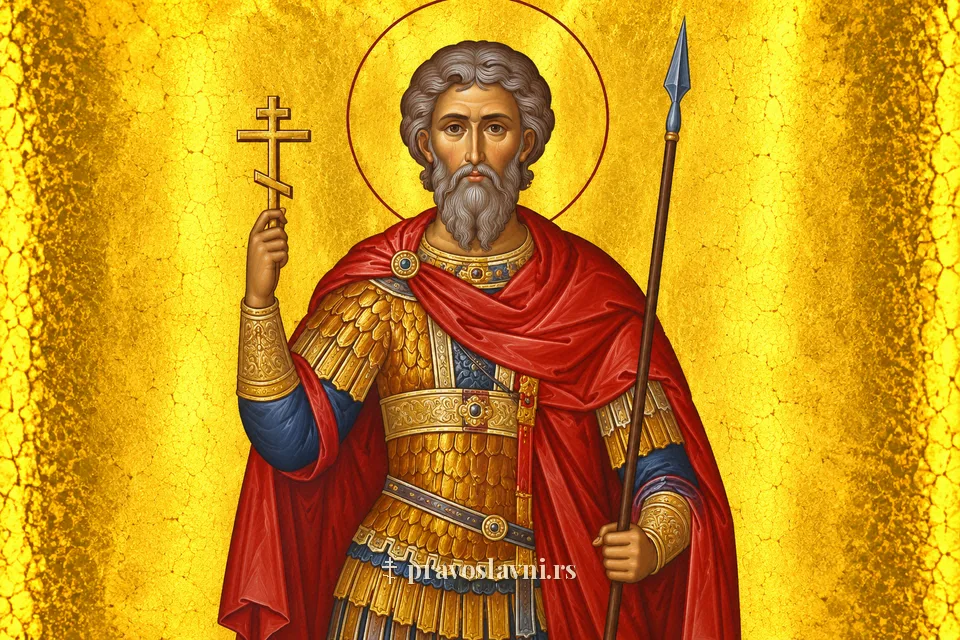
Holy Martyr Andrew Stratelates and those with him
What happenedThe commander Andrew, who ascribed his victory over the Persians to Christ, suffered for the faith together with 2,593 soldiers.
Read the LifeOrthodox Calendar · 19 August according to the Julian calendar
Wednesday, 1 September 202719 August (according to the Julian calendar)What happenedThe commander Andrew, who ascribed his victory over the Persians to Christ, suffered for the faith together with 2,593 soldiers.
Read the Life
No meat, dairy products, eggs, fish or oil — food cooked in water.
This is a recommendation — for your own fast, consult your priest or spiritual father.More about the fast →
Today the Church keeps the commemoration of a saint · not a Red Letter day.
More about the feast →
“Finally, my brethren, be strong in the Lord and in the power of His might.”
— Eph 6:10Where thousands of soldiers were put to death in the mountains, a spring appeared whose water, according to the Prologue and the Life, healed every disease. In this way God glorified the martyrs who had followed St Andrew.
Andrew was a tribune of the Roman army in Syria, in the time of Emperor Maximian, and the Life says that at that time he believed in Christ in secret, being still unbaptised. When the Persians attacked, he was appointed stratelates, that is, commander. Before the battle he told the soldiers to call upon Christ, the only true God, and the enemy was utterly routed. According to the Life, after that victory many of the soldiers came to believe.
In Antioch envious men accused him of being a Christian, and he did not deny it. The Life records his answer to the threats: “Those words of Antiochus fill me with courage rather than with fear.” The torture, according to the Life, by God's will did him no harm. The emperor released him from prison, because he knew how much the army and the people loved him, but he was planning to have him put to death later.
Warned by God, Andrew went with 2,593 soldiers to Tarsus in Cilicia, where Bishop Peter baptised them. They then withdrew into the mountains and waited in prayer. The soldiers found them ready for death; without a fight they accepted martyrdom. Bishop Peter buried them in secret, and from the spring, according to the Life, many sick people were healed, as was a cleric who was tormented by an unclean spirit.
St Andrew reminds us that the glory of Christ is greater than any earthly victory and that the faith of one man can lead thousands after him.
Andrew was a tribune in the Roman army in the time of Emperor Maximian and served in Syria; the Prologue says that he also came from there by birth. His Life records that at first he believed in Christ secretly and was not yet baptised. His faith, however, did not remain hidden for long.
When the Persians attacked, Andrew was appointed stratelates, the supreme military commander, and he led the army against them. Before the battle he called on the soldiers to invoke Christ, the one true God; the Life adds that he told them that the pagan gods could not help them. The Persians were utterly defeated, and according to the Life many soldiers came to believe after that victory.
Glory did not protect him from envy. When he returned to Antioch, envious men accused him of being a Christian, and he openly admitted it. According to the Life, Antiochus, who governed Syria, sent envoys to him with threats, and Andrew answered them: “Those words of Antiochus fill me with courage rather than with fear.” He reminded them that those who had suffered for Christ before him had received crowns. The Life says that he was tortured, but that by the will of God nothing harmed him, and some of his soldiers suffered as well.
Then he was thrown into prison. The Emperor knew how much the army and the people loved him, so he ordered that he be released, while in his own mind he was planning to put him to death later under some other pretext.
Warned by a revelation from God, Andrew secretly went with 2,593 soldiers to Tarsus in Cilicia, where Bishop Peter baptised them all. His Life records that Seleucus, the governor of Cilicia, received an order to seize them and arrived in Tarsus after them, but they had already gone. They took refuge in the Taurus mountains — the Prologue calls them Armenian, and the Life mentions a gorge with only one entrance — and there they waited in prayer.
According to the Life, Andrew begged his companions to remain of one mind and to lay down their lives out of love for God, like the first martyr Stephen. He prayed that God would receive their souls, that He would help those who would commemorate them, and that He would make that place a source of healings. The soldiers found them at prayer and put them all to death. No one resisted: the Life says that they knelt down and offered their necks themselves, and the Prologue that they all longed for martyrdom.
At the place of the martyrdom, according to the Prologue and the Life, a spring appeared whose water healed every illness. Bishop Peter buried the martyrs secretly and with honour; the Life says that this was at the very place of their suffering and that Peter then went away to Isauria. According to the Life, a cleric was freed from an unclean spirit after he drank from that spring, and many of the local people found healing there.
The victorious commander gave all the glory to Christ and preferred a heavenly crown to earthly honour. The thousands of soldiers who followed him bear witness to how much the faith of one man can do.


