Saints of the day
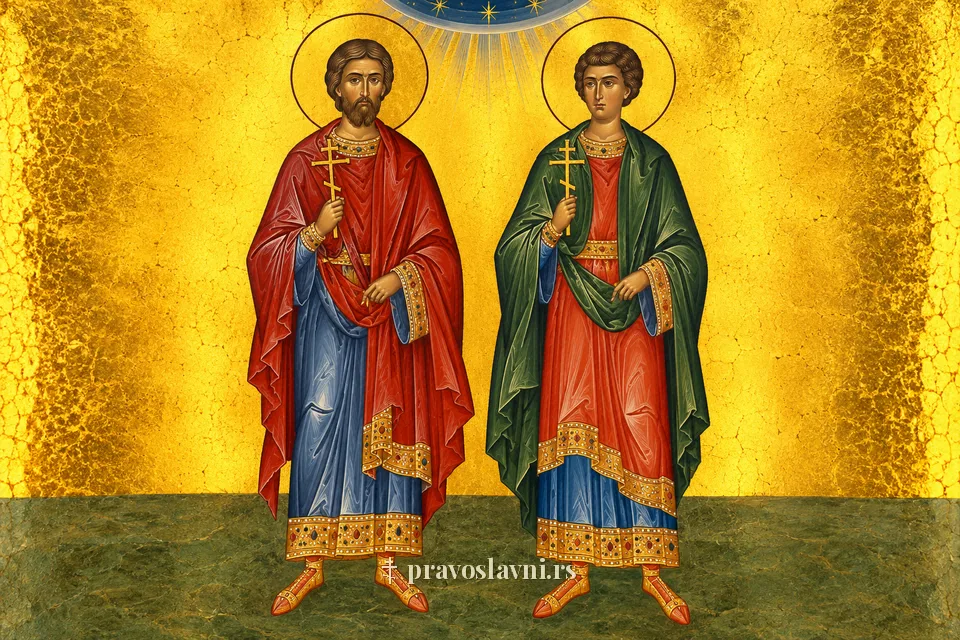
Holy Martyrs Florus and Laurus
What happenedSts Florus and Laurus, brothers and stonemasons, dedicated to Christ a temple that was meant for idols, and then suffered in Illyria.
Read the LifeOrthodox Calendar · 18 August according to the Julian calendar
Tuesday, 31 August 202718 August (according to the Julian calendar)What happenedSts Florus and Laurus, brothers and stonemasons, dedicated to Christ a temple that was meant for idols, and then suffered in Illyria.
Read the Life
You may eat meat, eggs, milk and dairy products, as well as any other food — but try to be moderate.
More about the fast →
Today the Church keeps the commemoration of a saint · not a Red Letter day.
More about the feast →
“For no other foundation can anyone lay than that which is laid, which is Jesus Christ.”
— 1 Cor 3:11Florus and Laurus were brothers, zealous Christians and stonemasons; according to the Prologue, they lived in Illyria in the 2nd century. The Life says that they learned their craft and a God-pleasing way of life from Sts Proclus and Maximus, who suffered for Christ before them. According to the Life, they were sent to build a great temple to the idols, and all the money they earned they gave to the poor, living in fasting and prayer and instructing the poor in the faith of Christ.
A chip of stone injured the eye of the son of a pagan priest, and the priest threatened them. The brothers promised healing if they would believe in their God, prayed with tears and made the sign of the cross over the eye, and the young man at once regained his sight. The priest Mamertinus and his son came to believe in Christ.
Over the finished temple the brothers raised a cross and dedicated the temple to the Lord Jesus Christ, spending the whole night in chanting, and according to the Life they also smashed the idols prepared for the temple. The prince then arrested them, and Mamertinus, his son and many other Christians were put to death by fire. Florus and Laurus were sent to the governor of Illyria, who, since they did not yield, buried them alive in a deep well. Their relics were uncovered only after many years and solemnly translated to Constantinople.
The faith of the brothers showed itself in prayer, work and mercy. The healing of one eye opened the eyes of the priest's family to Christ, and a temple intended for idols became a church of Christ.
Florus and Laurus were brothers — according to the Prologue, in blood, in spirit and in trade — zealous Christians and stonemasons. According to the Prologue, they lived in Illyria in the 2nd century. The Life says that they learned their trade and a God-pleasing life from Sts Proclus and Maximus, who suffered for Christ before them.
According to the Life, the Illyrian governor Licion sent them, at the request of a neighbouring pagan prince, to build a great temple to the idols. According to the Life, they gave all the money they earned to the poor; they spent the day in work and the night in prayer, they lived in fasting and instructed the poor in the faith of Christ.
While they were working, a small piece of stone struck the eye of the son of a pagan priest, and the enraged priest threatened them; according to the Life, the other workmen said that the young man had been standing too close. The brothers promised healing if they would believe in their God. The brothers prayed with tears and made the sign of the cross over the eye, and the young man at once regained his sight. The priest Mamertinus and his son believed in Christ, and according to the Prologue they were also baptised.
Over the finished temple the brothers raised a cross — according to the Life, facing east — and dedicated the temple to the Lord Jesus Christ, spending the whole night in chanting. According to the Life, there were up to three hundred poor believers with them, and a heavenly light filled the temple. According to the Life, they also smashed the idols that had been prepared for the temple.
The prince had the brothers and their companions arrested. Mamertinus, his son and many other Christians were put to death by fire. Florus and Laurus were sent to the Illyrian governor, who, since they did not give way, buried them alive in a deep well.
Their relics were found only much later and solemnly translated to Constantinople, and according to the Life, people sick with the most varied illnesses recovered through them.
The faith of the holy brothers showed itself in prayer, work and mercy. Only the true God heals: the healing of one eye opened the eyes of the priest's family to Christ, and the temple intended for idols became a church of Christ.
Venerable John of Rila, whose relics rest in the Rila Monastery, was born in the village of Skrino near Sofia, during the reign of Tsar Boris, into a poor but honourable family. After the death of his parents he became a monk — according to his Life, after he had given away his inheritance to the poor — and he lived as a hermit first in a cave in a wild forest, and then on the Rila mountain, in the hollow of a tree, feeding only on plants. Even in solitude he was not spared: he was attacked by demons, by men and by robbers, and his own relatives also caused him troubles. He spent long years without meeting anyone, until shepherds searching for their flock stumbled upon him. Then the sick and the afflicted began to come to him, and many were healed by his prayer, while he, according to his Life, used to say: “that is not in my power”, ascribing the healing to God. The Bulgarian Tsar Peter also heard of him; according to the Prologue, he visited him in order to hear his counsel, while according to his Life the humble ascetic avoided that meeting and sent his instruction to the tsar by letter. A brotherhood gathered around him, and a church and a monastery were built. He reposed in peace on 18 August 946 (according to the Julian calendar), at the age of seventy, and even after his death he appeared to his disciples. His relics were translated first to Sofia, then to Hungary, then to Tarnovo — according to his Life in the time of Tsar John Asen — and finally to the Rila Monastery; according to his Life, after the fall of Tarnovo to the Turks, Mara Branković also deserves credit for that translation. His Life mentions that the monastery was also renewed by Serbian rulers, King Milutin and Tsar Dušan, and according to the Prologue the monastery was a source of miracles and consolation for Bulgarian Christians, especially under Turkish rule.


