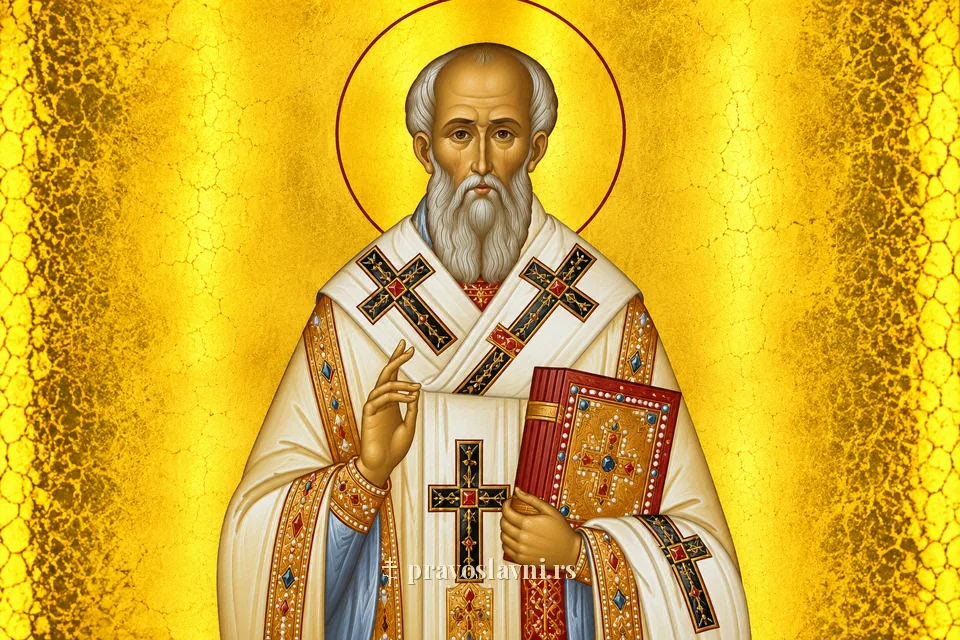
Saint of the day
Hieromartyr Eutychius
What happenedA disciple of the Apostles John and Paul, St Eutychius remained unharmed in the fire and among wild beasts, and he was beheaded in his native Sebastopolis.
Read the LifeOrthodox Calendar · 24 August according to the Julian calendar
Monday, 6 September 202724 August (according to the Julian calendar)What happenedA disciple of the Apostles John and Paul, St Eutychius remained unharmed in the fire and among wild beasts, and he was beheaded in his native Sebastopolis.
Read the Life
You may eat meat, eggs, milk and dairy products, as well as any other food — but try to be moderate.
More about the fast →
Today the Church keeps the commemoration of a saint · not a Red Letter day.
More about the feast →
“I have no greater joy than to hear that my children walk in truth.”
— 3 Jn 1:4St Eutychius ended his life in the very place where he had begun it — in Sebastopolis. According to the Life, he was brought to his native city in chains from Ephesus, and there he was beheaded with the sword. Between those two cities there lay a life spent beside the apostles and in preaching.
According to the Life, Eutychius left his parents and friends for the sake of the Gospel. His teachers were two great apostles, John the Theologian and Paul. He accompanied them on their journeys, and with Paul, as the Life says, he shared both preaching and hardships. From the apostles he received episcopal ordination, and so he himself also travelled far to preach Christ. Although he is not numbered among the Seventy, the Church calls him an apostle, because he lived and preached as they did.
On that path he was never alone. The Prologue and the Life say that an angel accompanied him. When he had gone hungry for a long time in prison, he received bread from heaven — according to the Prologue, an angel brought it to him, and according to the Life, it was held out to him by a hand that could not be seen. Neither fire nor wild beasts did him any harm: according to the Life, the fire was put out by rain and snow, the beasts were tame, and one lion even glorified Christ with a human voice. When they tortured him, according to both sources, sweet-smelling myrrh flowed out together with the blood.
Eutychius bears witness that a disciple who faithfully follows the apostles is not without God's protection, right up to the end which God has appointed for him.
Eutychius was born in Sebastopolis. According to the Life, the preaching of the Gospel was enough for him to leave his parents and friends and join the Apostle John the Theologian. He was a disciple and travelling companion of John the Theologian and of the Apostle Paul. He was with Paul, as his Life records, inseparably, sharing with him both the preaching and the hardships.
He did not belong to the Seventy Apostles. The Church nevertheless gives him the name of apostle, because he was a disciple of the apostles and preached with their zeal.
The apostles ordained him a bishop, and he travelled far, preaching Christ. According to the Life, he was not alone on those roads: an angel strengthened him and told him beforehand what would befall him.
Not even in prison was he left without God's care. After he had gone hungry for a long time, he received heavenly bread: the Prologue says that an angel brought it to him, and the Life — that an invisible hand brought it. Nor did his torments pass without a sign: according to the Prologue and the Life, his wounds gave forth not only blood, but also myrrh with a pleasant fragrance.
He was thrown into the fire, but the Life says that rain and snow from heaven put the fire out. He was also thrown to the wild beasts, and again nothing happened to him; according to the Life, the beasts were tame before him and did not touch him. His Life also records that a lion glorified Christ with a human voice, and it compares that miracle with Balaam's donkey.
At last he was beheaded in Sebastopolis, the city in which he had also been born; according to the Life, they brought him there from Ephesus in chains. From his native city he had set out after the apostles, and to it he returned to finish his road as a martyr.
Eutychius carried the zeal of the two great apostles into his preaching and into his suffering. God kept him through every torment, right to the end that was appointed for him, and fire, beasts and hunger could not separate him from Christ.
St Syra was a Persian; the Prologue says that she was the daughter of the chief pagan priest, a fire-worshipper, and a kinswoman of St Mary Golinduc. She was brought up in paganism, and she learned of Christ from poor Christian women; according to her Life, she went to church in secret and fasted, hiding her faith from her father. When she fell ill while still unbaptised, she asked the priest for some dust from the church, and when he refused, because she was not baptised, she, believing with all her heart, touched the priest's vestment, and the illness left her. Her Life says that by prayer and the sign of the Cross she drove away demonic temptations and that visions gave her courage for martyrdom. According to her Life, she renounced the idols before everyone with the words: “I am a Christian!” Her father handed her over to be tortured, and she was comforted by heavenly visions — according to her Life, of Moses, Elijah and the Apostle Peter. According to her Life, she was thrown into a deep, foul-smelling pit, but the pit shone with light, her chains fell off, and instead of the stench a pleasant fragrance spread. By night a bishop baptised her secretly in one of the city's churches, and God, as her Life says, gave her the gift of healing, so that those who touched her clothing or her chains recovered. They led her in chains with the royal court from place to place, and she, according to her Life, sang psalms along the way and rejected both promises and threats. She was strangled with a rope in the time of the Persian King Chosroes the Elder — according to the Prologue, in the year 558, in the eighteenth year of her life. Her Life says that the dogs would not touch her body, and the Christians buried her with honour. A girl from a household of pagan priests found Christ through poor Christian women and remained faithful to Him through every trial.


