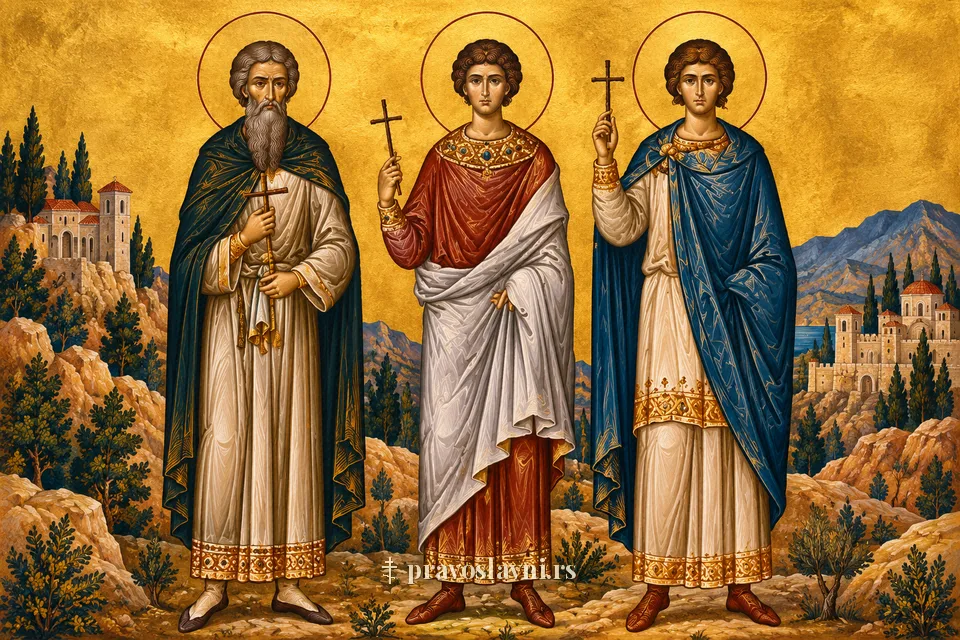
Saints of the day
Holy Martyrs Trophimus, Sabbatius and Dorymedon
What happenedTrophimus and Sabbatius in Antioch would not bow down to idols; in Phrygia the senator Dorymedon joined them — and the wild beasts did not touch them.
Read the LifeOrthodox Calendar · 19 September according to the Julian calendar
Saturday, 2 October 202719 September (according to the Julian calendar)What happenedTrophimus and Sabbatius in Antioch would not bow down to idols; in Phrygia the senator Dorymedon joined them — and the wild beasts did not touch them.
Read the Life
You may eat meat, eggs, milk and dairy products, as well as any other food — but try to be moderate.
More about the fast →
Today the Church keeps the commemoration of a saint · not a Red Letter day.
More about the feast →
“And do not fear those who kill the body but cannot kill the soul.”
— Mt 10:28Antioch in the third century, in the time of the Emperor Probus. The city is celebrating Apollo, and the merrymaking spreads as far as nearby Daphne. Among those who came to the city in those days were two Christians, Trophimus and Sabbatius. Their Life says that they wept over the error of the people and prayed for them. Those tears did not go unnoticed, and soon both of them were standing before the governor Atticus. He was expecting frightened strangers, but before him stood confessors.
Trophimus was not frightened either by threats or by tortures, and under the blows he remained steadfast. Sabbatius, when asked about his rank, answered, as the Prologue records: “my rank and my dignity, and my homeland, and my glory, and my wealth is Christ…” He did not come out of the tortures alive — he died in Antioch. So the first of the three reached the goal.
Trophimus was sent to Phrygia, to the cruel Dionysius. In Synnada he would not consent to bow down to the idols, but in his torments he kept repeating the psalm: “Many are the afflictions of the righteous, but the Lord delivers him out of them all.”
There lived the senator Dorymedon, according to their Life a secret Christian. Now his faith spoke out in deeds: he began to help the wounded prisoner, no longer caring about the danger. He confessed Christ publicly when he stayed away from the festival of Castor and Pollux. The tortures did not break him either.
Both of them were thrown to the wild beasts. The Prologue records that a she-bear did them no harm. Neither a lynx nor a lion touched them. Their Life says that then all the people saw that the God of the Christians is true and almighty. Nevertheless, Trophimus and Dorymedon were condemned to death and executed, and so in eternity they are together with Sabbatius once more.
The two newcomers did not keep silent before error, and the powerful senator did not remain in the shadows. Each of them could have hidden or given way, but not one of them did so. Dorymedon reminds us in particular that it is never too late to stand on the side of the truth, however long we have kept silent out of fear. We learn from them that no one can take from us Christ, our true treasure.
Three men, and one goal. Two newcomers could not look upon error and keep silent. The third hid his faith for a long time, and then confessed it before the whole city. The Church glorifies them together: Trophimus, Sabbatius and Dorymedon.
It was in the third century, in the time of the Emperor Probus. Antioch was celebrating Apollo, and the main festivities were taking place in nearby Daphne. Atticus, the governor of the city, who was also known as Heliodorus, was making sure that everyone took part in the sacrifices.
Into that festive commotion came Trophimus and Sabbatius, who according to the Prologue were distinguished and respected men. They had not come to quarrel or to tear anything down. Their Life says that they wept and prayed for the people who were bowing down to an idol. Those tears annoyed the people who were celebrating more than if someone had been cursing them. The two strangers were seized and brought before the governor. The judge was expecting frightened men, but what he got was confessors.
Trophimus came from a free and distinguished family, but before the judge he did not shelter behind his origins. He said simply that he belonged to Christ. He met calmly the threat of the cruel Dionysius of Phrygia. They tortured him, and he endured and prayed to God for strength. Not even the mockery of the judge made him waver.
Then Sabbatius was questioned. When he was asked about his rank he answered, as the Prologue records: “my rank and my dignity, and my homeland, and my glory, and my wealth is Christ…” He did not come out of the tortures alive. He breathed his last in Antioch and gave up his soul to the Lord. And so the first of the three reached the goal.
Trophimus was then sent to Dionysius. The road to Phrygia was a new torment, but, according to their Life, the Lord gave him the strength to endure it. In Synnada Dionysius tried to win him over with a promise: just a single sacrifice to the idols would be enough. Trophimus knew that no lengthening of his life was worth a betrayal. Under new tortures he sang a verse from the psalm: “Many are the afflictions of the righteous, but the Lord delivers him out of them all.” Then they threw him into prison. But the prison was not the end; it was the beginning of a new story.
Here Dorymedon comes onto the scene, one of the foremost men of Synnada, a senator and a city councillor. He was, according to their Life, a secret Christian. Now his hidden faith began to show itself in deeds: he cared for the wounded prisoner as much as he possibly could.
Then came the city festival of Castor and Pollux. Dorymedon's absence did not escape Dionysius, and so he sent men to fetch him. The senator no longer wished to hide. He told the messengers the truth about his faith, and by this he handed himself over to the persecutor. At the trial neither promises nor threats made him waver, and reputation and position no longer meant anything to him. They tortured him, and he called upon Christ without ceasing.
Dionysius then decided to throw Trophimus and Dorymedon to the wild beasts, in front of the people. But in the arena something happened that no one had expected: the beasts would not attack. The Prologue mentions a she-bear that did them no harm. Neither the lynx nor the lion, which were let loose after her, touched them. The lion attacked only the keeper who was trying to enrage it. Their Life says that then all the people saw that the God of the Christians is true and almighty. Only Dionysius remained hard.
He condemned them to death, and both of them fell by the sword. And so Trophimus and Dorymedon went after Sabbatius, into the Kingdom for which they had lived.
Each of them had something to lose — reputation, freedom, position. Not one of them lost what was most precious. The story of Dorymedon speaks especially to all of us who are sometimes silent out of fear: it is never too late to stand by the truth. Their example teaches us that no one can take away from us Christ, our true treasure.
St Irinej was born in 1884 in Sremski Karlovci as Ivan Ćirić and was orphaned early: he and his brother Stevan were cared for in Novi Sad by their uncle, Archpriest Milan Ćirić. A scholarly career lay before him — after the Theological Academy in Moscow he took a doctorate in philosophy in Vienna — but he chose the monastic path and at Hopovo became Irinej. As a bishop he served first, from 1919, in the Diocese of Timok, and at the end of 1921, at his own request, he moved to Bačka. The brightest moment of his ministry came in the darkest of times: during the Second World War he rescued more than 2,800 Serbian children from the Hungarian camp at Šarvar (Sárvár). He placed them in homes throughout Bačka, and for the sick he opened hospitals. After the war the new authorities declared him an enemy of the people and kept him under house arrest for seventeen months. The stones of an enraged mob flew at the Bishop's Palace, and one of them struck the aged bishop on the head. On the feast of the Transfiguration in 1946, in Odžaci, he was severely beaten, and the deacon Mladen Ružić stood between him and the attackers. He bore the consequences until his death, but, according to his Life, he did not repay his slanderers with evil. From those years his Life also remembers his words: “The more I suffer, the more I pray to God.” He died on 6 April 1955, and his body was laid in the crypt of the Cathedral Church of St George in Novi Sad. St Irinej, the translation of whose relics we celebrate today, teaches us that hatred is not overcome by hatred, but by prayer and patience.
Separate page: Translation of the Relics of St Irinej (Ćirić), Bishop of Bačka →


