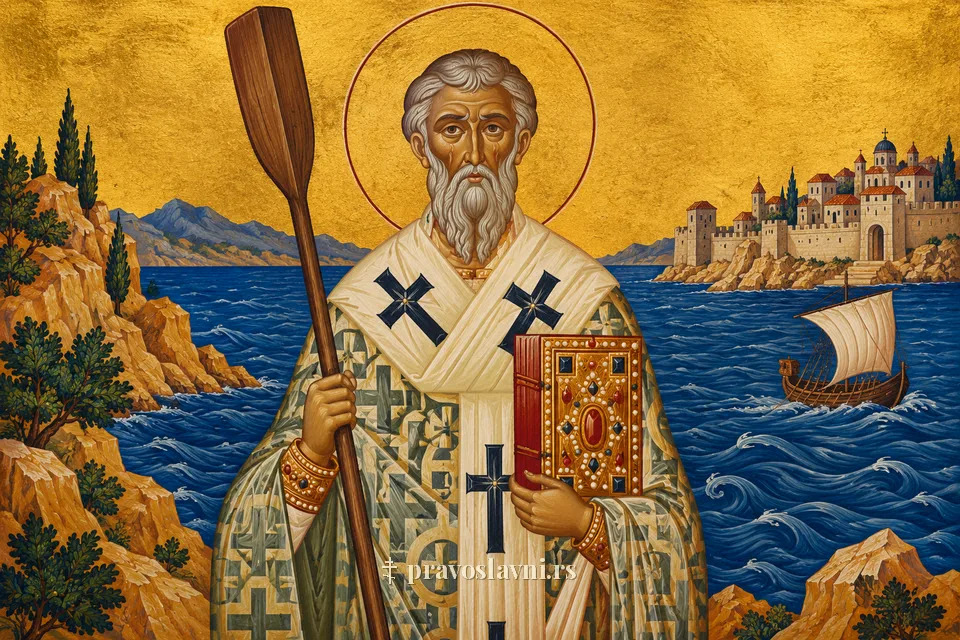
Saint of the day
Hieromartyr Phocas
What happenedA Bishop of Sinope on whose head, in a vision, a dove laid a wreath — and who was not afraid of martyrdom.
Read the LifeOrthodox Calendar · 22 September according to the Julian calendar
Tuesday, 5 October 202722 September (according to the Julian calendar)What happenedA Bishop of Sinope on whose head, in a vision, a dove laid a wreath — and who was not afraid of martyrdom.
Read the Life
You may eat meat, eggs, milk and dairy products, as well as any other food — but try to be moderate.
More about the fast →
Today the Church keeps the commemoration of a saint · not a Red Letter day.
More about the feast →
“Do not forget to entertain strangers, for by so doing some have unwittingly entertained angels.”
— Heb 13:2St Phocas was a native of Sinope on the Black Sea, the son of Pamphilus and Maria. According to his Life, God endowed him with grace early on, and many suffering people went away from him healed. The people of Sinope had known him since he was small and they trusted him, so when they needed a shepherd they looked no further. According to the Prologue, he was a support to the Christians, and many pagans too became Christians because of him.
The idolaters in the city, according to the Prologue, hated him. God then revealed to Phocas what awaited him, and He did so by a sign — a wreath from heaven. The Prologue also gives the words that he heard: “your cup is filled, and you must drink it!” It was not hard to understand: martyrdom awaited him, but his suffering would not be in vain. Flight never crossed his mind, nor did the thought of leaving his people. He was thankful to God for everything.
In the time of the Emperor Trajan he was brought before the governor Africanus, who demanded that he bow down to the idols. The bishop would not. Neither fair words nor threats moved him. They tortured him cruelly, but, according to his Life, God did not leave him for a moment, neither under torture nor in prison. His Life explains where such peace came from — he was thinking of Christ's sacrifice, not of his own torment. David's words, “My heart is steadfast, O God”, were his words too.
According to the Prologue, he died in boiling water. His Life adds that he went to God in prayer. God, as it relates, did not forget him even after death, but glorified him with miracles. The death that his torturers had intended for him did not separate him from God, but brought him to Him.
Neither the Prologue nor his Life mentions that he ever wavered. St Phocas teaches us that a man who knows whose he is calmly meets even that from which others flee. None of us stands before a torturer today, but each of us sometimes chooses between the easier and the more righteous path — and then the bishop of Sinope is a good example for us.
Phocas was born in Sinope, a city on the shore of the Black Sea, the son of Pamphilus and Mary. God endowed him with gifts early on. According to his Life, even in his youth many suffering people went away from him healed. The Prologue says something different about his youth: from his young days he led a pure and upright life, the kind that befits a Christian.
The people of Sinope had known Phocas since he was little. They watched him grow, watched him help others, watched him pray. When a bishop had to be chosen, they chose him. That is no small thing — to be a shepherd to your neighbours and those of your own age, to people who remember you as a boy. Yet Phocas won their trust. According to the Prologue, he was a support to the Christians, and many pagans also became Christians because of him. His Life stresses that the dignity of a bishop did not lull him to sleep: he lived the ascetic life even more strictly than before.
Not everyone was pleased with this. The Prologue does not hide that the bishop thereby made enemies as well: the idol-worshippers in the city hated him.
Then God revealed to Phocas what awaited him. He received a sign from heaven — a crown, and the Prologue also records the words that came with it: “your cup has been filled, and you must drink it!”
The sign did not promise an easy road. In fact, it said two things at once: it will be hard, but it will not be in vain.
What does the crown mean, and what does the cup mean? Christians have always known this: the crown is the reward of a martyr, and the cup is the suffering that must be borne to the end. The Prologue says only this much, that Phocas understood that his martyr's end was drawing near.
He could have fled. He did not. Nor did he abandon his flock. He stayed in Sinope, and the days that were left to him he spent, according to the Prologue, in thanksgiving to God.
When the Emperor Trajan was on the throne, the bishop was brought before the governor Africanus. Only one thing was asked of him: to bow down to the idols. Neither kind words nor threats were of any use — Phocas remained Christ's.
He was tortured cruelly; both the Prologue and his Life confirm this. Yet the main thing in this story is not pain, but the nearness of God. His Life records that not even fire had power over him. God was with him in the dark prison too.
Where does a man find such peace? His Life reveals the secret: Phocas was thinking of Christ's sacrifice, and not of his own torment. According to his Life, David's words “My heart is steadfast, O God” were his words too.
According to the Prologue, he ended his life in boiling water. To his torturers this looked like the final end of the story. For Christians it was the day of his birth into heaven. His Life adds that he prayed until his last breath.
God did not forget His martyr after death either: his Life says that He glorified him with miracles. The death that the torturers regarded as a defeat became his victory.
He could have chosen an easier road: to hide, to fall silent, or to offer sacrifice to the idols just once and stay alive. Neither the Prologue nor his Life records that he wavered — neither when he received the sign from heaven, nor before the boiling water.
That is why the Church remembers him with love to this day. Phocas was neither a general nor an emperor, but a shepherd who did not abandon his flock when things became dangerous. He did not seek glory, yet neither did he run away from the cross. His lesson is simple: a man who knows whose he is meets calmly even the things from which others flee.
Today none of us stands before the governor Africanus or before boiling water. But each of us sometimes has to choose between the easier road and the more righteous one. At such a time it is worth remembering the bishop of Sinope and his cup, which he did not push away.
The Prologue says that more than eight hundred years passed from the Prophet Jonah to Christ. It also gives the tradition that Jonah died as a boy and that Elijah restored him to life, in Zarephath, where his mother lived as a widow; his Life, however, says that his father was Amittai, and it calls the story about Zarephath a tradition. God sent him to the great city of Nineveh, to call the people to repentance. According to his Life, Jonah was afraid that they would torment him there instead of listening to him. So he boarded a ship that was sailing in quite the opposite direction, to Tarshish. When a storm threatened to sink the vessel, the lot showed that Jonah was the cause of the trouble, and he himself asked them to throw him into the sea — and the sea grew calm at once. A whale swallowed him, and inside it Jonah prayed to God for forgiveness for three days and three nights, and then he found himself alive on the shore. When God sent him a second time, Jonah went and proclaimed that Nineveh had forty days left. The city repented in fasting and sackcloth, from the king down to the least of men, and God spared it. Hence, according to the Prologue, Jonah's story is not only a story about flight and repentance — it speaks in advance of Christ's tomb and of the Resurrection. Jonah teaches us that we can always return to God, however far we may have gone.


