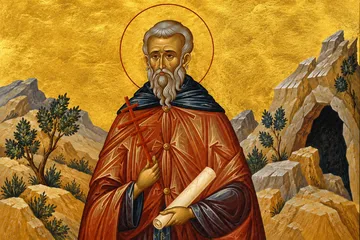
Venerable Euphrosyne
Euphrosyne was the daughter of Paphnutius, a wealthy man of Alexandria, a child for whom her parents, according to her Life, had long prayed to God. Her father taught her the Scriptures himself, because her mother died when she was twelve years old. When she grew up, he betrothed her to the son of a prominent man. But in the monastery to which her father took her for a blessing, she came to love the monastic life. She received the tonsure in secret and, disguised as a man, left home. As the eunuch Smaragdus she was received — who would have thought it — into none other than her father's own monastery.
Paphnutius looked for her everywhere and could not be comforted. The monks too prayed that she might be found, but, according to her Life, God heard a different prayer — hers, that she might remain hidden. The abbot sent the grief-stricken father to none other than Smaragdus. Paphnutius had no idea that his own child was sitting before him, while she, knowing everything, consoled him by saying that he would see his daughter before his death. Thirty-eight years went by in this way.
On her deathbed she revealed herself to him in the words that the Prologue records: “I am Euphrosyne, your daughter; you are my father!” After that Paphnutius himself chose her path. He spent the rest of his life as a monk in the place where she had lived the ascetic life, and he was buried beside her. For the sake of Christ a person can leave even what is dearest to him — and in the end God gives it back to him.
Venerable Sergius of Radonezh
Venerable Sergius was born in Rostov in the year 1314, and as a boy he was called Bartholomew. He simply could not learn his letters, until an old monk blessed him in a field; his Life says that after that reading came easily to him. He stayed with his parents until their death, and then he gave away his property and went with his brother Stephen into the forest at Makovets. There they built a church of the Holy Trinity. His brother gave up, but Bartholomew stayed on alone and as a monk received the name Sergius. According to his Life, he defended himself from the demons by prayer, and he shared his bread even with a bear.
A brotherhood gathered around him. When he became abbot, he still carried water and chopped wood himself. Metropolitan Alexis wanted Sergius to succeed him, but he refused, for he did not care for honours. Before the Battle of Kulikovo Prince Dimitry came to him, and Sergius, as the Prologue says, foretold to him the victory, which came in the year 1380. His Life records that the Most Holy Theotokos visited him and promised that she would watch over his monastery.
He reposed in the year 1392. He teaches us that humility, labour and prayer, without any desire for honours, can do more than any force.
Full Life
Venerable Euphrosyne
The daughter her father obtained by prayer
Paphnutius, a prominent and wealthy man of Alexandria, had everything except a child. He and his wife, according to her Life, prayed to God for offspring for a long time, and he especially honoured one monastery and asked the monks there to pray for him. God heard them: Euphrosyne was born.
The little girl lost her mother early — she was twelve years old. From then on her father was everything to her, both parent and teacher, and he himself instructed her in the Holy Scriptures. She grew into a beautiful and wise young woman, and Paphnutius found her a prominent and wealthy bridegroom.
A decision made in silence
One visit changed everything. Before the wedding her father took her to that same monastery to receive a blessing, and Euphrosyne, according to her Life, watched for several days how the monks lived. From then on marriage was no longer on her mind. She knew that this decision would wound her father, and that weighed on her most of all. She took counsel with one of the monks and secretly received the monastic tonsure.
The boldest step was still to come. No one would have thought of looking for her among the monks, and that is exactly where she went — to her father's monastery, disguised as a man, as the eunuch Smaragdus.
The father and the monk
The grief of Paphnutius was great. He searched for her everywhere, and he called on the monks for help as well. So two prayers met before God — the father's, that he might find her, and hers, that she might remain hidden — and according to her Life, God heard hers.
The most moving part of the story is still to come. The father sought comfort from the abbot too, and the abbot sent him to none other than Smaragdus. Father and daughter found themselves face to face. Paphnutius never dreamed that he was talking with his own child, while she listened to his every word knowing who was speaking it. Instead of revealing herself, she comforted him by saying that he would see his daughter before he died. And so it went on for thirty-eight years: Paphnutius came for comfort, never suspecting to whom he was coming.
The secret revealed
Only on his deathbed did Smaragdus call Paphnutius to be at his side. On the third day, as the Prologue records, she said to him: “I am Euphrosyne, your daughter; you are my father!” Her last wish was that her father himself should bury her and that the monastery should receive her inheritance. Soon after that she reposed.
According to her Life, her body brought healing to a monk who could not see in one eye. And the father? What he had sought for years he found in the end — and he set out on the same path. He gave away everything he had and became a monk. He spent his last years in the place where she had kept her secret for so long, and he was given a grave beside hers.
Euphrosyne teaches us that nothing is too much when it is given to Christ. For His sake a person can leave even what is dearest to him — and in the end God gives it back to him.
Venerable Sergius of Radonezh
The boy who could not learn his letters
Sergius came into the world in Rostov in the year 1314, as the son of the devout Cyril and Maria, and in childhood his name was Bartholomew. His brothers learned to read easily, but nothing would go right for him. One day in the field he met an old monk and asked him for his prayers, so that he might be able to learn. From the elder, according to his Life, he received a blessing and a small piece of prosphora. After that his studies came easily to him. So, while still a boy, he learned that God hears a humble prayer.
Alone in the forest
He wanted to enter a monastery, but his parents had grown old, and so he stayed with them to the end. When they died, he divided his inheritance among others. With his brother Stephen he went far into the forest on Makovets. There, in the wilderness, a hut and a small church of the Holy Trinity arose. His brother could not endure it and went away, and Bartholomew remained alone — in the wilds, without people and without any protection except God's. Abbot Mitrophan tonsured him a monk and gave him the name Sergius. According to his Life, his nights were full of demonic terrors, but prayer was stronger. Even a bear began to come to him for bread, and Sergius did not refuse it.
A servant to all
Soon people came to know of him, and a brotherhood gathered around him. For a long time he did not want to be abbot, and when he agreed, no task was beneath his dignity, from carrying water and wood to baking prosphora. His Life records that by prayer he brought a dead child back to life, but he told the father that the little one had only been chilled through. He did not want the miracle to glorify him, but God. Metropolitan Alexis wanted to leave him his throne, but Sergius refused, because gold and honours were not for him.
When Khan Mamai set out against Russia, Prince Dimitry came for a blessing. The Prologue says that Sergius foretold victory for him, and that word was fulfilled on 8 September 1380, on the Field of Kulikovo. His Life also says that, praying while the battle lasted, he followed in spirit what was happening, and so he announced the victory to the brethren. Thus the prayer of one humble monk found itself at the centre of the destiny of an entire people.
According to his Life, he was also granted a visit from the Most Holy Theotokos, who was accompanied by the Apostles Peter and John, and from her he heard the promise that his monastery would always have her protection. Sergius reposed in the year 1392, and thirty years later his incorrupt relics were found.
He had neither an army nor gold, and yet his word strengthened both the prince and the people. His life shows that humility, labour and prayer, without any desire for honours, can do more than any power.