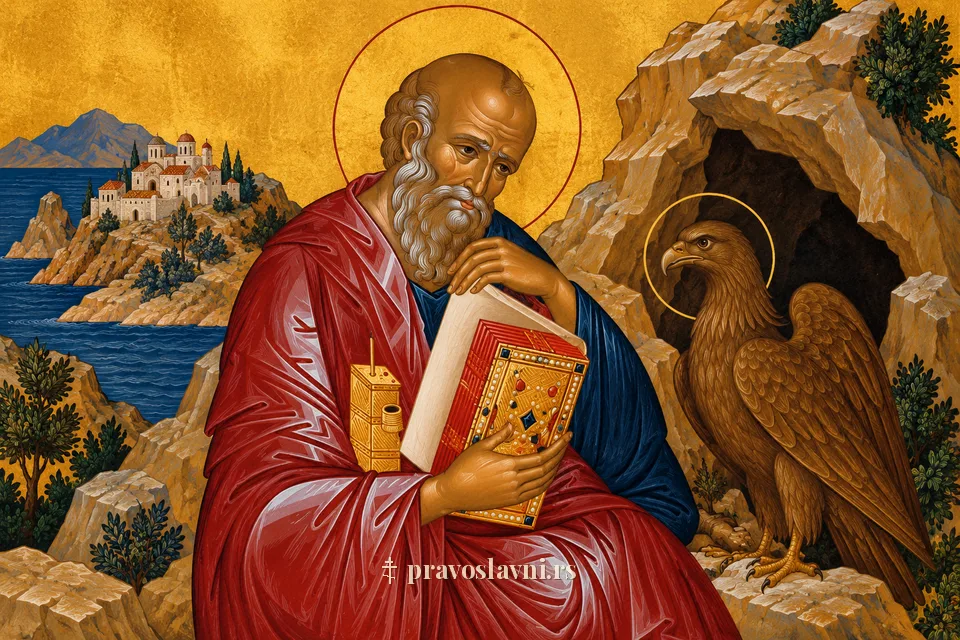
John was a Galilean fisherman, the son of Zebedee and Salome and the brother of James. When Christ called him, according to the Prologue, he went without hesitation and stayed with Him to the end. He and James received from the Lord the name “Sons of Thunder”. Together with Peter they were the closest witnesses of Christ's works, while John himself, in his Gospel, calls himself only “the disciple whom Jesus loved”.
When they seized Christ, the disciples scattered. The Prologue stresses that John was nevertheless on Golgotha beside the Cross, together with the Theotokos. There the Crucified One entrusted His Mother to him: “Behold your mother!” John took her into his own home and cared for her until she fell asleep.
After that Asia Minor and Ephesus became his home, and with him was his disciple Prochorus. According to his Life, in Ephesus they were at first servants in the bathhouse of the cruel Romana. When the son of the city's ruler was killed there, and the father himself died of grief, John raised them both by his prayer. After that Romana was baptised with her whole household. His Life also records that the temple of Artemis collapsed at his prayer, so that many Ephesians came to believe.
Under Domitian, according to the Prologue, he was taken to Rome as a prisoner. They tried to get rid of him in various ways, but God protected him, and in the end he was banished to Patmos. The island of exiles gave the world the Apocalypse and the Gospel that begins with the words: “In the beginning was the Word.”
When he returned to Ephesus, there happened what his Life relates on the authority of Clement of Alexandria. A young man whom John had baptised had gone off to join the robbers. John, by now an old man, went to look for the lost one himself. His love was stronger than the young man's shame, and he brought him back into the Church.
According to the Prologue, he reposed in deep old age, at more than a hundred years. His Life says that his body was not found in the tomb afterwards.
He alone among the apostles remained beneath the Cross. John shows us that there is no power stronger than the love which does not leave Christ even when everyone else has gone.
Full Life
The fisherman whom Christ loved
John was a fisherman from the Sea of Galilee, the son of Zebedee and Salome and the brother of James. Christ's call found him at work, beside his father and the nets. According to the Prologue, he set off without a second thought — and it was a road with no return. From that hour he was always at the Teacher's side.
The Lord called the two brothers “Sons of Thunder”. Together with Peter, the two of them saw what the other disciples did not: the daughter of Jairus rose from the dead before their eyes, on Tabor they beheld the glory of Christ, and in Gethsemane they were close to His prayer. It was John who at the Mystical Supper, leaning on the Teacher, asked the Lord who would betray Him. In his Gospel he does not call himself by name. He says only that he is “the disciple whom Jesus loved”.
He stayed when everyone had left
When Christ was seized, the disciples scattered. The Prologue points out what set John apart from the others: on Golgotha, beside the Cross, he stood together with the Theotokos. The crucified Lord then entrusted His Mother to him, and him to His Mother: “Behold your mother!” John received that word as a sacred charge. He took her into his own home and, according to the Prologue, cared for her until she fell asleep.
After the Resurrection he was not slow either. When he heard from Mary Magdalene about the empty tomb, he ran with Peter and arrived before him. And when the Risen One stood on the shore of the Sea of Tiberias, while the disciples in the boat had not yet recognised Him, John was the first to tell Peter that it was the Lord.
Ephesus: service and miracles
John's preaching is most closely bound up with Asia Minor. He went there, with his disciple Prochorus, only after he had seen the Theotokos to her rest. His Life tells of a shipwreck on that journey. The sea parted them, Prochorus arrived alone, and only after many days did John come back to him alive out of the waves.
In Ephesus both of them worked as servants for Romana, who kept the city bathhouse and was cruel to them. When the son of the city elder perished in the bathhouse, and the father died of grief after him, Romana turned on John. He prayed, and God gave life back to both of them. After that, according to his Life, Romana and her whole household were baptised.
His Life also remembers John's struggle against the cult of Artemis. At a pagan festival the people rose up against him, but could do nothing to him. Later, at his prayer, the temple of Artemis collapsed, and many Ephesians received Christ.
Exile on Patmos
Domitian's persecution reached him too: according to the Prologue, he was taken to Rome as a prisoner. They tried to get rid of him in various ways, but God kept him safe. Since nothing was of any use, he was banished to Patmos.
The exile turned into a harvest. Even on Patmos, according to the Prologue, he did not stop preaching, and with much fruit. The island of exiles gave the world two holy books: the Gospel of John and the Apocalypse. According to his Life, the Gospel was born after three days of prayer on the mountain: John spoke it aloud, and Prochorus wrote it down. It begins with the words: “In the beginning was the Word.”
The Apostle of love
Under the Emperor Nerva the exiles were allowed to return, and so John too returned to Ephesus. His Life, following Clement of Alexandria, preserves a story from his old age. A young man whom John had baptised and entrusted to a bishop fell away and became the leader of a band of robbers. The old Apostle did not wait for the sinner to come back by himself. He went into the mountains himself to look for him. The meeting began with flight: the young man could not look his old teacher in the eye. But John did not let him go. He called after him and assured him that there was still hope for him and that he himself would stand before God on his behalf. The young man gave himself up, and John brought him back into the Church.
The Prologue says that he lived more than a hundred years. According to his Life, he himself marked out a grave for himself in the shape of a cross, outside the city, and lay down in it. Later it turned out that his body was no longer in the grave.
Alone among the Apostles he remained beneath the Cross. His old age was not peaceful either — journeys, chains, exile — but even then he did not stop seeking the lost. John shows us that there is no stronger power than the love that stays with Christ even when everyone else leaves.