Saint of the day
Tomindan — Holy Apostle Thomas
Holy Apostle Thomas
What happenedThe Apostle who did not believe until he had touched the wounds of the Lord — and who then travelled farthest of all, as far as India.
Read the LifeOrthodox Calendar · 6 October according to the Julian calendar
Tuesday, 19 October 20276 October (according to the Julian calendar)Save your slava — you'll get a reminder a week and a day before.
Send a greeting card →What happenedThe Apostle who did not believe until he had touched the wounds of the Lord — and who then travelled farthest of all, as far as India.
Read the Life
You may eat meat, eggs, milk and dairy products, as well as any other food — but try to be moderate.
More about the fast →
Many families celebrate their Krsna slava (family patron saint's day) today
More about the feast →
“Blessed are those who have not seen and yet have believed.”
— Jn 20:29Sung at the Slava (family patron saint's feast) and on the saint's feast day.
Thou wast a disciple of Christ and a partaker of the divine company of the Apostles; by thine unbelief thou didst confirm the Resurrection of Christ, and by touch didst assure thyself of His most pure Passion, O all-praised Thomas: and now ask for us peace and great mercy.
Translation: pravoslavni.rs
Tomindan is the feast of the holy Apostle Thomas, one of the Twelve. He was also called the Twin, in Greek Didymus. Many Serbian families celebrate Tomindan as their Krsna slava (family patron saint's day).
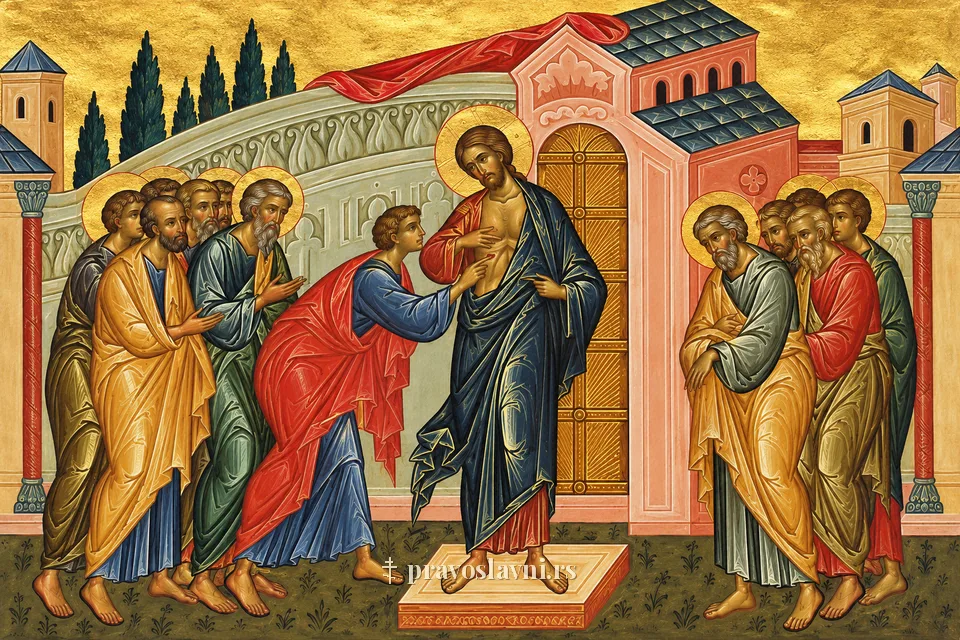
Thomas is remembered for the words “My Lord and my God!”, with which he confessed the risen Christ when He appeared to him and invited him to touch His wounds. For more on fasting on this day, see the guide “Fasting — simply explained”.
Thomas, called the Twin, was, according to his Life, a native of Paneas in Galilee and one of the Twelve. The Gospel according to John shows him as a man who does not know how to pretend. When the Lord set out for Judea, where death was threatening Him, Thomas called to his companions: “Let us also go, that we may die with Him.” And at the Mystical Supper he said openly that he did not know where the Lord was going.
Yet we remember him most of all for the meeting after the Resurrection. He was not with the others when the Lord appeared to them, and he would not believe until he saw the wounds. A week later the Lord called him to touch them. Then Thomas, the Gospel records, cried out: “My Lord and my God!” The Prologue says that in this way his doubt became a benefit for all of us, and his Life explains that the disciples saw Christ in the same body that had suffered on the cross.
The lot, according to the Prologue, sent him to faraway India. There, according to his Life, King Gundaphorus made an agreement with him that he would build him a palace. Thomas gave away the king's gold to the poor and preached. Thrown into prison, he told the king that the palace existed, but in heaven. That night the king's brother died and came back to life again, and in the meantime he had seen that heavenly palace. Gundaphorus repented and was baptised together with his brother.
The Prologue also mentions that Thomas arrived late for the burial of the Most Holy Theotokos. They opened the tomb on his account and found it empty, and this, according to the Prologue, became a sign that the Mother of God had been glorified.
In the land of Prince Mazdai he also baptised the prince's wife. The prince asked him whether he was a slave, and he, according to his Life, answered: “I am the slave of Him over Whom you have no power.” He did not waver even under the threat of death. According to the Prologue, soldiers put him to death with spears.
St Thomas shows that an honest question does not lead a person away from God, if he perseveres at Christ's side until the answer reaches him.
Thomas, who is also called the Twin, came, according to the Life, from Paneas in Galilee. When Jesus began to preach, Thomas was among those who set out after Him and never left Him again. The Lord chose him to be one of the Twelve.
The Gospel according to John lets Thomas speak several times, and each time we hear a man who says what he thinks. When the Lord set out for Judea, where they were threatening to stone Him, the others hesitated. Thomas said: “Let us also go, that we may die with Him.” And at the Mystical Supper, while the Lord was speaking of His departure, Thomas sincerely admitted that the disciples knew neither where He was going nor by what way. So he heard the words which Christians remember to this day: Christ is the way, the truth and the life.
On that first Sunday, when the risen Lord appeared to the disciples, Thomas was not with them. He did not believe what the others told him. He wanted to see the wounds of the nails with his own eyes and to touch them with his hand. A week later the Lord came again and addressed him in particular: let him reach out his hand and let him not doubt. Then Thomas, as the Gospel according to John records, cried out: “My Lord and my God!”
That is why Thomas has been remembered not as an unbeliever, but as a witness. The Prologue sees in his hesitation a benefit for all of us: by it the Resurrection is attested still more firmly. The Life explains this simply — the disciples were convinced that what stood before them was not an apparition, but the Lord in the body that bore the wounds from the cross.
The apostles, according to the Prologue, went their separate ways through the world after the descent of the Holy Spirit, and distant India fell to Thomas. According to the Prologue, he set out on that journey only after the Lord had appeared to him and filled him with strength.
Here the Life gives one of the most beautiful stories about him. The Indian king Gundaphorus was looking for a builder for a splendid palace, and Thomas took on the work. He was given gold and a free hand, while the king was far away. But Thomas shared out all the gold among the poor, and spent the time preaching Christ throughout the king's land.
When the king learned the truth, he threw Thomas into prison. The apostle calmly told him that the palace was finished, but not on earth — Gundaphorus would enter it only when he died. That night, according to the Life, the king's brother died and came back to life again. In that short time he saw in heaven the palace that Thomas had built for the king. Now Gundaphorus understood. He asked the apostle for forgiveness and was baptised together with his brother.
The Prologue also mentions an event from Jerusalem. Thomas did not arrive for the burial of the Most Holy Theotokos together with the other apostles. He wished to see her at least once more, and so they opened the tomb, but it was empty — the Lord had taken His Mother to Himself. The Prologue sees God's providence in this: the empty tomb, opened on account of Thomas, became a testimony that the Theotokos has been glorified.
Among those whom Thomas baptised in the land of Misdaeus were two sisters, one of whom was the prince's wife. When after their baptism, according to the Prologue, they no longer wished to live with their idol-worshipping husbands, the anger fell upon the apostle. Misdaeus asked him whether he was a slave. Thomas, according to the Life, answered: “I am the slave of the One over whom you have no power.”
Not even threats of death were of any use. Still, the prince did not dare to execute him in front of the people, among whom there were already many believers, and so they led him out of the city. The Life says that before his death he ordained a priest and a deacon, so that the faithful would not be left without a shepherd. According to the Prologue, soldiers put him to death with spears. So the apostle sealed his testimony to Christ with his blood. The Life adds that later Misdaeus himself also believed, when his son was healed by the power of Thomas's tomb.
St Thomas shows that an honest question does not lead away from God, if a person perseveres beside Christ until the answer reaches him.


