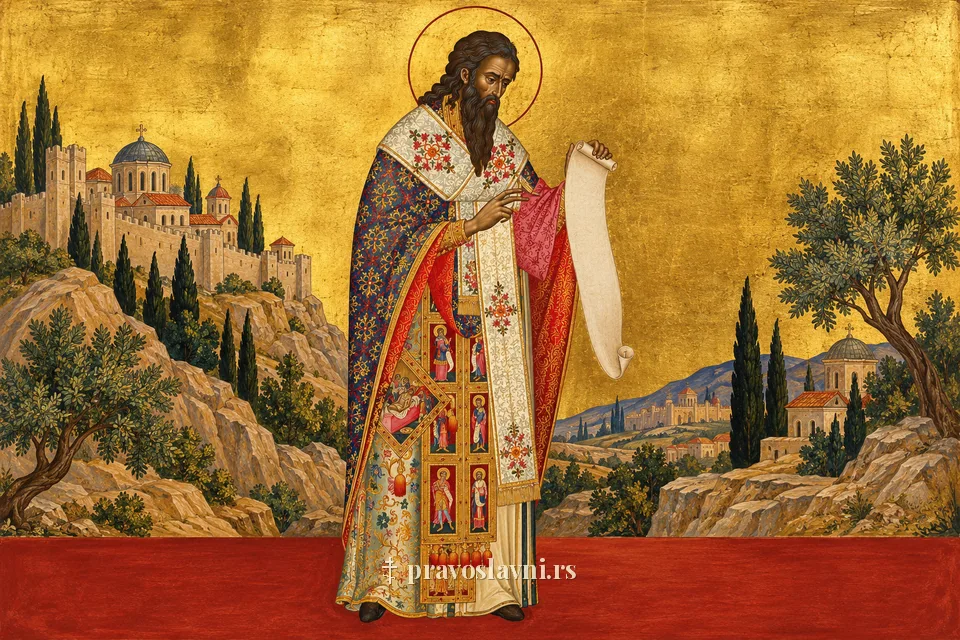
Saint of the day
Holy Apostle James, the Brother of the Lord
What happenedSet upon the roof of the Temple to speak against Christ, James, the Brother of the Lord, confessed Jesus before the multitude as the Son of God and the Messiah.
Read the LifeOrthodox Calendar · 23 October according to the Julian calendar
Friday, 5 November 202723 October (according to the Julian calendar)Save your slava — you'll get a reminder a week and a day before.
Send a greeting card →What happenedSet upon the roof of the Temple to speak against Christ, James, the Brother of the Lord, confessed Jesus before the multitude as the Son of God and the Messiah.
Read the Life
No meat, dairy products, eggs or fish — oil and wine are allowed.
This is a recommendation — for your own fast, consult your priest or spiritual father.More about the fast →
Many families celebrate their Krsna slava (family patron saint's day) today
More about the feast →
“Thus also faith by itself, if it does not have works, is dead.”
— Jas 2:17The father of James, whom the Church calls the Brother of the Lord, was the righteous Joseph, the betrothed of the Virgin Mary. Tradition also explains that name by a story: when Joseph was dividing his land, James alone among the sons agreed that Jesus too should receive a share. According to tradition, he was also the companion of the holy family on the flight into Egypt.
From his youth he lived as an ascetic — the plainest food, a hair shirt, vigil by night — and he remained a virgin. He set out after Christ as soon as He began to preach, was found among the Seventy, and a special appearance of the risen Lord to him is attested by Paul's epistle.
As the first bishop of Jerusalem he led the Church for thirty years. Both sources say that he composed the first liturgy, later shortened; he brought many to the faith, and according to his Life he also wrote the General Epistle on faith and works. The name “the Just” was given to him even by those outside the Church, and the elders, according to his Life, called him Oblias. His Life also ascribes to him prayer for the whole world in the Holy of Holies, which the high priests allowed him to enter.
The high priest and the scribes, envious of so many conversions, decided to get rid of him. At Passover, before a full city, they set him on the temple, expecting that he would deny Christ before the people. They heard the opposite: a confession of faith in the risen Jesus, the Son of God and the Messiah, who will come to judge the living and the dead. They threw him down from the height, and his Life says that, having survived the fall, he prayed for them: “Lord, forgive them this sin, for they do not know what they do.” His Life also remembers a man of the line of Rechab who tried to stop the stoning, but James was soon killed as a martyr and buried beside the temple. According to the Prologue he was sixty-three, according to his Life sixty-six years old.
James teaches us that holiness and humility win the respect even of those who do not believe, and that the greatest courage is to confess Christ before those who hate Him and to forgive those who are killing you.
Among the Christians of Jerusalem there was no man more respected even by those outside the Church: even the Jews who had not accepted Christ called James the Just. That is exactly why his opponents chose him as a witness against Christ — and exactly why their plan failed.
The name “the Brother of the Lord” James owes to his father, the righteous Joseph, the betrothed of Mary; his Life specifies that he was a son from Joseph's first marriage. Tradition also explains this name by the inheritance: of all Joseph's sons only James, out of love for Jesus, was willing to share with Him his own portion of their father's land, while the others were against it. According to tradition, he was also with Mary and Joseph when they fled before Herod into Egypt.
The Prologue and his Life describe him as an ascetic from his early youth: his table was the most modest possible, his clothing a rough haircloth, and his sleep short, for he gave his nights to prayer. He preserved his virginity to the end of his life.
He followed Jesus as soon as He began to preach, and both sources stress that the Lord loved him especially; he is numbered among the Seventy. That the risen Christ appeared to him separately is attested by the Apostle Paul: “After that He was seen by James, then by all the apostles.”
The Church of Jerusalem received in him its first bishop — according to his Life, by the hand of Christ Himself — and he led it for thirty years. The Liturgies of Basil the Great and John Chrysostom, according to both sources, have their root in that of James, the first, which he composed at God's command, and which they later shortened. His preaching brought both Jews and pagans to Christ, and his Life also ascribes to him the Catholic Epistle, addressed to the twelve tribes of Israel, about the faith that is shown by works.
His reputation, says his Life, opened doors to him that were closed to others: the high priests allowed him to enter the Holy of Holies, and there, according to his Life, he prayed for the whole world. The elders gave him the name Oblias, seeing in him the protection of the people; people flocked to hear him and at least to touch his clothing, and many of the eminent came to believe as well.
Such great success aroused the envy of the high priest — Ananus in the Prologue, Ananias in his Life — and of the scribes and Pharisees. They had already marked him out for death, but before that they wanted from him a public renunciation that would turn the people away from Christ. For this they chose the Passover, when the city was full to overflowing; his Life notes that there was no Roman governor in Judea at that time, because Festus had died.
They set him on the roof of the temple so that everyone might hear him. Both sources say that James, instead of a renunciation, spoke before the people the whole faith of the Church in Jesus — from the cross and the tomb to the resurrection, the sitting at the right hand of the Father and the second coming, when He will judge the living and the dead — and called Him the Son of God and the Messiah. According to his Life, the people answered with joyful acclamation to the Son of David.
They replied with violence: the priests and elders threw him down from the roof. He survived the fall, and his Life says that on his knees he prayed for them: “Lord, forgive them this sin, for they do not know what they do.” According to his Life, a descendant of Rechab tried to stop the stoning. A blow from a fuller's club cut short James's life. According to his Life, he was buried beside the temple, and the faithful mourned his death bitterly. How old he was the sources remember differently: the Prologue says sixty-three, his Life sixty-six.
James teaches us that holiness, prayer and humility win the respect even of those who do not believe. When a renunciation was demanded of him, he confessed Christ, and he died forgiving. The Church remembers him as the first bishop of Jerusalem, the author of the first liturgy and of the Catholic Epistle.


