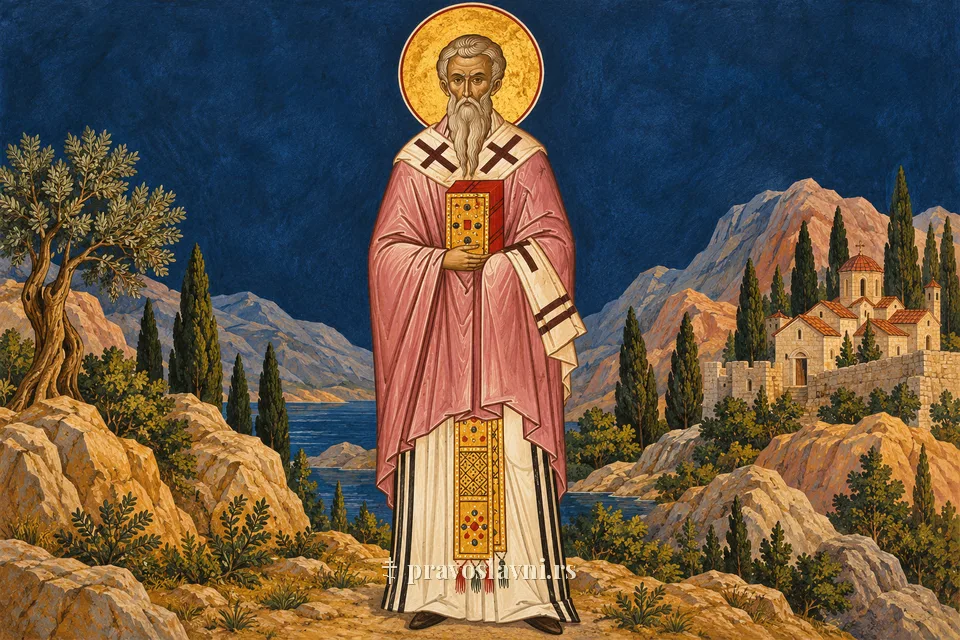
St Abercius, bishop of Hierapolis in Phrygia in the second century, lived in a city in which Christians were in the minority. According to his Life, after praying for his city he received in a dream a staff and the command to overthrow error. The Prologue and his Life say that on that night the locked doors of the temple of Apollo opened to him of their own accord and that he threw down all the idols.
The pagans demanded his head, but he, instead of fleeing, stood before them and preached. The turning point came when three young men, tormented by demons, cried out before him: according to both sources, he freed them by prayer and the touch of his staff. From then on, say the Prologue and his Life, Hierapolis kept turning to Christ — first about five hundred baptised, and soon both the city and the surrounding places.
Word of the bishop was spread by the healings. When the blind mother of the governor of the province, according to both sources, received her sight, she became a Christian and with half of her property helped the poor; her son and many others followed in her path. His Life also mentions the hot springs that gushed forth at the place of his prayer and in which the sick were treated.
In his old age, both sources say, he had to travel to Rome, because the emperor's daughter Lucilla was tormented by a demon; Abercius freed her and raised her up in good health. His Life tells that the demon had to carry an enormous stone to Hierapolis, where people saw it fall from the sky. Gold and estates, according to his Life, he did not want; he asked for grain for the poor of his city and baths for the sick.
What he had begun in Hierapolis he continued after Rome in distant lands as well, all the way to Mesopotamia, and he converted and healed so many people that he was called Equal-to-the-Apostles. The Prologue adds that the Lord appeared to him more than once and that the demons were afraid of him. He died in great old age, and on his grave, according to his Life, stands the stone from Rome.
Abercius teaches us that zeal for God and fearless faith can convert a whole city, and that a true shepherd seeks nothing for himself, but bread for the poor and medicine for the sick.
Full Life
On the tomb of St Abercius in Hierapolis, as his Life tells, there stood a stone brought from Rome — and not by any human hand. To understand how it came to be there, one must start from the beginning, from a small Christian flock in a city of idols.
Bishop of a little flock
In the second century Abercius led the Church in Hierapolis in Phrygia. The sources differ as to the emperor under whom he lived: the Prologue names Antoninus, and his Life names his son Marcus Aurelius. They agree, however, that the Christians in the city were no more than a handful, and the pagans the overwhelming majority.
His Life places the beginning of the turning point at the time of a great pagan festival. While the city feasted and sacrificed, the bishop was at home praying for it; the answer came in a dream, in the form of a staff and a charge to overthrow error, and Abercius received the dream as God's command.
At about the third hour of the night he found himself before the temple of Apollo. According to the Prologue and his Life, the locked doors were no obstacle — they opened — and Abercius cast down Apollo and all the other idols. His Life also ascribes to him a mocking message to the pagan priests about the ruin of their gods.
From anger to baptism
The city was seething. Some demanded his death, others that he be handed over to the emperor, others again that his house be burned, which the authorities nevertheless prevented out of fear of a fire. The neighbouring bishops and the faithful advised him to go into hiding, but Abercius, according to his Life, saw in suffering for Christ not a misfortune but a blessing, and so he went straight out among the people and began to preach.
The decisive moment was brought by three young men who were tormented by demons. When the enraged crowd set upon the bishop, they began to cry out before him, and he, according to both sources, freed them by prayer and by a gentle touch of his staff. The mob that had come to kill stayed to listen; according to his Life, the sermon lasted until the ninth hour, with healings in the name of Jesus Christ. The Prologue and his Life record that on the next day about five hundred people were baptised, and soon there were Christians not only in Hierapolis but in the surrounding places as well.
Among the miracles after that, the healing of the blind mother of the governor of the region is remembered; the Prologue calls her the mother of Publius, and his Life calls her Phrygella, the mother of Euxenianus Publius. When she received her sight, she accepted baptism and gave half of her estate to the poor, and after her both her son and many others came to believe. His Life adds three more blind women who were healed after they confessed the faith, as well as the warm springs which, after Abercius's prayer by the river at Selište, burst forth with thunder and became a remedy for the sick.
The journey to Rome
His Life connects the foretelling of the journey with an encounter with the devil, who appeared to him in the form of a woman and threatened that in his old age he would drag him off to Rome. After seven days of fasting and prayer the Lord revealed to him that the journey would indeed take place, but so that the name of God might become known there too.
The occasion, according to his Life, was Lucilla, the daughter of Marcus Aurelius, who was tormented by a demon and whom no one was able to cure; the demon himself asked for Abercius of Hierapolis. Both sources say that the emperor summoned the old bishop to Rome, that he and Faustina received him kindly, and that Abercius raised up the girl, who after the expulsion lay without any sign of life, completely healthy. To this his Life adds one scene: the demon, at the bishop's command in the name of Christ, had to carry an enormous stone from Rome to the South Gate of Hierapolis, and so the people of Hierapolis saw the stone falling from the sky.
He refused a reward. Instead of treasure, says his Life, he asked for a yearly gift of grain from the imperial taxes for the poor Christians of his city, and for baths at the warm springs; the emperor confirmed this in writing, and the grain was distributed right up until the gift was abolished by Julian the Apostate.
Equal-to-the-Apostles
From Rome, at the Lord's command, he went to Syria and Mesopotamia: Antioch, Apamea, Nisibis, and then Cilicia, Pisidia and Synnada remembered his preaching and his healings. The people therefore called him Equal-to-the-Apostles, and the Prologue records that the Lord appeared to him many times and that the demons were afraid of him.
When he learned that his end was drawing near, according to his Life, he gathered his flock, left it his last instructions and himself prepared his grave. He died in deep old age: his Life says at seventy-three, the Prologue — at the end of the second century. On the tomb stood the Roman stone, and healings, according to his Life, took place both there and at the springs.
Abercius shows that zeal and the fearless confession of the faith can convert a whole city. From the emperor he asked nothing for himself — only bread for the poor and a remedy for the sick — and that is why the Church calls him Equal-to-the-Apostles.
Other saints of the day
Holy Seven Youths of Ephesus
In the time of Emperor Decius, who gave orders in Ephesus that sacrifices be offered to the idols, seven young officers refused to do so: Maximilian, Iamblichus, Martinian, John, Dionysius, Exacustodianus and Antoninus. Their Life records Maximilian's confession before the emperor: “We confess the One God and King of Heaven”. They gave away their gold and silver to the poor and took shelter in a cave on Mount Ochlon, where after their prayer God put them to sleep for a long time. Decius had the entrance to the cave walled up, but the story did not vanish: two of Decius's men, Christians at heart, Theodore and Rufinus, left a record on lead tablets in the wall. When, according to the Prologue more than two centuries later, in the days of Theodosius the Younger, there appeared those who deny the resurrection of the dead, workmen who were quarrying stone opened the cave, and the young men woke up convinced that they had slept through only a single night. Their Life tells that Iamblichus set off to the city for bread and paid the baker with a coin from the time of Decius, and so the whole matter came to light. The news reached Constantinople, and Emperor Theodosius came in person to embrace them, on his knees and in tears. A week later all seven of them died, in the hope of the general resurrection. God gave their awakening as a visible proof of the resurrection of the dead, and their steadfastness under persecution is an example of faithfulness to Christ.
Separate page: Holy Seven Youths of Ephesus →