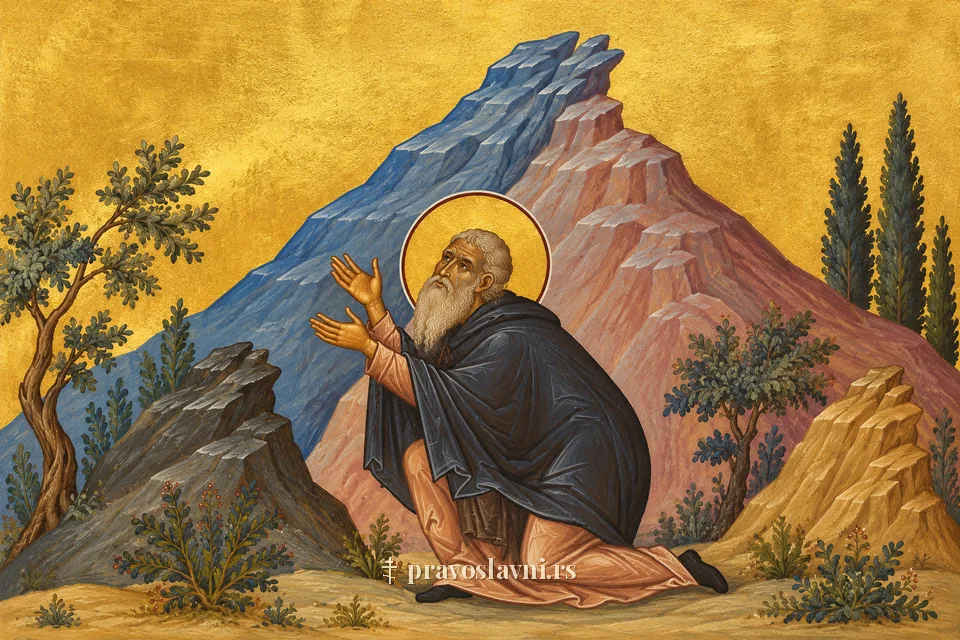
Saint of the day
Venerable Hilarion the Great
What happenedFleeing from the praise of men, Hilarion the Great travelled through distant lands, from Palestine and Egypt to Sicily, Dalmatia and Cyprus.
Read the LifeOrthodox Calendar · 21 October according to the Julian calendar
Wednesday, 3 November 202721 October (according to the Julian calendar)What happenedFleeing from the praise of men, Hilarion the Great travelled through distant lands, from Palestine and Egypt to Sicily, Dalmatia and Cyprus.
Read the Life
No meat, dairy products, eggs, fish or oil — food cooked in water.
This is a recommendation — for your own fast, consult your priest or spiritual father.More about the fast →
Today the Church keeps the commemoration of a saint · not a Red Letter day.
More about the feast →
“Man shall not live by bread alone, but by every word that proceeds from the mouth of God.”
— Mt 4:4Hilarion the Great, a native of Tabatha near Gaza, grew up in a pagan house, and came to know Christ during his schooling in Alexandria, where he was also baptised. He learnt the monastic life from St Anthony in the desert. The inheritance that he found on the death of his parents he divided, according to his Life, among his relatives and the poor.
He sought the desert in the region near Maiuma, where robbers were on the rampage. To those who tried to dissuade him he replied that the ruin of the soul frightened him more than that of the body. He lived in poverty, fasting and labour, and he fought against the demons with prayer and the sign of the cross.
According to his Life, God worked countless miracles through him: to a childless woman He granted a child, to the sons of a distinguished woman of Gaza He restored health, to a blind woman her sight, and to many of the possessed their freedom. When Orion of Aila, freed from demons, wanted to repay him with gifts, he heard: “The grace of the Lord is not for sale.” His disciples grew ever more numerous, and both sources regard him as the founder of monasticism in Palestine. The Prologue says that even the pagans honoured him.
Fame, however, pained him, and because of it, both sources say, he grieved for two years. The Prologue preserves his lament over the honours that people paid him: “woe is me, I have received my reward on earth!” That is why he changed his place more than once, even crossing the sea, but the report of his miracles caught up with him everywhere, all the way to Cyprus. In Dalmatia, according to both sources, he destroyed an enormous serpent by his command and calmed the sea with the sign of the cross, and on Cyprus pirates stopped at his word.
He died on Cyprus in his eightieth year, and the Prologue places this around the year 372. According to his Life, on his deathbed he encouraged his own soul to leave the body without fear. His incorrupt body was later carried to Palestine, without the knowledge of the Cypriots, by his disciple Hesychius. His Life says that the miracles do not cease either on Cyprus or in Palestine.
Hilarion teaches us that a humble man does not rejoice in human praise and that he ascribes to God every good thing he does.
Rarely has any saint travelled so much while seeking nothing but to be hidden. Hilarion the Great, according to his Life, crossed half the Mediterranean, from Gaza to Cyprus — and everywhere fame caught up with him. Why he fled is best shown by one sorrow of his. In his sixty-third year, surrounded by people who called him master, he wept over himself, for he saw that he was once again in the world from which he had fled. The Prologue remembers his sigh: “Woe is me, I have received my reward on earth!”
He was born in Tabatha near Gaza, in a pagan home; his Life gives the year 291. His schooling in Alexandria brought him both worldly knowledge and faith: there he became a Christian and was baptised. He spent some time as a disciple of St Anthony. When he returned, his parents were no longer living, and the inheritance, according to his Life, he gave away to the last coin to his relatives and to the poor.
The place he chose had an evil name on account of robbers, not far from Maiuma near Gaza. His friends tried to dissuade him, but he, according to both sources, feared the death of the soul more than the death of the body. His Life describes a very strict way of living: he ate little and only in the evening, sometimes nothing at all for three or four days, he wore rough clothing and Anthony's sheepskin coat, and he worked constantly with his hands.
The demons, according to the Prologue and his Life, attacked him in every way — with thoughts, with noise, with apparitions, and even with the thunder of war chariots. Against all of this he had only prayer and the sign of the cross, and his Life tells of those struggles with many wondrous details. The robbers with whom his friends had frightened him, according to his Life, in the end promised that they would change their way of life, amazed that the man before them was always ready for death.
The miracles began, according to his Life, with a childless woman from Eleutheropolis, who gave birth a year after Hilarion's promise. There followed the recovery of the three sons of Aristaenete, the wife of the dignitary Elpidius, after which many pagans in Gaza accepted Christ. His Life then sets out a long list of those healed — the blind, the paralysed, the possessed. When Orion from Aila, freed from a multitude of demons, wanted to repay him with gifts, Hilarion refused him with the words: “The grace of the Lord is not for sale.” Nor did he accept ten pounds of gold from one grateful governor.
Disciples gathered around him, and monasteries, according to his Life, spread throughout the whole of Palestine. The Prologue and his Life for that reason regard him as the father of Palestinian monasticism. Anthony, says the Life, praised him and directed people from Egypt to him. The Prologue adds that he enjoyed esteem even among those who were not Christians.
For two years, according to both sources, he grieved because of his fame. Then, according to his Life, he learned in a revelation that Anthony had died, and he set out for Egypt, to Anthony's mountain. At Aphroditopolis, after three years of drought, his prayer brought rain, and afterwards he spent about a year in the Oasis. He went to Libya, then by ship to Sicily, where his disciple Hesychius searched for him for three years until he found him near Pachynum.
Further on, according to the Prologue and his Life, he went to Epidaurus in Dalmatia. There, by his command, he drove an enormous serpent into the fire, and he calmed the raging sea with the sign of the cross. His last refuge was Cyprus. Pirates, according to both sources, stopped at his word, and near Paphos about two hundred people were freed from evil spirits.
It was on Cyprus that he died, in his eightieth year; the Prologue places this around the year 372. His last words, which his Life preserves, were an encouragement to his own soul: “Go forth, my soul, what do you fear!” He was buried, as he wished, in a garden, but the grave did not remain long on Cyprus: according to both sources, Hesychius pretended for ten months that he had settled there, and then secretly carried the body to the monastery near Maiuma, where it proved to be incorrupt and fragrant. His Life says that miracles take place both on Cyprus and in Palestine.
Hilarion fled from honours and refused gifts, and every healing he ascribed to God; it was precisely through such a humble man that Palestine received monasticism.
Hilarion of Meglen, say the Prologue and his Life, was announced by the Theotokos to his mother, who had long been childless: in a dream She promised her a son, and the Prologue hands down the words “do not grieve, you will bear a son, and he will turn many to the light of truth”. The promised boy showed early on what he was meant for — he was already singing the Trisagion at the age of three. He entered a monastery as an eighteen-year-old, already well educated, and after the abbot's death he himself became abbot. His Life also remembers a famine in which the empty monastery granary was filled by his prayer with tears. He was consecrated Bishop of Meglen, according to the Prologue, in the year 1134; the Prologue says that he was consecrated by Eustathius of Tarnovo, while his Life says it was Eustathius, Archbishop of Ohrid. Bogomils, Armenian Monophysites and Manichaeans — with these, according to both sources, he disputed for almost his whole life. Even when the heretics, according to his Life, stoned him and brought him to the brink of death, he did not seek revenge, but went back to his cell by himself and forbade anyone to avenge him. Emperor Manuel, according to his Life, did not stray into heresy thanks to him, and a great number of heretics returned to Orthodoxy, drawn by his learning and holiness. The Prologue states that he reposed in peace in the year 1164; his Life adds that healings took place at his grave and that the relics were later translated to Tarnovo. He teaches us that the faith is defended by a patient word, by forgiveness and by personal holiness.
Separate page: St Hilarion of Meglen →
Nikola, as Bessarion was named at baptism, came into the world in 1714 in Majdan in Bosnia, in the home of Maksim and Marija. He received the name Bessarion at his monastic tonsure in the Monastery of St Sabbas in the Holy Land, where he went at the age of eighteen; later he also stayed on the Holy Mountain (Mount Athos). Pakra in Slavonia became his new home: there he was a deacon for a full seven years before being ordained a priest, and he became well known both for his holy life and for his eloquent preaching. After 1742 Patriarch Arsenije IV Jovanović sent him to the Banat and Erdelj (Transylvania), where the Orthodox were suffering under the pressure of the Unia. He went round to the people in the villages, preaching faithfulness to the faith of their forefathers, and the people, says his Life, welcomed him with great ceremony. Around 1744 the Habsburg authorities, urged on by Roman Catholic officials, threw him into prison. The prisons in Sibiu, Deva, Timișoara and Raab were only stations on the way to the fortress of Kufstein in Tyrol, where his sufferings finally brought him to his end. The Serbian Church entered him in the calendar in 1962, and the Romanian Church as early as 1950 He is celebrated together with the confessor Sophronius and the martyr Oprea Miclăuș, who also suffered while defending Orthodoxy in Transylvania. Their example reminds us that faithfulness to the faith of the fathers has a price; the Church turns to them for their prayers for all the Orthodox.


