Saint of the day
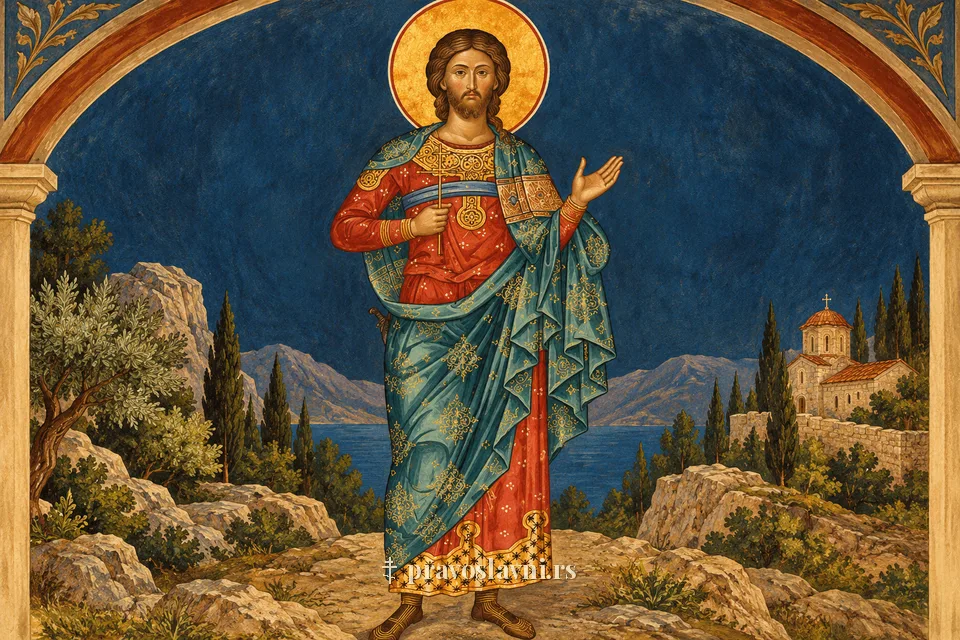
Great Martyr Artemius
What happenedThe imperial commander Artemius openly rebuked the Emperor Julian the Apostate for torturing innocent priests and foretold his speedy downfall.
Read the LifeOrthodox Calendar · 20 October according to the Julian calendar
Tuesday, 2 November 202720 October (according to the Julian calendar)What happenedThe imperial commander Artemius openly rebuked the Emperor Julian the Apostate for torturing innocent priests and foretold his speedy downfall.
Read the Life
You may eat meat, eggs, milk and dairy products, as well as any other food — but try to be moderate.
More about the fast →
Today the Church keeps the commemoration of a saint · not a Red Letter day.
More about the feast →
“Be faithful until death, and I will give you the crown of life.”
— Rev 2:10Among those whom Constantine the Great led into battle was the commander Artemius. The Prologue and his Life remember the moment that settled the course of his life: the shining cross in the sky on the eve of the battle with Maxentius, after which he became a Christian. With Constantius, the son of Constantine, he enjoyed, according to his Life, the greatest trust, and so it was he who brought the relics of the Apostle Andrew and the Evangelist Luke to Constantinople. After that Artemius became the imperial governor of Egypt, where, as his Life says, he pulled down idols.
Everything changed when power was taken by Julian the Apostate, who rejected Christ and began to persecute Christians. Artemius arrived in Antioch at the emperor's summons, in the midst of the preparations for the Persian campaign, and found the Antiochian priests Eugenius and Macarius in the hands of the torturers. He did not keep silent: he publicly called the emperor inhuman, and according to the Prologue he also foretold to him that his end was drawing near. According to his Life, Julian recognised in Artemius the man whom he blamed for the death of his brother Gallus, and so the execution was already decided.
The answer was torture. Artemius lost his rank, but he endured in silence. Not even the honours which the emperor, according to his Life, offered him, if only he would offer sacrifice to Apollo, made him waver. Yet his wounds did not bring him death: according to both sources, Christ restored his strength in prison, and from then on he no longer needed food. Nor did the enormous stone under which, again according to both sources, he spent a day and a night kill him.
In the end he was beheaded; the Prologue gives the year 362. According to his Life, he went to the place of execution joyful and with prayer, and his relics later came to Constantinople and there they heal to this day.
Julian, as both the Prologue and the Life say, soon perished in the war with the Persians, and the army, according to the Life, chose the Christian Jovian as emperor.
Artemius teaches us that there is no earthly power that can defeat the one who holds fast to Christ, and that the persecutors of the Church prepare their own ruin.
“Thou hast conquered, O Christ! Take Thy fill, O Galilean!” — his Life says that these were the last words of the Emperor Julian the Apostate, mortally wounded on the Persian campaign, though no one saw who had wounded him. The Prologue speaks of it more briefly: the Emperor perished in the war with the Persians. Both books, however, remember that this end was foretold to him in advance by a man whom Julian had put to death a short time before — the commander Artemius.
About his origin the sources speak differently: the Prologue has him as an Egyptian, and his Life as a Roman from a distinguished house of senatorial rank. On what is decisive, however, they agree. He was a commander of Constantine the Great, and when Constantine was preparing for the battle with Maxentius, Artemius saw in the sky a cross of light; the Prologue adds that stars surrounded it and that the Emperor saw it too. From then on Artemius belonged to Christ.
The relics of the Apostle Andrew and the Evangelist Luke rested at that time in Achaia — the Prologue specifies: Andrew's in Patras, Luke's in Thebes in Hellas — and Constantine's son Constantius, when he heard of this from a certain bishop, wished to have them in the capital. That task was given to Artemius, who according to his Life was the Emperor's closest friend and the keeper of his personal estate. He carried it out solemnly, as befits a holy thing. As a reward he received Egypt to govern and kept it even after the death of Constantius, for some time longer under Julian; his Life remembers that in that land he tore down idols.
Julian, according to the Life, did not hide his apostasy: he restored idolatry, turned churches into pagan shrines, and persecuted and plundered the Christians. At that time Artemius was summoned to Antioch, where the Emperor had stopped while preparing for Persia. Just then, as the Life tells, two priests of Antioch, Eugenius and Macarius, got the better of him in a debate, and so he had them mercilessly beaten.
Arriving with the army, Artemius, with all due courtesy, called the torture of innocent men of God an act of inhumanity and, according to the Prologue, told the Emperor that his end was drawing near. His Life adds that Julian saw in him a man whom he considered an accomplice in the death of his brother Gallus, and swore that he would put him to death.
From that day Artemius was without rank and in the hands of the torturers. Both sources stress his silence under the scourges, which astounded those present. Arabia awaited the two priests: there, in exile, they soon died.
His Life tells that Julian then tried to win him over: he offered him to be first among the pagan priests, even co-ruler, if he would offer sacrifice to Apollo. Artemius refused, appealing to the example of the three youths from the Book of the Prophet Daniel. He denied any guilt for the death of Gallus, calling Gallus a devout Christian, and reminded the Emperor of the cross that Constantine had seen, to which the old soldiers could bear witness.
His Life then speaks of new torments and of a dungeon without bread and water. It was there, according to the Prologue and his Life, that Christ visited him and healed him, promising him a crown of glory, and the Life preserves the words: “Be of good courage, Artemius!” Earthly food and drink, according to his Life, he no longer took to the end of his life, for angels fed him.
Julian then devised a torture with a great stone split into two halves; Artemius, crushed beneath it, spent a whole day and night in prayer with the psalms. His Life says that, when they released him, he stood up and walked, and Julian did not know whether to ascribe this to his own gods or to sorcery.
The sentence read: death by the sword. He met death, as his Life tells, with joy and prayer. The Prologue records the year as well: 362. Thanks to Arista, a deaconess of the church of Antioch, the relics, according to his Life, reached Constantinople, where the healings do not cease even today. His words to the Emperor came true soon afterwards, and after Julian, according to the Life, the throne passed to the Christian Jovian, whom the army chose.
Artemius had rank, power and the friendship of emperors, yet he chose Christ. His silent endurance, Christ's visit in the dungeon and the swift fulfilment of his words show that earthly might cannot overcome the one who holds fast to Christ — and that the persecutors of the Church prepare their own ruin.
Gerasimus, whom the Prologue calls the New and the calendar calls “of Cephalonia”, comes from the noble Notaras family of Trikala in the Peloponnese; his father's name was Demetrius, his mother's Kalia, and the Prologue gives 1509 as the year of his birth. According to his Life, after studying the holy books he travelled through many lands, from Zakynthos to Constantinople, and he also lived the ascetic life on the Holy Mountain (Mount Athos), which is where his nickname Kapsali comes from. He left the Holy Land, where according to his Life he stayed for twelve years, as a priest: he was ordained by Patriarch Germanus, after Gerasimus had first served as a sacristan at the Tomb of the Lord; there he also fasted for forty days — in Palestine according to the Prologue, at the Jordan according to his Life. After living in caves on Crete and Zakynthos, he arrived on Cephalonia, where the Orthodox were suffering under the pressure of Latin missionaries. The New Jerusalem, a convent founded in 1561 near Omala, grew up around an old church which the priest George Valsamos handed over to Gerasimus. According to both sources, the future was not hidden from him, and at his prayer the sick and the possessed were healed and rain fell. He reposed on 15 August 1579, after the service for the Dormition, at about seventy years of age. Two years after his death the grave was opened, and his Life records that the body had not decayed and that it gave off a sweet fragrance, which encouraged the Orthodox people of Cephalonia. The miracles did not cease even after his death, and many inhabitants of Cephalonia bear his name to this day. His life shows that saints are born in later centuries too, and that a people living under foreign rule kept the faith by relying on God.


