Saint of the day
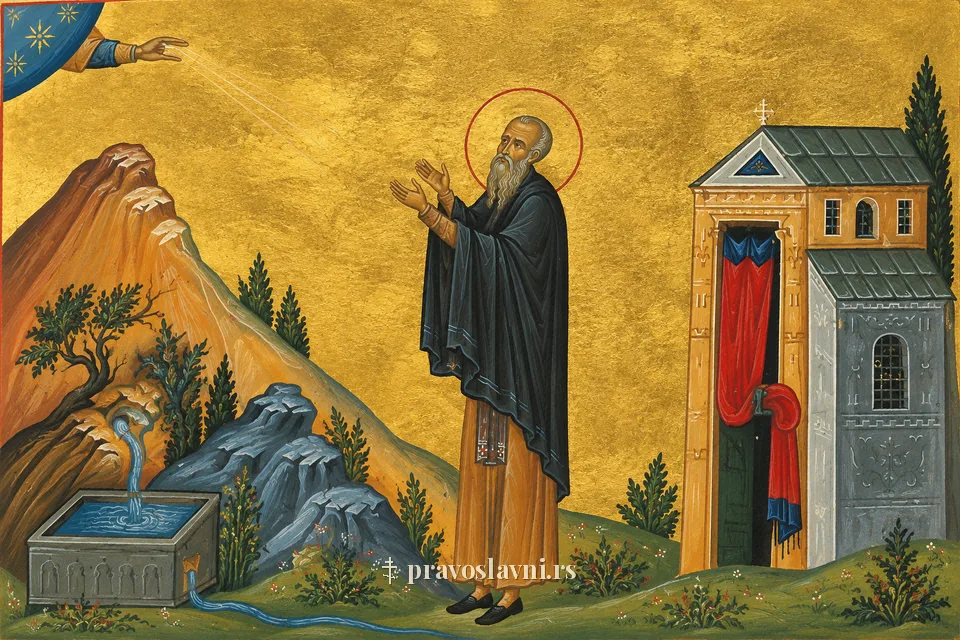
Venerable Abramius the Recluse
What happenedAbramius the Recluse endured beatings from the pagans for three years without cursing them, until the villagers came to believe that his God is the true God.
Read the LifeOrthodox Calendar · 29 October according to the Julian calendar
Thursday, 11 November 202729 October (according to the Julian calendar)Save your slava — you'll get a reminder a week and a day before.
Send a greeting card →What happenedAbramius the Recluse endured beatings from the pagans for three years without cursing them, until the villagers came to believe that his God is the true God.
Read the Life
You may eat meat, eggs, milk and dairy products, as well as any other food — but try to be moderate.
More about the fast →
Many families celebrate their Krsna slava (family patron saint's day) today
More about the feast →
“For the Son of Man has come to seek and to save that which was lost.”
— Lk 19:10Sung at the Slava (family patron saint's feast) and on the saint's feast day.
In thee, O father, that which is according to the image was manifestly preserved; for taking up the cross thou didst follow Christ, and by deed didst teach us to disdain the flesh, for it passeth away, but to care for the soul, a thing immortal. Wherefore thy spirit, O venerable Abraham, rejoiceth with the angels.
Translation: pravoslavni.rs
St Abramius was born into a devout family and from his youth he loved the church. His parents persuaded him to marry, but soon afterwards he secretly left his bride and his home. His Life says that he withdrew to a hut not far from the town and that, when his parents died, he gave away his large inheritance to the poor, keeping for himself only what was most necessary. He spent fifty years in the ascetic life.
For a long time the bishop had been sending priests to a certain large pagan village, but without success. Then he ordained Abramius and sent him there. The Prologue records his words: “Let God's will be done; I go out of obedience.” In the village he built a church and smashed the idols. The villagers beat him almost to death and left him under a heap of stones, but he went back to the church and prayed. For three years he bore insults and beatings, and instead of anger he had only tearful prayers for those people. At last they understood that his God was the true one, because he had borne with them without a curse, and they accepted the faith. His Life says that about a thousand souls were baptised.
His greatest feat of love came later. His Life tells of his niece Mary, whom he had brought up from the age of seven and taught the psalms. After twenty years of monastic life she was seduced by a false monk. In despair, she fled to another town and lived in an inn. Then Abramius came out of his seclusion, disguised himself as a soldier and went to fetch her. He refused neither meat nor wine, because he had to look like a man of the world. When, weeping over her fall, she asked him whether God would receive her, he answered: “Who is without sin, save God alone?” He carried her home as a shepherd carries a lost sheep. Mary sincerely repented, and God gave her the gift of healing.
Abramius reposed in his seventieth year, and the Prologue gives the year 360. His Life says that the sick were healed beside his body.
Patience and prayer for one's enemies can soften even the hardest hearts, and repentance brings even a fallen soul back to God. God does not wish that anyone should perish.
His Life tells that at an inn in a foreign city there appeared a man in soldier's clothing, with a tall fur cap, who ordered meat and wine. He was a recluse who for decades had not left his cell. He had come for one lost soul.
The path of Abramius began in a devout home, and the church was close to him from his youth. He did not want marriage, but in the end he gave way to his parents. Yet neither the house nor the bride held him back: he went away in secret — according to the Prologue on the very day of the wedding, according to his Life on the seventh day after it. His Life says that he settled in an empty hut not far from the city, where his relatives found him only after seventy days; at his request, they left him in peace.
When, ten years later, his parents died, the wealth he inherited went, according to his Life, through a friend into the hands of the poor. He was left with only what one cannot do without — the clothes on his back, a hair shirt, a jug and a rush mat. His ascetic labour lasted fifty years, and the Prologue records that in all that time he left his cell only twice.
The first time it was obedience that brought him out. The bishop was having trouble with a large pagan village nearby: the priests and deacons he sent there came back without fruit. So he chose the recluse. Abramius protested that he was not worthy, but the bishop ordained him all the same and sent him to the village. The Prologue remembers how Abramius consented: “let God's will be done; I go for the sake of obedience.”
In the village a church rose first, built with a friend's money. Only when the church was finished did the turn of the idols come: after prayer, Abramius broke the altar and the statues there, where the villagers were watching. The answer was rage: they beat him until they thought he was dead, and then carried him out and buried him under stones. But he was alive — he dragged himself back to the church and prayed. The insults and blows went on for three years, and he did not answer with a single word of anger, but wept for his tormentors in prayer.
In the end the villagers understood that a man whom they had been beating for years, and who neither cursed them nor ran away, must be serving a God who exists — unlike their powerless idols. The village bowed down before him and asked to become Christian. His Life counts about a thousand baptised. For a year he taught them every day, and then he returned unnoticed to his solitude, leaving them to the local clergy.
Not even in his cell did the devil leave him in peace, but Abramius, as his Life describes, resisted him with the name of Jesus Christ.
The second time he went out because of his niece. His Life tells that, when his brother died, little Mary, then seven years old, was brought to him. She lived in the outer cell, and through a small opening he taught her the psalms. For twenty years she followed his ascetic life as a nun. Then, with the devil's help, she was seduced by a false monk who had long lain in wait for her. Out of despair she fled as far away as she could, to another city, and there, unknown to anyone, she spent almost two years at an inn.
Abramius, according to his Life, had a twofold vision: a dove in the jaws of a serpent, which the second time he saw alive. When he looked into her cell, she was no longer there, and he wept. When he learned where she was, he set out for her in a way no one would have expected of a recluse: as a soldier, with a gold coin in his hand. Mary, when she drew near to him, sensed the fragrance of holiness and wept over her fall. Then she heard: “Mary, my child, do you not know me?” He called her to repentance and told her that he would bear her sin, together with his friend Ephraim. To her question whether God would receive her, he answered: “Who is without sin, save God alone?” He brought her home on horseback, and his Life recognises in this the shepherd of the Gospel and the lost sheep.
Now the roles were reversed: she lived in the inner cell, and he in the front one. His Life describes her repentance — the hair shirt, tears, abstinence and prayer — and says that God endowed her with the power to heal those who came to her. Abramius lived another ten years and reposed in his seventieth year — according to the Prologue, in the year 360. His Life records that his burial gathered a multitude and that healings took place beside his body. Mary lived five more years after him and reposed in peace.
The life of Abramius shows that patience and prayer for one's enemies can soften even the hardest hearts. And repentance brings even a fallen soul back to God. God does not wish anyone to perish, and so the holy recluse left his solitude and took another's sin upon himself, only to bring back the lost sheep. His story also warns that temptation lies in wait even in monastic stillness.
Anastasia the Roman, a girl from a respected house, was left early in life without father or mother — she was only three years old. She was brought up by the abbess Sophia, in a small and remote convent in the countryside near Rome, and there the little girl grew into an ascetic of fasting and prayer. The whole of Rome knew of her beauty and her ascetic life, so that not a few rich men vied for her hand, but she had long since set herself apart for Christ. During the persecution under Emperor Decius the pagans reported her to the governor Probus, whose soldiers broke down the convent gate with axes. Before they led her away, Sophia, according to both sources, obtained a little time and before the altar encouraged her not to give in, and Anastasia answered her: “my heart is ready to suffer for Christ”. Probus tempted her with marriage and honours, and then tried to frighten her, but she stood her ground, explaining to him that her name means resurrection. When they wanted to put her to shame, she said to the governor, according to her Life: “Know that you have shamed yourself more than me.” The Prologue records that during her torture an angel of God gave her strength. The Christian Cyril paid with his life for having given her water when she was thirsty; before he was executed, Anastasia blessed him. The sword reached her outside the city. Not a single wild beast touched her body, and her Life tells that an angel led Sophia to it by night, and that she buried it fittingly with the help of two Christians. Her love for Christ was stronger than beauty, marriage and life itself.


