Saint of the day
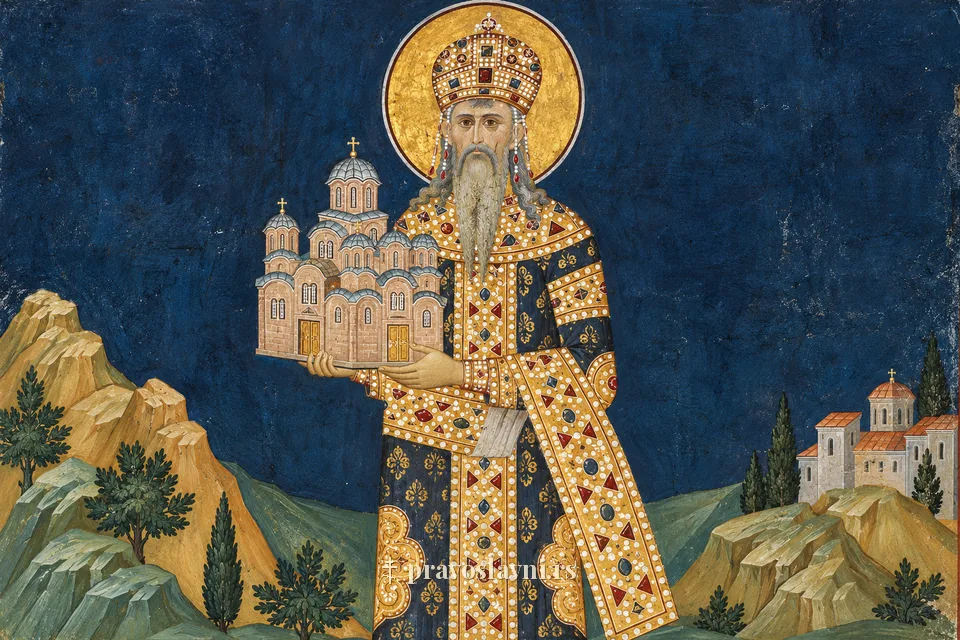
Holy King Milutin
What happenedKing Milutin vowed to build one church for every year of his reign, and his Life records that he built forty of them.
Read the LifeOrthodox Calendar · 30 October according to the Julian calendar
Friday, 12 November 202730 October (according to the Julian calendar)What happenedKing Milutin vowed to build one church for every year of his reign, and his Life records that he built forty of them.
Read the Life
No meat, dairy products, eggs, fish or oil — food cooked in water.
This is a recommendation — for your own fast, consult your priest or spiritual father.More about the fast →
Today the Church keeps the commemoration of a saint · not a Red Letter day.
More about the feast →
“Unless the LORD builds the house, They labor in vain who build it.”
— Ps 127:1The holy King Milutin was the son of King Uroš the First and Queen Jelena. According to his Life, he received the rule in 1282 at the assembly in Deževo, when his elder brother Dragutin handed the kingdom over to him. His biographer, Archbishop Danilo, says that he was dear to God from his youth.
Milutin was a warrior and a defender of the faith. Michael Palaiologos, who had accepted union with Rome and wanted to impose it on the whole of the Balkans and on the Holy Mountain, had in him an opponent on the battlefield, for Milutin was defending Orthodoxy. He conquered Polog and Skopje, which he made his capital, and many other regions. He also repelled the attacks of the Tatars and of Shishman, the lord of Vidin. When Khan Nogai threatened the land, he prayed, as his Life records: “You alone help me.” According to the Prologue, fortune in war followed him because in not a single war did he rely on himself, but on prayer and on God. He made alliances with western rulers when he had to, but he never betrayed Orthodoxy.
He has remained especially remembered as a builder. Every year of his reign, according to the vow that he had made, was to leave behind one church, and his Life counts forty of them. Among them are Gračanica, Banjska, Treskavac, the Mother of God of Ljeviš and Staro Nagoričino. He restored Hilandar, and he also built in Thessalonica, Constantinople and Jerusalem. The guest-house and hospital that he raised in Constantinople fed the poor with bread every day. In his time there were sixteen Serbian bishoprics.
His Life also remembers his hidden side: the alms that he gave out unrecognised, and the tears with which he prepared himself at night for his last hour. His last will, which he entrusted to Archbishop Nikodim, concerned the poor: to them he left everything he had, hoping for the forgiveness of his sins. He reposed at Nerodimlje on 29 October — in 1321 according to his Life, and in 1320 according to the Prologue. He was buried at Banjska, which he himself had built. His Life says that after two and a half years his relics were found incorrupt. Their resting-place today is the church of the Holy King in Sofia.
Faith, repentance and mercy made this ruler a saint. His life bears witness that prayer and faith in God preserve both the Church and the people.
Milutin was the son of King Uroš the First and Queen Jelena, and the younger brother of King Dragutin. According to his Life, his parents brought him up in piety. His biographer, Archbishop Danilo, says that he was dear to God from his youth. The throne came to him from the hands of his elder brother Dragutin, who had overthrown their father: after a fall and a broken leg Dragutin repented and, according to his Life, in 1282 at Deževo he yielded the crown to Milutin.
His first great opponent was the Byzantine Emperor Michael Palaiologos. Michael, having agreed to the union, wanted to impose it on everyone in the Balkans, and on the Holy Mountain as well; Milutin, according to both sources, answered this with arms, defending Orthodoxy. His Life lists his conquests: Polog, Skopje, which he made his capital, Ovče Polje, Zletovo and other regions, and later also Serres, Kavala, Debar and Kičevo, all the way to Thessaly. When Shishman of Vidin broke into the land and reached Hvosno and Peć, he was driven back, and his Life ascribes this to St Sava, Simeon and Arsenije. Milutin took Vidin, and he sealed the peace by giving his daughter Ana in marriage to Shishman's son Michael.
When the Tatar khan Nogai threatened the land, Milutin, according to his Life, prayed: “Do You alone help me”. He sent envoys and promised that he would not attack Bulgaria or the Tatar regions. Nogai took his son Stefan as a hostage, and Stefan returned after Nogai was killed. The Prologue links his success on the battlefield with his life of prayer and his trust in God. His Life stresses that no one won him over to union with Rome. He made alliances with Western rulers when it was needed, but never at the price of Orthodoxy.
His vow was an unusual one: as many churches as years of his reign. His Life says that he built exactly forty of them, of which 35 or 36 are known or preserved, while the Prologue says — more than forty. Among them are Treskavac, Gračanica, St George in Staro Nagoričino, the Mother of God of Ljeviš in Prizren, the Church of Sts Joachim and Anna in Studenica, and Banjska, which he prepared as his own burial place. In Hilandar he rebuilt the main church and raised guest quarters, walls and towers. He also built in Thessalonica, Constantinople, Jerusalem and Sofia. In Constantinople he built the Church of St John the Forerunner with a guesthouse and a hospital, and bread was given out at its gates every day. In his time the Serbian Church received sixteen dioceses.
His Life especially stresses his almsgiving to the poor, to travellers and to the sick. Part of those alms he gave out at night, unrecognised, so that no one knew who was helping. Night after night, in tears, he would admonish himself: “Arise, wretched one, that you may be ready before that time”.
His Life does not pass over the hard moments in silence either. When his son Stefan, persuaded by the nobles, rebelled in Zeta, Milutin put down the rebellion and, as his Life says, allowed Stefan to be blinded. Stefan was healed in Constantinople by a miracle of St Nicholas, was later reconciled with his father and succeeded him. With his brother, too, Milutin quarrelled and made peace, with the help of their mother and of Danilo.
His Life records that before his death he asked Archbishop Nikodim: “Take my property and give it to the poor”, for the forgiveness of his sins. He reposed at the court in Nerodimlje in Kosovo on 29 October — his Life gives the year 1321, and the Prologue 1320. He was buried in Banjska. Two and a half years later, according to his Life, the grave was opened and the body was found whole. Banjska did not keep the relics for ever either: when the Turks burned it, they were hidden in Trepča, and around 1460 Metropolitan Siloan translated them to Sofia, to the Church of the Holy King, where they remain to this day.
Milutin was a ruler shaped by faith, repentance and mercy. He defended Orthodoxy, relied on prayer in his wars, built churches and hospitals and secretly helped the poor. He repented of his sins and sought peace in his family. God answered this with relics that do not decay and that work miracles.
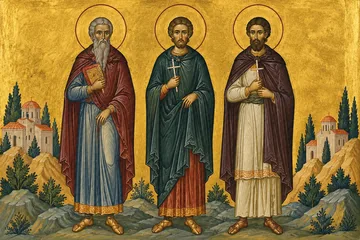
St Zenobius and his sister Zenobia were born in Aegae in Cilicia, into a devout family; their parents died early and left them a large estate and the true faith. Zenobia gave her share to her brother for the poor and lived in poverty, prayer and virginity, while Zenobius gave everything away until he himself became poor. God gave them His protection for their mercy, and to Zenobius the gift of healing, and he was chosen as bishop of his native city. In the persecution of Diocletian the governor Lysias, as the Prologue records, said to him: “I offer you two things – life and death”, and Zenobius answered: “life without Christ is not life but death”. Zenobia came to the place of torture of her own accord and, as their Life records, said: “I am a Christian like my brother”, asking to share with him both the suffering and the crown. Both sources say that neither the red-hot iron bed nor the cauldron of boiling pitch did them any harm because, as they said, Christ was with them. At the place of execution outside the city they gave thanks to God that they had persevered to the end; both sources also mention a voice from heaven which promised them a reward, and then the sword reached them. According to the Prologue, this was around the year 285, and their Life says that the presbyter Hermogenes buried them by night in a single grave. Their example teaches that the only true life is the one in Christ.
Separate page: Holy Martyrs Zenobius and Zenobia →
Venerable Teoktist is King Dragutin, the elder son of King Uroš the First and Queen Jelena. His Life says that in the year 1276, at the urging of his father-in-law, the Hungarian king, he rose up against his father and cast him down from the throne, but afterwards repented. He accepted the injury to his leg after a fall from his horse near Jeleč as God's punishment, and so at the assembly in Deževo in 1282 he handed over the crown to his brother Milutin with the words: “My beloved brother, here you see: as I did, so it has been returned to me”. Ruling from Debrc on the Sava, he lived the ascetic life in secret, kept vigil at night, fed the poor and pilgrims, and converted many Bogomils in Bosnia to Orthodoxy. After his mother's death he was reconciled with Milutin through the mediation of Danilo, and on his deathbed, in the year 1316, he was tonsured a monk with the name Teoktist. His mother Jelena, of French descent, cared for the poor as a widow, built churches and kept the peace between her sons; she built the Gradac Monastery on the Ibar and a school for girls at her court in Brnjaci. In old age she became a nun with the name Jelisaveta, and her Life says of her: “With an untroubled soul and a meek heart she always offered prayers to God”. Her Life says that three years after her death she appeared to Bishop Pavle of Raška, and that her body, undamaged, was then translated into a reliquary at Gradac. Their life teaches that repentance, almsgiving and peace in the family bring a person back to God.