Friday19November 20276 November (according to the Julian calendar)‹›
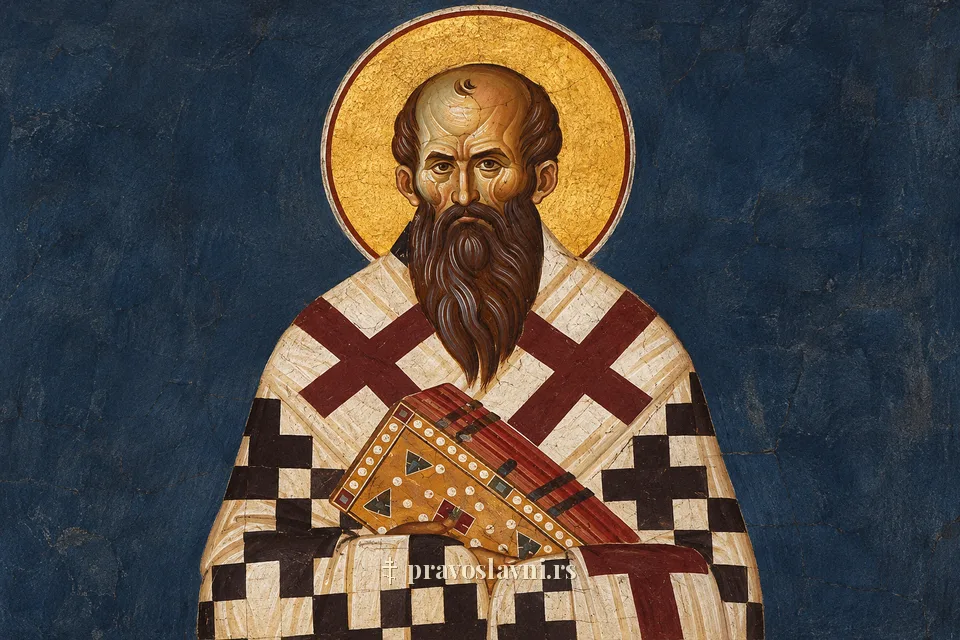
Illustration
Saint of the day
St Paul the Confessor, Patriarch of Constantinople
What happenedThe dying Patriarch Alexander advised the faithful to choose as their shepherd Paul, who teaches by virtue, and not Macedonius, who was respectable only outwardly.
The Emperor Constantius, son of Constantine the Great, took the side of the Arians, and they used this to persecute the Orthodox. At that time there lived Paul, a presbyter from Thessalonica.
The successor of Patriarch Alexander was chosen according to his last recommendation: the Orthodox did not want the deacon Macedonius, who was respectable only outwardly, but Paul, whom the dying man had pointed out as a teacher by his virtue. He was enthroned in the church of Hagia Irene.
From that hour his life is measured in exiles. The Emperor was enraged, and a council under the influence of the Arians deposed Paul and installed Eusebius of Nicomedia. He found refuge in Rome, with Pope Julius, where Athanasius the Great also was. When Eusebius died, the Orthodox brought Paul back, but the Emperor removed him again and confirmed Macedonius on the throne. From the West, Pope Julius and the Emperor Constans, the brother of Constantius, spoke up for him, and so he returned once more to Constantinople. The prefect Philip then, according to his Life, removed Paul from the city by a trick: from the palace to which he had invited him he led him straight to a ship bound for Thessalonica. In the crush around the enthronement of Macedonius, his Life records, about 3,150 people lost their lives.
Paul took shelter in the West again. His Life records that at the council in Sardica in the year 343 Paul received full support. Constans threatened his brother, and Paul returned to the throne.
After Constans perished at the hand of Magnentius, the Arian side grew strong once more. Paul was driven out to Cucusus in Armenia. There he suffered during the divine service — Arian murderers strangled him with his omophorion. According to the Prologue, this was in the year 351. Nor did two of his fellow workers, the clerics Marcian and Martyrius, outlive him for long — they were beheaded.
When Theodosius summoned the Second Ecumenical Council in 381 and the heresy was condemned, Paul's relics were translated from Cucusus to the capital. The Prologue records that since 1236 they have rested in Venice.
St Paul shows us that a man is measured by his life, and not by his appearance. Faithful to the Nicene faith, he endured all his exiles and death.
Full Life
Two successors
“To whom are you leaving us, your children, father?” With that question, according to his Life, the faithful turned to Alexander, Patriarch of Constantinople, on his deathbed. He did not give them one name, but two, and with each a brief judgement. Of Paul, a presbyter from Thessalonica, he said that he would teach them by the way he lived; the deacon Macedonius had, in his judgement, only a handsome appearance. He left the choice to them, but with clear advice: “choose Paul”.
Emperor Constantius, the son of Constantine the Great, was well disposed towards the Arians, and the Orthodox suffered persecution from them. Athanasius the Great was at that time not in Alexandria, but in exile. The Orthodox chose Paul, while the Arian side supported Macedonius. Paul's enthronement took place in the church of Holy Peace (Hagia Irene).
Exile after exile
News of the election reached the Emperor in Antioch and angered him. The Arians took advantage of this: a council removed Paul from the throne and installed Eusebius of Nicomedia, who rejected the teaching that the Son is of one essence with the Father. In Rome, where Paul went, there were also Athanasius the Great and other deposed bishops, and Pope Julius supported their confession. Not even the slanderous letter which Eusebius sent to Rome was of any help: Julius, as his Life records, rejected it, called on the exiles to return and, in a letter to the eastern bishops, came to their defence.
As soon as Eusebius died, Constantinople had two patriarchs: the Orthodox brought back Paul, and the Arians chose Macedonius for themselves. Unrest gripped the city. The commander Hermogenes, whom the Emperor sent to drive Paul out, had his house set on fire by the mob, according to the Life, and was killed. Then Constantius himself arrived. Paul once again had to go into exile, Macedonius was confirmed, and in addition the city was left without half of its daily ration of bread: instead of eight thousand, four thousand loaves were given out.
Help again came from the West: Pope Julius and Constantius's brother, Emperor Constans, interceded for him by letters, and Constantinople once more welcomed its Patriarch. But not for long, for the Emperor gave the prefect Philip an order to remove the Patriarch. His Life describes Philip's trick. Having summoned Paul to the palace of Zeuxippus, supposedly about taxes, Philip led him out by a side exit to the sea, put him on board a ship and sent him to Thessalonica, forbidding him to set foot in the eastern provinces. The people paid for the enthronement of Macedonius: the army dispersed the crowd, and his Life states that about 3,150 people were killed or trampled to death.
The Council of Sardica
Paul spent some time in Corinth, and then found himself in Rome again, beside Athanasius. Constans demanded an explanation from his brother. His Life describes at length the council in Sardica in the year 343, to which about a hundred bishops came from the West and seventy-six from the East. The eastern bishops would not sit in session while Athanasius and Paul were there, and so they went off to Philippopolis. The council nevertheless had its say. It deprived their slanderers of their rank, confirmed the Nicene Creed, and pronounced anathema on anyone who denies that the Son is of one essence with the Father.
Then Constans decided to act. Paul returned accompanied by two bishops, carrying a letter in which Constans threatens his brother with arms if Paul and Athanasius do not get their thrones back. The threat worked, and the Emperor gave way in fear: he sent Macedonius into exile, restored the throne to Paul, and let Athanasius go back to Alexandria. For a time there was peace.
The crown of a confessor
When Magnentius killed Constans while he was hunting, the peace was over: the Arian side grew strong again, and Athanasius went into hiding to save his life. Paul's last place of exile was Cucusus in Armenia; there he lived shut up and separated from others. Death came during the Liturgy: the Arians strangled him, and what they used was the omophorion, a part of his episcopal vestments. For that death the Prologue gives the year 351. Nor did Marcian and Martyrius, the clerics who kept his correspondence, outlive him for long: soon afterwards they were beheaded.
Macedonius returned to the throne and cruelly persecuted the Orthodox. The Arian and Macedonian heresies survived for some forty years more. Their final condemnation was pronounced only by the Second Ecumenical Council, which Emperor Theodosius convened in Constantinople in the year 381. In that year the relics of the Confessor left Cucusus and arrived in Constantinople. The Prologue adds that in 1236 they were received by Venice, which keeps them to this day.
From St Paul we learn that a true spiritual leader is recognised by his life, and not by his appearance. He confirmed this through many exiles and through death at Arian hands, remaining to the end an unshakeable confessor of the Nicene faith.
Other saints of the day
Venerable Varlaam of Khutyn
Venerable Varlaam comes from Veliky Novgorod, from a devout house. Instead of games, his childhood was filled with the reading of the holy books and strict fasting. When his parents begged him to eat, he would answer them, according to his Life, with the words of the Apostle Paul that food does not bring us nearer to God, and he would add that fasting and prayer do so. After he had buried his father and mother, he shared out his inheritance among the poor, and he received the monastic tonsure from the elder Porphyrius. He built his cell on the bank of the Volkhov and raised a small Church of the Transfiguration; in time the Khutyn Monastery grew up there. His Life states that he saw through some fishermen who, before Pascha, had hidden a large sturgeon, and he asked them: “Children, you have brought small fish; but where is that big one?” His Life also relates how by prayer he gave back to a father, alive, his only son, who had breathed his last on the way to him. His prayer delivered the monastery from famine, and the sick, the blind, lepers and the possessed went away from him healthy. Sensing that his end was drawing near, he handed over the abbacy to Anthony, kissed the brethren and breathed his last with the words: “Lord, into Your hands I commit my spirit.” The miracles did not cease even after his death: at his grave those who could not see were healed, and those who could neither hear nor speak, and those who were at the point of death. The Prologue also connects with the year 1471 a miracle with fire, before which the Tsar fled after he had ordered the grave to be opened. From his life it can be seen that the way to God lies in fasting, prayer and an upright life, and not in what is outward.