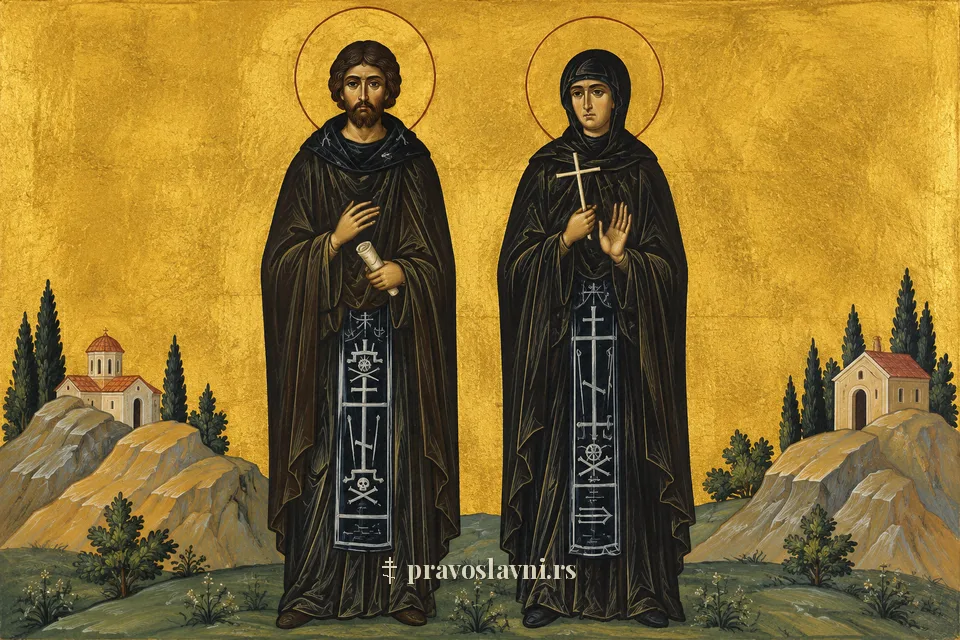
Saints of the day
Venerable Martyrs Galaction and Episteme
What happenedGalaction and Episteme, a betrothed couple who chose the monastic life, saw each other again only when they were arrested — and suffered for Christ together.
Read the LifeOrthodox Calendar · 5 November according to the Julian calendar
Thursday, 18 November 20275 November (according to the Julian calendar)What happenedGalaction and Episteme, a betrothed couple who chose the monastic life, saw each other again only when they were arrested — and suffered for Christ together.
Read the Life
You may eat meat, eggs, milk and dairy products, as well as any other food — but try to be moderate.
More about the fast →
Today the Church keeps the commemoration of a saint · not a Red Letter day.
More about the feast →
“For to me, to live is Christ, and to die is gain.”
— Phil 1:21Galaction was born in Phoenicia — his Life says, in the city of Emesa — into a rich pagan family. His mother Leucippe could not have children. His Life tells that a monk, Onuphrius, came to the house disguised as a beggar, and that Leucippe, moved by his words about Christ, secretly received baptism. Soon afterwards she conceived, and she brought her husband Clitophon to the faith as well. When the child was born, Onuphrius, according to the Life, gave him the name Galaction and foretold: “This little child will come to hate earthly life and to love the heavenly.”
Both Galaction's baptism and his Christian childhood were his mother's work. The girl for him, the beautiful Episteme from a pagan house, was chosen by his father, since his mother had died when her son reached the age for marriage. Galaction persuaded her to accept Christ and baptised her in secret. Then they decided on the monastic life: they gave away their property to the poor and, together with Eutolmius, who had also received baptism, went to Mount Publion. There Galaction received the monastic tonsure, while Episteme found a place among the women ascetics in a neighbouring community.
The Prologue says of them: “First in labour, first in prayer.” Their paths crossed again only when they were arrested.
The soldiers of the governor Ursus seized Galaction while he was reading the Holy Scriptures. Episteme did not want to be left without him, and so she too was seized. Before the court Galaction confessed Christ, and both of them were scourged. Their Life records that Ursus and all who were present, when they wanted to put Episteme to shame, went blind at her prayer, and by her prayer they also regained their sight, and fifty-three men came to believe. Even so, the torturer did not give way: after heavy torments both of them were beheaded. Their grave was looked after by Eutolmius, to whom we also owe the written record of their life. The Prologue records that this was in the year 253.
Galaction and Episteme teach us that faith can be kept both in secret and under persecution, and that God's grace can save a whole family. Whoever remains steadfast to the end, God crowns him with an eternal crown.
Galaction and Episteme were from Phoenicia — his Life says, from the city of Emesa. Galaction's parents were pagans: his father Cleitophon, a rich man of high birth, and his mother Leucippe, the daughter of the prefect Memnon, who worshipped Artemis. Leucippe was unable to have children.
At that time, as his Life records, the governor Secundus the Syrian was persecuting the Christians in the city, so that some were hiding and others were openly giving themselves up. It was then that the monk Onuphrius came to Cleitophon's house, disguised as a beggar. Leucippe took him in, his words about the true God Jesus Christ touched her heart, and she asked him to baptise her. Onuphrius reminded her of the words of the First Epistle to the Corinthians (1 Cor 7:14), that the unbelieving husband is sanctified by the believing wife, and he baptised her in secret, with water kept by her servants, who were sworn to silence. His Life says that the crucified Christ then appeared to her and promised her a son.
After her baptism Leucippe conceived. She brought her husband to the faith as well, and Onuphrius also baptised Cleitophon, who agreed to keep the faith in secret. When the son was born, Onuphrius, according to his Life, gave him the name Galaction and said: “This little child will come to hate earthly life and to love the heavenly.” He received baptism and a Christian upbringing from his mother.
His education, according to his Life, included philosophy, rhetoric and astronomy. He lost his mother in his twenty-fourth year, as his Life states, at the age when young men marry. His father betrothed him to Episteme, a beautiful girl of pagan family. Galaction, as his Life tells, did not give her the customary kiss, because she was not baptised, and he promised her his affection only when she had received baptism. He persuaded her to accept the faith and, under the pretext of an outing, secretly baptised her in the river Kiphes. At that time Eutolmius, a servant of Galaction's father-in-law, also came to believe and was baptised.
His Life tells that Episteme afterwards had a vision of three choirs — of monks, of virgins and of angels. Galaction interpreted it as a call to renounce the world. They agreed to live in virginity, gave away their property to the poor and on the third day left their home, together with Eutolmius.
After ten days' journey they reached Mount Publion. There was a men's monastery there with ten monks, and nearby a women's one, with four ascetics and an old deaconess at its head. The abbot tonsured Galaction and Eutolmius as monks, and Episteme was received among the sisters. The Prologue says of them: “First in labour, first in prayer.” Each remained in his own community, and until the day of their arrest they did not meet again.
His Life says that Episteme saw in a dream a palace in which a radiant king was crowning her and Galaction. The abbot interpreted the dream as the reward that awaited them through martyrdom.
A fierce persecution began. The governor Ursus learned of the monks from an informer and sent soldiers. Most of the monks scattered, but Galaction was seized while he was reading the Holy Scriptures. Episteme did not want to stay behind. To the deaconess she said: “I cannot live without my lord Galaction,” and so she too was seized and brought before Ursus.
For confessing Christ Galaction paid with a scourging, which Episteme could not watch without tears, and then she herself went through the same. His Life records that, when they wanted to strip her naked, she prayed that those present might go blind — and Ursus and all those around him lost their sight. At her prayer their sight returned, and fifty-three men came to believe in Christ. Ursus, however, did not see the hand of God in this, but the merit of his own idols. After severe tortures both were beheaded.
The witness of their death was Eutolmius, who had come dressed as a layman; afterwards he saw to it that the relics received a worthy tomb, and he also left us their Life. The Prologue records that they suffered in the year 253.
Galaction and Episteme teach us that the faith can be kept both in secret and under persecution, and that the grace of God can save a whole family. And whoever remains steadfast to the end, an eternal crown awaits him.


